
What Is Tankini Swimwear - Latest Guide to Fit and Coverage
The tankini swimwear was born out of a women's swimwear designer Anne Cole. She innovatively paired a tank-top-style upper with standard bikini bottoms, namely TANKINI.
This single design innovation gave women a modern one-piece alternative that didn't compromise on style or comfort.
How a Tankini Is Constructed
A tankini is a two-piece swimsuit that pairs a tank-top-style upper with bikini or swim bottoms — the top covers the midriff fully or partially, giving the coverage of a one-piece while retaining the two-piece convenience of separate sizing, easy bathroom access, and mix-and-match flexibility.
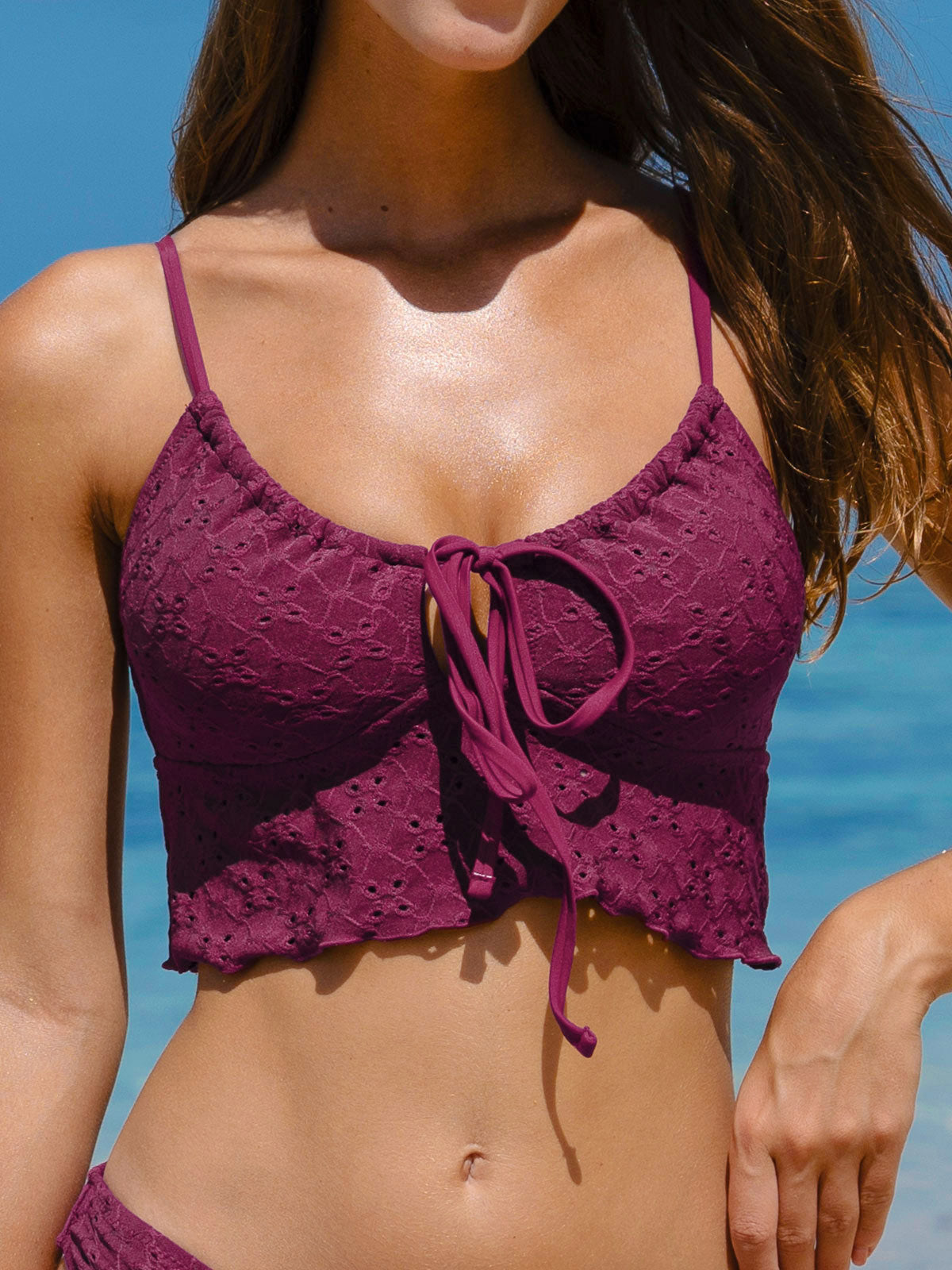
Editor's Pick
Burgundy Textured Tankini Top
A flattering, secure style made for comfort, support, and beach-day confidence.
Shop This Style →Best Match
Blue Shimmer Gold-Accented Tankini Top
Pair it with your favorite bikini top for an easy, confident swimwear look.
View Product →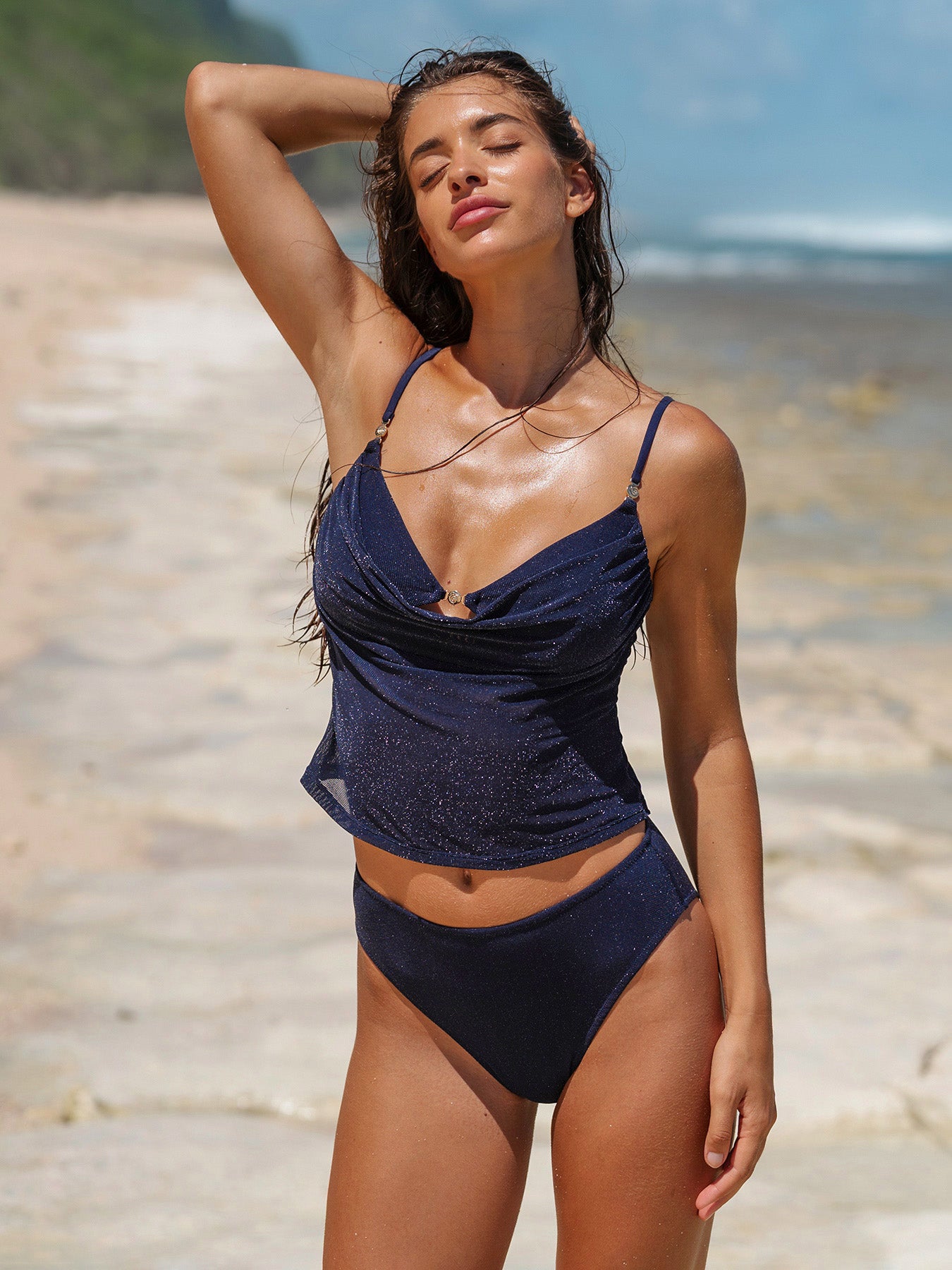
Further sepaking, the detailed features of tankini are:
- The top: A stretch-knit panel that extends from the bust or neckline down to anywhere between the natural waist and the high hip. The hem length is the primary variable that distinguishes tankini styles from one another.
- The bottom: Any standard bikini, swim short, high-waist, or skirt bottom. The top and bottom are independent garments — this is what enables mix-and-match sizing.
- Lining: Quality tankini tops include a built-in shelf bra or structured lining at the bust. Premium pieces use bonded or molded cup construction; budget pieces use a simple fabric shelf.
- Fabric: Most tankinis use a polyester-elastane (Lycra/spandex) blend. Higher-end pieces use recycled nylon or PBT (polybutylene terephthalate) yarn — a chlorine-resistant fiber that holds shape and color far longer than standard polyester under pool conditions.
Tankini vs. Bikini vs. One-Piece
A direct comparison:
|
Criteria |
Tankini |
Bikini |
One-Piece |
|
Pieces |
2 (tank top + bottoms) |
2 pieces |
1 piece |
|
Midriff Coverage |
Full or partial — your choice |
Minimal |
Full |
|
Sizing |
Top & bottom sized independently |
Top & bottom independent |
Single size; torso fit tricky |
|
Bathroom Ease |
Easy — no full removal |
Easy |
Requires full removal |
|
Active Movement |
High — stays secure |
Moderate — risk of shifting |
High — fully connected |
|
Style Flexibility |
High — mix & match freely |
High — wide variety |
Limited |
Although we know the differences among them, but how do we know when to choose a tankini? You can decide by where you'd wear them. The principle is simple:
Scenario 1: Active pool days & water sports
Provides secure fit for lap swimming, beach volleyball, or paddleboarding without wardrobe malfunction risk.
Scenario 2: Chasing kids at the beach
Complete peace of mind when bending, lifting, and running after little ones.
Scenario 3: Resort transitions
Toss on a skirt or shorts and move seamlessly from the water to boardwalk dining.
Scenario 4: Hard-to-fit proportions
Ideal if you need a different size for your top and bottom — something no one-piece can offer.
10 Types of Tankini Tops
The word 'tankini' covers a far wider range of silhouettes than most people realise. The hem length, neckline, strap configuration, and structural details combine to create distinct styles — each with different coverage levels, support architectures, and aesthetic identities. Here is the full taxonomy.
1. Longline Tankini Top

Coverage: Highest — hem falls to the high hip or beyond, fully covering the midriff and often the lower back.
Best for: Maximum coverage preference, tummy confidence, sun protection across the torso, postpartum wear, and women who want the appearance of a one-piece with two-piece convenience.
Key detail: Because the hem extends below the natural waist, longline tops must be cut with enough hem circumference to allow movement without pulling up during activity. Look for a relaxed or A-line hem — a straight-cut longline will ride up.
2. Cropped Tankini Top

Coverage: Medium — hem sits at or just above the natural waist, exposing a small strip of midriff.
Best for: Women who want coverage without a full tank length; athletic builds who want to show a defined waist; and anyone mixing with high-waisted bottoms for a coordinated, navel-covered look.
Key detail: The cropped tankini is the most versatile silhouette for mix-and-match pairing. A cropped top with high-waist bottoms gives the same coverage as a longline while allowing more proportional play.
3. Rash Guard Tankini

Coverage: Maximum — this style extends the tank concept into a structured, often long-sleeved or three-quarter-sleeve form, frequently rated UPF 50+.
Best for: Sun protection priority, water sports, families, post-surgical recovery, and women with photosensitivity conditions or a history of skin cancer.
Key detail: Unlike a standard tankini, the rash guard hybrid prioritises UV blocking over silhouette. Look for flatlock seams (seams lying flat, not standing up) — standard raised seams cause skin abrasion during repetitive paddle strokes or swimming laps.
4. Wrap Tankini Top

Coverage: Medium — the wrap construction creates a V-shaped front opening that can be cinched tighter or left looser depending on comfort preference.
Best for: Hourglass figures who want to highlight a defined waist; women who want adjustable neckline depth; and those transitioning between poolside and resort dining since the wrap silhouette reads as intentionally styled.
Key detail: The wrap style naturally creates bust enhancement through diagonal fabric tension. For larger busts, confirm the top has an internal tie or button closure — a wrap held only by external ties can shift in water.
5. Ruched or Shirred Tankini Top

Coverage: Medium to high — the gathered fabric creates visual texture that simultaneously camouflages and defines.
Best for: Rectangle and oval body shapes that want to create the illusion of curves; women who find flat-panel tanks unflattering; and post-pregnancy bodies where fabric needs to accommodate shape variation without clinging.
Key detail: Ruching works through fabric volume — the gathers draw the eye away from the body contour beneath. Vertical ruching lengthens; horizontal ruching adds width. Choose vertical ruching along the front panel for a slimming, elongating effect.
6. Blouson Tankini Top

Coverage: High — the fabric blouses out from the chest or underbust band, creating a loose, flowing silhouette over the midriff.
Best for: Apple and oval shapes who want comfortable, non-clinging coverage over the midsection; women who prefer a relaxed, resort-casual aesthetic over a structured, athletic look.
Key detail: The blouson effect depends on the fit of the elastic or band that holds the fabric in place — usually at the underbust or natural waist. If this band sits too low, the top looks shapeless; too high, and it shortens the torso. The band should sit at your natural underbust line for the most flattering drape.
7. Bandeau Tankini Top

Coverage: Medium — a strapless or minimal-strap configuration with a full-length tank panel below.
Best for: Avoiding tan lines; inverted triangle shapes who want to reduce shoulder emphasis; women who want the aesthetic of a strapless suit without the coverage anxiety of a strapless bikini.
Key detail: Strapless bandeau tankinis require either boning, silicone grip tape at the top edge, or an underwire in the panel to stay in place during activity. A bandeau tankini without these structural features is a lounging suit, not an activity suit.
8. Halter Tankini Top

Coverage: Medium to high — the halter neckline concentrates weight at the neck, with a tank panel providing full midriff coverage below.
Best for: Triangle (pear) shapes who want to draw attention upward; women with smaller busts who want bust-enhancing lift; resort-to-beach transitions where the halter reads as intentionally fashionable.
Key detail: Halter styles distribute bust weight through a single neck tie or fixed neck band — comfortable for B–C cups, potentially fatiguing for D+ cups over a full beach day. For larger busts, look for halter tops with additional side-body support straps rather than neck-only attachment.
9. Underwire Tankini Top

Coverage: Medium to high — identical hem range to other tankini styles, but with a structured underwire channel built into the bust.
Best for: D-cup and above; women who find soft-cup swim tops insufficient; anyone who wears underwire in everyday bras and finds swimwear without it uncomfortable.
Key detail: Swimwear underwire is not the same as lingerie underwire — it must be coated or fully encased in the fabric channel to prevent corrosion from salt water and chlorine. When evaluating an underwire tankini, press the wire channel: a good wire will be smooth and fully enclosed with no exposed metal at the channel ends.
10. High-Neck Tankini Top

Coverage: High — the racerback eliminates traditional shoulder straps; the high-neck closes the neckline entirely.
Best for: Active water sports (lap swimming, paddleboarding, surfing); women who experience shoulder strap slipping; anyone prioritising maximum security over styling.
Key detail: The racerback configuration moves the shoulder load to the centre-back panel rather than two independent shoulder straps. This is structurally stronger for repetitive overhead movement — specifically freestyle and backstroke swimming, and paddle sports. If active use is your primary scenario, racerback or high-neck is the category to shop first.
Who Tankinis Are For?
The beauty of tankini swimwear is its ability to balance proportions while keeping you completely comfortable. I design our collection to celebrate real bodies, ensuring every cut serves a structural purpose.
Here is how to choose the perfect full coverage bathing suit top based on your specific shape.
The Triangle (Pear Shape)
If you carry your weight primarily in your hips and thighs, the goal is to draw the eye upward and balance your lower half.
- Best Styles: Halter necklines, vibrant patterns, and tops with eye-catching chest details.
- The Strategy: Pair these eye-catching tops with dark, solid bikini bottoms to instantly balance your proportions.
The Inverted Triangle
For broader shoulders and narrower hips, you want a tank top style that offers excellent framing and security.
- Best Styles: Clean square necklines and thick, supportive shoulder straps.
- The Strategy: Avoid spaghetti straps that can dig in. Instead, opt for clean lines that streamline your upper body while providing effortless bust support swim tops.
The Rectangle / Athletic Frame
If your bust, waist, and hips are relatively aligned, you can use clever fabric manipulation to create the illusion of curves.
- Best Styles: Ruched, cinched, or blouson-style tankini tops.
- The Strategy: Side tie adjustments and gentle gathering break up straight lines, adding soft, feminine dimension exactly where you want it.
The Oval / Apple Shape
For those who carry weight around the midsection, a one-piece alternative should offer both comfort and confidence.
- Best Styles: Asymmetric cuts, gentle shirring, and built-in tummy control swimwear linings.
- The Strategy: Look for strategically placed tummy-smoothing fabrics that skim the body rather than cling to it, giving you a smooth, comfortable fit all day long.
The Hourglass
If you have a naturally defined waist with a balanced bust and hips, your goal is to highlight that natural alignment.
- Best Styles: Fitted, structural cuts and wrap-style tops.
- The Strategy: Embrace mix and match swimwear by pairing a contoured top with high-waisted swim bottoms to accentuate your waistline beautifully.
Extra Tip: Address Bust Support & The D-Cup Dilemma
Finding a full-coverage bathing suit that actually supports a larger bust is one of the most common and least well-solved problems in swimwear.
A standard tank top construction often falls short for D-cup wearers. Quality tankini tops address this with architecture built directly into the garment:
- Underwire options: Provides the same lift and structure as an everyday bra. Look for fully encased, corrosion-resistant wire.
- Molded cups: Shape, modesty, and contouring without shifting.
- Built-in shelf bras: Wide elastic bands that sit flat against the ribcage for reliable wireless support.
- Thick adjustable shoulder straps: Distributes weight evenly and prevents neck strain and strap dig-in.
How to Choose a Tankini in 5 Steps
Choosing the right tankini involves five sequential decisions. Work through them in order — each one narrows your options meaningfully.
Step 1 — Decide Your Primary Use Case
Your primary use case determines which structural features are non-negotiable, and which are nice-to-have.
|
Primary Use |
Non-Negotiable Feature |
Recommended Style |
|
Lap swimming / competitive |
Stays in place during stroke; no drag |
Racerback tankini + performance bikini bottom |
|
Paddle sports / surfing |
Arms free; no strap slipping |
Racerback or high-neck + athletic shorts |
|
Beach lounging |
Comfort over hours; UV coverage |
Longline or blouson + any bottom |
|
Resort / pool socialising |
Looks intentional; easy transitions |
Wrap, halter, or cropped + high-waist |
|
Family / kids beach day |
Active coverage; bathroom speed |
Longline with wide straps + shorts |
Step 2 — Choose Your Coverage Level
Tankini coverage is primarily determined by hem length. Know which level you want before shopping, because it is the most important filter:
- Full midriff coverage (longline / blouson): Hem at high hip; full torso covered. Choose this if you want the look of a one-piece with two-piece convenience.
- Natural waist coverage (standard tankini): Hem at natural waist; a small gap between top and bottom when you move. The most common configuration.
- Cropped coverage: Hem above the natural waist; a visible strip of midriff exposed when styled with low- or mid-rise bottoms. Pair with high-waist bottoms for complete coverage if preferred.
Pro tip: Coverage and bottoms work together.
Step 3 — Identify Your Support Requirement
Be honest about what your bust needs from a swimsuit — then look specifically for those structural features:
|
Cup Size |
Minimum Support Required |
What to Look For |
|
AA – B |
Shelf bra or light lining |
Most styles work; bandeau and halter give aesthetic lift |
|
C |
Shelf bra with wide band or soft cup |
Any style with built-in shelf bra and adjustable straps |
|
D |
Molded cup or underwire |
Underwire tankini or molded cup construction; thick adjustable straps |
|
DD / E+ |
Underwire with side-body support |
Underwire tankini with side panels; avoid halter-only attachment |
Step 4 — Get the Fit Right
Tankini tops and bottoms are sized independently — this is the format's primary advantage. Use it:
- Measure both: Take your bust and underbust for the top; your hip and waist for the bottom. If one measurement falls in a different size bracket than the other, size up in that category.
- Check strap adjustability: Straps should be fully adjustable. If a strap cannot be shortened enough to prevent the bust panel from pulling away from your chest, the top is too large.
- Test the hem: When you raise your arms above your head, the hem should move but not ride up past your natural waist (for standard coverage) or hip (for longline coverage). If it does, size down in the top or choose a style with a longer hem.
- Sit and bend: The top should remain in the same position when you sit down or bend forward. A top that gapes at the bust or rides up at the hem when seated is the wrong style or size.
|
⚠ The most common tankini fit mistake: Buying the top and bottom as a set in a single size because they come packaged together. Always check that your bust measurement and hip measurement correspond to the same size. If they don't, buy the top and bottom separately and size each appropriately — most quality tankini brands sell separates. |
Step 5 — Choose Your Bottom Style
The bottom silhouette completes the look and significantly affects both coverage and styling flexibility:
|
Bottom Style |
Best With |
Styling Note |
|
High-Waisted Bikini |
Cropped tankini top |
Creates a waist-defined silhouette; retro-modern aesthetic |
|
Classic Bikini Bottom |
Longline or standard top |
Maximum versatility; choose cut (brief, cheeky, full) based on comfort preference |
|
Athletic Swim Shorts |
Racerback or high-neck top |
Best for active sports; provides thigh coverage for water activities |
|
Swim Skirt |
Any top style |
Resort and boardwalk transitions; most flattering with a fitted (not blouson) top |
|
High-Waisted Shorts |
Longline or cropped top |
Maximum active coverage with a contemporary silhouette |
Frequently Asked Questions
Is a tankini considered a two-piece swimsuit?
Yes. A tankini delivers the same two-piece layout as a traditional bikini — separate top and bottom — but replaces the standard bikini top with a tank-style cut. You get the easy-wearing benefits of a two-piece with full-coverage midriff protection.
Does a tankini offer enough tummy control and support?
Many modern tankini tops include built-in tummy-control technology — mesh lining, ruched panels, or structured shelf bras. For bust support, quality pieces offer molded cups, underwire, and thick adjustable straps, making it straightforward to find a well-supported option for any cup size.
Can you swim laps or do water sports in a tankini?
Yes — with the right style. For active water sports, choose a racerback or high-neck tankini with performance bikini bottoms or swim shorts. The separate sizing of top and bottom means the suit can fit your measurements precisely, minimising movement and drag in the water.
