
tutorial
How to Look Better in a Bikini? Acts Made Easy.
People looking good in a bikini has little to do with their bodies but to do with clothing choices. The cut's right? The fabric holds its shape? The way she stands? A bit of skin prep? All these can change how a suit looks and feels far more than any last-minute diet.
This guide walks through all of it, from picking flattering cuts and textures to easy posture tweaks, sensible beach-day prep, and accessories that pull the whole look together. Let's go.
Choosing the Right Bikini Cut

Once you know how necklines, waistlines, and straps interact with your frame, it gets much easier to play up the features you like.
Show Curves & Manage the “Mom Pooch”
If you want to smooth the lower abdomen, the structure of your bottoms matters most. You don’t need to hide anything to feel secure, just choose pieces cut with a bit of intention.
- Flattering High Waisted Bikini Bottoms: A well-cut high-rise bottom that hits right above the belly button lengthens the leg line while holding the midsection firmly

- Ruched Bikini Sets for Curves: Gathered fabric, or ruching, softens the midsection line and draws the eye across rather than inward

- The Best Swimsuit for Mom Pooch: Tummy-control styles with double-lined compression panels give comfortable support without flattening your natural curves.

Balancing an Apple Shape
An apple shape tends to carry weight around the torso with slimmer legs and arms. The aim is to shift the focus vertically and define a waistline.
| Design Element | How It Works | Benefit |
|---|---|---|
| Deep V-Necklines | Draws the eye downward vertically | Elongates the torso |
| High-Leg Cut-Outs | Exposes more hip bone | Makes legs look longer |
| Wide Waistbands | Breaks up the midsection | Defines the waistline |
Skip tiny string ties that cut into the skin. Thick, flat-banded bottoms that sit comfortably on the hips create a more balanced, proportional frame.
Full Busts vs. Smaller Chests
A good top anchors the whole look, and the right build depends on your cup size and how much support you want. As a rule of thumb from bra fitting, the band, not the straps, should carry most of the weight, which is why fuller busts do better with structured cups and a firm underband than with thin triangle tops. (Source: large-bust support guide.)
For Full Busts
- Underwire & Wide Straps: Skip flimsy triangle tops. Molded cups with supportive underwires and thick shoulder straps spread the weight more evenly.
- Full Bust Coverage Bikini Tops: Halter styles with thick ties, or scoop necks with double stitching, help prevent spilling and keep everything in place.
For Smaller Chests
- Adding Visual Shape: To suggest a fuller chest, lean on textures, ruffles, or bold horizontal patterns.
- Bandeau & Triangle Styles: Take advantage of cuts that fuller busts often can’t wear comfortably. Tie-front tops and classic slide triangles add shape without heavy padding.
How Texture Changes the Way Swimwear Sits

Material does a lot of quiet work. Beyond how it looks, the fabric you choose affects how swimwear softens, shapes, and supports.
Why Ribbed and Textured Fabrics Help
Thicker, textured fabrics tend to feel more reassuring than thin nylon, which clings to everything. The added structure is the main reason.
- Ribbed Materials: Vertical ribbing draws the eye up the torso, a simple lengthening effect.
- Waffle and Seersucker Textures: These heavier weaves compress gently without digging in, which suits tummy-control styles.
- The Eco-Friendly Angle: Higher-density recycled fibers tend to hold their shape better when wet, so the suit is less likely to sag or stretch out. The thing to actually check is the spandex content and whether the fabric is chlorine-resistant, since standard elastane breaks down in pool water over time. (Source: swimwear fabric guide.)
| Fabric Type | Shaping Benefit | Best For |
|---|---|---|
| Premium Ribbed | Elongates the torso | Camouflaging midsection worries |
| Waffle / Crinkle | High-stretch compression | Smoothing out the waistline |
| Double-Lined Matte | Maximum hold & lift | Shaping a best swimsuit for mom pooch |
Prints vs. Solids: Balancing Proportions
The choice between solids and patterns mostly comes down to how you want to balance your proportions.
- Solids: Darker, matte tones create a smooth, unified line, the streamlined, classic option.
- Prints: Busy patterns hide shadows and uneven texture. To balance an apple shape or a fuller bust, put prints where you want attention and solids where you don’t.
- Print plus Ruching: Patterns paired with gathered fabric create a flattering overlay across the lower belly while emphasizing the natural waist.
Posture and Angles
The quickest way to look better in a bikini doesn’t involve a gym or a diet, just how you hold yourself. A few small adjustments noticeably change your silhouette and read as confidence.
Simple Alignment Cues
Slouching makes even great swimwear look off. To lift your frame and look more toned right away:
- Roll your shoulders back and down: opens the chest, lengthens the neck, and lifts the bustline.
- Engage your core: gently draw your belly button toward your spine to switch on the deep abdominal muscles for a natural flattening effect.
- Lengthen your spine: imagine a string lifting the crown of your head, which creates space between the ribs and hips and visually leans out the midsection.
- Shift your weight: put your weight on your back leg when standing; it tilts the pelvis at a flattering angle and softens the body line.
Poses That Photograph Well
No need to be as good as our model did. Just skip the stiff, straight-on stance and try these:
| Pose Technique | How to Do It | Visual Benefit |
|---|---|---|
| The Hand-on-Hip Pop | Place one hand on your high waist, pop that hip out, and bend the corresponding knee forward. | Creates an instant hourglass shape and makes the most of high-leg cuts. |
| The Seated Twist | Sit on the edge of your lounge chair, lean back slightly on your hands, and twist your knees away from the camera. | Angling your torso away from the lens narrows the waist. |
| The Crossed-Leg Stride | Take a slow step forward, crossing one foot slightly in front of the other while lifting onto your tiptoes. | Engages the calf and thigh muscles while making the legs look longer. |
| The Overhead Stretch | Raise one or both arms playfully, as if adjusting your hair or sunglasses. | Lifts the torso, stretching out the stomach area and minimizing natural skin folds. |

Reducing Bloating Before Beach Day (24–48 Hours)
If you want to feel less puffy in a day or two, the goal isn’t a crash diet, it’s easing temporary water retention and gas. A few choices in the 24 to 48 hours beforehand can make a real difference. One honest caveat worth keeping in mind: these adjustments affect fluid and digestion, not body fat, and the change is temporary, anything you “lose” this way comes back once you eat and drink normally. (Source: Oregon State University blog on water-weight infusions.)
Diet Tweaks for a Flatter-Feeling Stomach
- Ease off sodium: excess salt makes the body hold extra water, so go lighter on processed snacks, takeout, and heavy sauces for a day or two. (Source: Healthline on water retention.)
- Skip carbonation and sugar alcohols: fizzy drinks and sugar-free gums or sweets can leave gas trapped in the gut. Plain water with lemon or cucumber is an easy swap.
- Go easy on common gas triggers: if you’re prone to bloating, large amounts of cruciferous veg (broccoli, cauliflower), beans, and dairy can be culprits; lean proteins, eggs, rice, and water-dense fruit sit lighter for many people. (This is general guidance, not a rule, individual triggers vary.)
- Herbal teas may help a little: peppermint, ginger, and dandelion are traditional digestive aids, and dandelion in particular acts as a mild diuretic. The effect is gentle, not dramatic. A safety note: dandelion and similar herbs can interact with blood-pressure medication, lithium, and some antibiotics, and peppermint can aggravate acid reflux, so check with a pharmacist or doctor if you take medication or have kidney or gallbladder issues. (Source: GoodRx on teas for digestion.)
| What to Avoid | What to Choose Instead |
|---|---|
| Carbonated drinks & seltzers | Flat water with lemon or mint |
| Salty snacks & soy sauce | Fresh, unseasoned nuts & avocados |
| Beans, broccoli, & dairy | Spinach, zucchini, & grilled chicken |
| Artificial sweeteners | Small amounts of natural maple syrup or honey |
Skin Prep & Beach Grooming
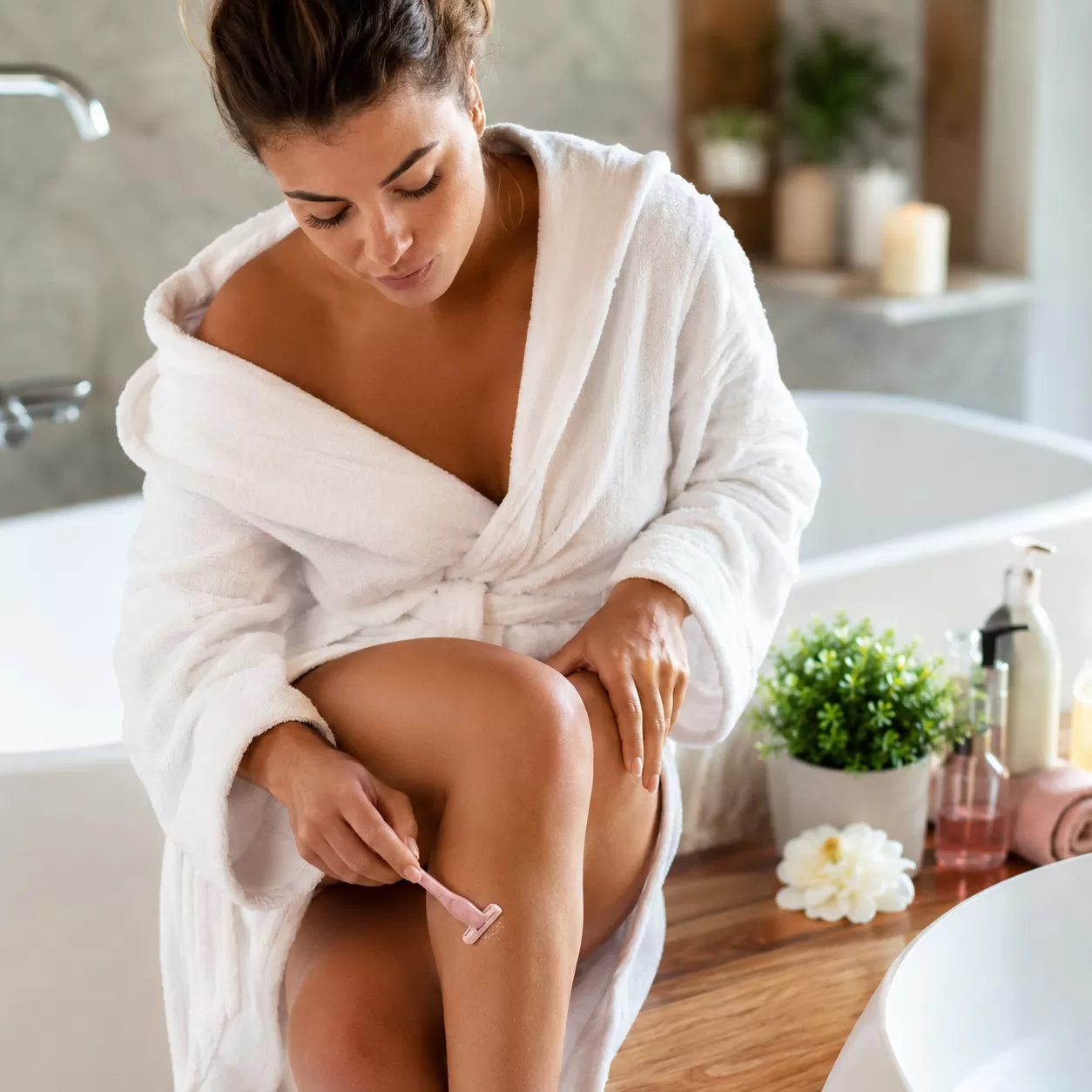
Prepping your skin matters as much as the suit. A smooth, comfortable surface helps you feel at ease the moment you step onto the sand.
Exfoliation and Moisture
That fresh, glowing look starts in the shower the day before.
- Exfoliate gently: a natural sugar scrub or a dry brush lifts away dead skin. Focus on rougher areas like elbows and knees.
- Boost circulation: massaging in upward, circular motions brings blood to the surface, which can temporarily plump and firm the skin.
- Lock in moisture: follow with a lightweight body oil or a hyaluronic-acid lotion. Skip heavy creams right before sun exposure, as they can mix with sweat and feel greasy.
- If you self-tan: a gradual self-tanner the night before gives a subtle, even tone that makes muscle definition read more clearly. (It’s worth remembering self-tanner offers no sun protection, so sunscreen still applies.)
Managing the Bikini Line
Timing is what prevents irritation, redness, and bumps around the bikini line.
- Plan ahead: do hair removal 24 to 48 hours before beach day so the skin can settle and any redness fades before it meets saltwater, chlorine, or sand.
- Shave smart: use a fresh, sharp razor and a moisturizing gel, and shave in the direction of hair growth to reduce ingrown hairs.
- Soothe right after: a fragrance-free aloe gel calms freshly shaved skin.
- For ingrown hairs, exfoliate between shaves, not right after: a salicylic-acid (BHA) product genuinely helps prevent ingrowns, but it’s best used a couple of days before or after hair removal rather than on just-shaved skin, which is raw. Note that salicylic acid also increases sun sensitivity, so apply it at night and wear SPF the next day. (Source: Bushbalm on chemical exfoliants for the bikini line.)
Add Fashion Accessories to Frame Your Look

Layering to Round Out the Look
The right extras do more than match your swimwear, they frame your silhouette and make an outfit feel finished.
A little smart layering carries you from the lounge chair to the boardwalk.
- Cover-ups: a sheer oversized button-down or a lightweight kimono adds movement. A high-waisted sarong wraps the waist and gives you adjustable coverage.

- Sunglasses & hats: a wide-brimmed straw hat and classic aviators draw the eye upward, add an elongating line, and provide real sun protection.

- Minimal hardware: lightweight, water-resistant gold or silver belly chains and layered necklaces add a low-key finishing touch without overpowering a textured suit.

| Layering Piece | Best For | Styling Tip |
|---|---|---|
| High-Waisted Sarong | A lengthening, waist-defining layer | Tie it at the narrowest part of your waist to elongate the legs. |
| Oversized Linen Shirt | Effortless, relaxed vibe | Leave it unbuttoned to frame a full-coverage bikini top. |
| Mesh Midi Dress | Subtle coverage with airflow | Choose a monochrome shade that matches your bikini for a cohesive look. |
The right layers keep you looking put-together while staying comfortable. Mixing textures and lengths lets you highlight the features you like with very little effort.
Frequently Asked Questions
I want to feel more confident in a bikini. What to do?
Confidence comes down to fit and mindset. Pick a swimsuit you genuinely feel good in, stand with your shoulders back, and focus on how your body moves rather than how it looks held still.
What is the most flattering bikini color?
It depends on your skin tone and what you’re after, but three reliable directions:
- Dark Solids: Black, navy, and deep olive give a smooth, streamlined look.
- Rich Jewel Tones: Emerald, ruby, and sapphire flatter a wide range of skin tones and read as luxe.
- Bright Neons: Pop against tanned or deeper skin and bring energy to beach photos.
How can I smooth my lower belly in a two-piece?
The easiest option is a pair of high waisted bikini bottoms. Look for tummy control swimwear with built-in mesh panels or ruched detailing; these smooth the lower abdomen while holding everything securely in place.
A note on the wellness tips: the diet, de-bloating, and skincare suggestions here are general information, not medical advice. “De-bloating” affects water and digestion rather than body fat, and results are temporary. If you’re pregnant, take medication, or have a medical condition, check with a doctor or pharmacist before trying herbal teas, diuretics, or new active skincare ingredients. Patch-test new products first.
Does Tan Through Swimwear Work Or Not? A Complete Guide
If you are a fan of getting tan lines, you probably wonder does tan through swimwear work? It sounds like magic — but it is actually the result of smart textile engineering.
In this guide, we explain precisely how the UV-permeable fabric works, what results you can realistically expect, and — critically — what sun safety steps you still need to take no matter what.
Swimwear Technology: Micro-Perforated Fabric

Traditional swimwear relies on tightly woven Lycra or nylon that blocks out virtually all sunlight. Tan-through swimwear uses a highly specialized knitting mechanic that achieves a fundamentally different result.
Traditional swimwear relies on tightly woven Lycra or nylon that blocks virtually all UV radiation. Tan-through swimwear uses a highly specialized knitting structure — commercially known as Transol® — developed in the early 2000s, that achieves a fundamentally different result.
Specialized Polymer Yarns
Advanced, ultra-fine polymer threads are knitted in a unique matrix. These yarns are selected for their optical properties as well as tensile strength and elasticity.
Micro-Perforated Mesh
The fabric features thousands of microscopic openings. These pores are large enough to let a controlled portion of sunlight pass through, yet small enough to remain invisible to the naked eye and maintain fabric opacity. The pore geometry — not a chemical treatment — is the source of UV permeability, which is why the effect is durable through washing.
The Light Filter Matrix: Selective UV Transmission
How does the fabric allow a tan while providing any protection? It controls which wavelengths pass through and which are absorbed or deflected:
• UVA rays (315–400 nm): pass through the micro-pores at a controlled angle, stimulating melanin production (tanning).
• UVB rays (280–315 nm): significantly deflected and absorbed by the polymer fiber walls, reducing — but not eliminating — acute burn risk.
• Visible light: scattered and reflected by the fiber structure, preserving the fabric's opaque appearance.
|
Light Component |
Fabric Action |
Result on Skin |
|
UVA Rays (Tanning) |
Controlled percentage passes through micro-pores |
Promotes gradual, even tan |
|
UVB Rays (Burning) |
Significantly blocked by polymer fiber walls |
Reduces acute sunburn risk — but does NOT eliminate it |
|
Visible Light |
Scattered and reflected by fiber structure |
Fabric remains visually opaque |
|
⚠ Important: No fabric eliminates UVB entirely. A UPF 7 rating still allows roughly 14% of UV-B radiation to reach the skin — enough to cause sunburn with extended exposure. Tan-through swimwear is not a substitute for sunscreen. It is a reason to choose sunscreen carefully rather than skip it. |
Does Tan-Through Swimwear Actually Work?

When women first discover womens tan through swimwear, the big question is always: does it actually work? The short answer is yes, but understanding how it manages expectations is key to getting good results and avoiding disappointment.
The short answer is yes — with realistic expectations. Tan-through swimwear does allow UVA rays to reach the covered skin, melanin production does occur, and tan lines are genuinely reduced. But it is not instant bronzing.
The UPF Reality You Need to Understand
Most reputable tan-through fabrics are independently tested at approximately UPF 6–15. Standard swimwear typically achieves UPF 50+. Tan-through fabric cannot reach UPF 50 by design — blocking UV is the opposite of its function. To explain the numbers more clearly:
|
Skin Cancer Foundation UPF Scale • UPF 50+ = Excellent (blocks ≥98% UV) — minimum for SCF Seal of Recommendation • UPF 30–49 = Very Good (blocks 97%) • UPF 15–29 = Good (blocks 93%) • UPF 6–14 = Minimal — this is where most tan-through fabrics fall Do not use this calculation to extend your session without sunscreen reapplication. Apply SPF 30+ under the suit regardless of time elapsed. |
It does not account for UVA, which ages skin and contributes to cancer without causing immediate redness.The AAD and Skin Cancer Foundation both state that SPF/UPF math should never be used to justify longer sun exposure without sunscreen.
Results by Skin Type (Fitzpatrick Scale)
Results vary significantly by skin phototype. The Fitzpatrick scale, the standard dermatological framework for classifying UV skin response, predicts how quickly and easily you will tan:
|
Skin Type |
Characteristics |
Expected Timeline |
Best Practice |
|
Fair / Fair-Light (Fitzpatrick I–II) |
Burns easily, tans poorly |
Multiple sessions over 1–2 weeks |
Start 10–15 min; apply SPF 30+ under suit |
|
Medium / Olive (Fitzpatrick III–IV) |
Burns moderately, tans well |
Visible results within a few sessions |
Shift straps regularly; SPF 15–30 under suit |
|
Dark / Deep (Fitzpatrick V–VI) |
Rarely burns, tans deeply |
Gradual deepening of tone |
SPF 15 under suit for baseline UV-B protection |
Fitzpatrick Scale reference: Fitzpatrick TB. "The validity and practicality of sun-reactive skin types I through VI." Arch Dermatol. 1988;124(6):869–871. Individual variation is significant; when in doubt, consult a dermatologist.
The Truth About Straps and Seams
The main panels of a tan-through suit transmit UV, but structural elements cannot match the panels' permeability:
- Elastics & trims: Edges, seams, and straps require thicker stitching for structural integrity and block more UV than the main fabric.
- Hardware: Metal rings, adjusters, and clasps block 100% of sunlight.
- The fix: Nudge straps and seams slightly every 30–45 minutes while sunbathing to prevent distinct lines along structural elements.
Sun Safety: What You Must Do Regardless of Your Swimwear
Because tan-through fabric allows UV rays to reach covered skin, the skin under the suit must be treated as meaningfully exposed — not the same as bare skin, but far more exposed than under standard UPF 50+ swimwear.
Apply Sunscreen Under the Suit
Broad-spectrum SPF 30 or higher is the minimum recommended for most outdoor activities, per the American Academy of Dermatology (AAD). Reapply every two hours, or immediately after swimming and toweling off.
The AAD Sun Protection Guidelines (2023) recommend broad-spectrum SPF 30+ sunscreen for all outdoor sun exposure, reapplied every two hours. The WHO Global Solar UV Index: A Practical Guide (2002) advises avoiding unprotected exposure when the UV Index reaches 3 or above. The Skin Cancer Foundation's Seal of Recommendation now requires a minimum SPF 30 for daily-use sunscreens.
Authority Sources —
AAD: Sunscreen FAQs — recommends broad-spectrum SPF 30+ for outdoor activities; reapply every 2 hours.
Skin Cancer Foundation — Expert Answers — broad-spectrum SPF 30+; UPF 50 Seal requires minimum UPF 50 fabric.
WHO UV Index Practical Guide — avoid unprotected exposure when UV Index ≥ 3.
MD Anderson: 7 Things to Know About UPF — UPF measures both UVA and UVB; SPF measures only UVB.
Two-Zone Sunscreen Strategy
Since the fabric naturally filters some UV, a proportionate approach works well:
• Under the suit: Apply SPF 15–30 directly to covered skin before putting on the swimsuit.
• Exposed skin: Apply SPF 50 to arms, legs, face, shoulders — areas with direct, unfiltered exposure.
• Spray sunscreens: Make under-suit application practical without needing to remove the garment.
Progressive Sun Exposure Schedule
You can take a step-by-step procedure for sun exposure. Don't come on too hard.
|
Skin Tone |
Initial Session Max |
Weekly Progression |
|
Lighter Skin Tones |
15–20 minutes |
Increase by 5 min per session; prioritize SPF 30+ |
|
Medium / Olive Tones |
30 minutes |
Increase by 10 min per session; use SPF 15–30 under suit |
|
Darker Skin Tones |
45 minutes |
Maintain consistent SPF care throughout |
⚠ These are general starting guidelines only. Actual safe exposure time depends on UV Index, altitude, latitude, and individual skin sensitivity. Always prioritize how your skin feels over any fixed schedule.
- Avoid peak hours: UV radiation is most intense between 10 AM and 2 PM in most mid-latitude locations — confirmed by both WHO UV Index guidelines and the AAD. At UV Index 8 or above (very high, common in tropical and high-altitude locations), even 20 minutes of midday exposure can cause damage for Fitzpatrick I–III skin types.
- Reapply consistently: Every two hours, or immediately after swimming or towel drying.
- Listen to your skin: If skin feels hot or looks pink, move to shade immediately.
BERLOOK Buying Guide: How to Choose Your Swimuit
Sizing and Fit for Sport Performance
Fit is not just about comfort — it directly affects how the fabric functions.
- Snug to the skin: The fabric must sit firmly against your body. If the suit sags, the micro-pores close and UV transmission drops.
- Avoid over-stretching: A size too small widens the pore matrix and compromises visual opacity.
- Rule of thumb: Choose your true size for a second-skin fit that keeps the fabric functional and fully opaque.
Verifying UPF Claims Before You Buy
Not all tan-through swimwear on the market is equal. When evaluating a product, look for:
- Third-party test reports: Reputable brands provide UPF test results from accredited labs testing to AATCC 183, ASTM D6603, or AS/NZS 4399 standards. These are internationally recognized textile UV protection testing protocols.
- Specific UPF range: A legitimate tan-through fabric states a specific UPF range (e.g., UPF 7–15). Vague claims like 'UV protection' without a numeric rating are insufficient.
- Fabric composition disclosure: Yarn type and knit construction should be disclosed. Brands unable to describe their fabric technology with specificity may be making unsupported claims.
One-Piece vs. Bikini: Choosing Your Silhouette
Deciding on the right silhouette depends on your personal style and activities:
One-Piece Swimsuit
Ideal for active beach days, pool sessions, and full-body coverage. Offers a sleek, sculpting silhouette while enabling an even tan across the torso.
Bikinis
Ideal for classic sunbathing and maximum flexibility. Allows you to mix and match tops and bottoms to achieve your preferred fit, while the fabric works the same UV-filtering magic.
Frequently Asked Questions
Can people see through tan-through swimsuits when they get wet?
No, you do not have to worry about transparency. While tan-through swimwear features a unique micro-perforated fabric, it relies on strategically engineered, high-contrast prints and patterns to trick the human eye. This clever visual illusion ensures the material remains completely opaque and modest, whether you are sunbathing on dry sand or stepping out of the ocean.
Do I really need to apply sunscreen under a tan-through swimsuit?
Yes, applying sunscreen under your suit is an absolute must. Because this UV-permeable swimwear allows a controlled percentage of UV-A rays to pass through, it functions similarly to a low-factor sunscreen (equivalent to a UPF 7 to 15 rating).
How long does it take to get an even tan through the fabric?
Tanning through the fabric takes a little longer than it does on completely bare skin, but the payoff is a seamless tan lines look. Because the suit acts as a light filter, your tan builds gradually and safely over several sessions. This slower process actually helps you manage your base tan more effectively, resulting in a deeper, longer-lasting sun-kissed glow without the harsh burn.
Key references used in this article:
• AAD Sun Protection Guidelines (American Academy of Dermatology, 2023)
• Sun Protective Clothing — Skin Cancer Foundation (SCF, updated 2024)
• WHO Global Solar UV Index: A Practical Guide (WHO/UNEP/WMO, 2002)
• Fitzpatrick TB. "The validity and practicality of sun-reactive skin types I through VI." Arch Dermatol. 1988;124(6):869–871. PubMed
• UPF vs SPF — MD Anderson Cancer Center (2024)
This article is informational only and does not constitute medical advice. Consult a board-certified dermatologist for personalized guidance.
How to Shrink a Swimsuit Safely and Restore Perfect Fit
There is nothing worse than pulling out your favorite, go-to bathing suit only to realize it looks completely stretched out and baggy. Whether it’s a pricey piece that arrived a size too large or an older favorite that has lost its snappy synthetic fibers elasticity due to constant chlorine and fabric damage, an ill-fitting suit is a major confidence killer.
If you want to make your swimsuit tighter, you can absolutely do it.
In this quick guide, you will learn exactly how to shrink a swimsuit that’s too big without ruining the material.Let’s dive right in.
Pre-check the Care Label & Fabric Composition
We have all been there. You find the perfect bikini or one-piece, only to realize it is a bit too loose or has stretched out after a few swims. Before you try to make a swimsuit tighter, you must check the care label.
Skipping this step can completely ruin your swimwear. Different synthetic fibers react differently to heat, and knowing what your suit is made of determines whether you can safely shrink it.
Why the Label Matters? The care label is your roadmap. It tells you exactly what fabric blend you are working with and the maximum heat it can tolerate. Because shrinking a swimsuit requires controlled heat, guessing the fabric composition can lead to melted fibers, warped elastic, or a completely destroyed suit.
Source: ISO 3758:2023 – Textiles: Care Labelling Code Using Symbols.
1.Nylon & Spandex Blends
Most modern swimwear relies heavily on a nylon and spandex blend. These synthetic fibers give your suit its signature stretch and body-hugging fit.
- Heat Sensitivity: High. Spandex begins thermal degradation at approximately 85 °C (185 °F). Keep water temperature between 60–80 °C (140–176 °F) for safe shrinkage.
- Shrinkage Potential:Moderate (0.5–1.5 sizes). You can achieve a tighter fit, but you must use precise, controlled temperatures to avoid destroying the synthetic fibers’ elasticity.
2.Polyester
Polyester is highly durable and often used for competitive swimwear due to its chlorine-resistant fabric properties.
- Heat Sensitivity: Medium-low. Polyester’s glass transition temperature is approximately 67–81 °C (153–178 °F), but it does not soften significantly until around 100 °C (212 °F).
- Shrinkage Potential: Low to Medium (0.25–0.75 sizes). Because it is designed for maximum shape retention, shrinking a polyester swimsuit takes more effort and higher temperatures than nylon blends.
3.Natural Blends (Cotton/Ribbed)
Some fashion swimwear features natural blends, such as cotton-ribbed fabrics or terry cloth mixed with synthetics.
- Heat Sensitivity: Low. Natural fibers can handle higher heat than pure synthetics, tolerating water up to 95 °C (203 °F) without structural damage.
- Shrinkage Potential: High (1–2 sizes). If your suit has a high percentage of cotton, it will shrink much faster and more significantly than purely synthetic options. Always proceed with caution to avoid over-shrinking.
4 Safe Methods to Shrink Your Swimsuit at Home
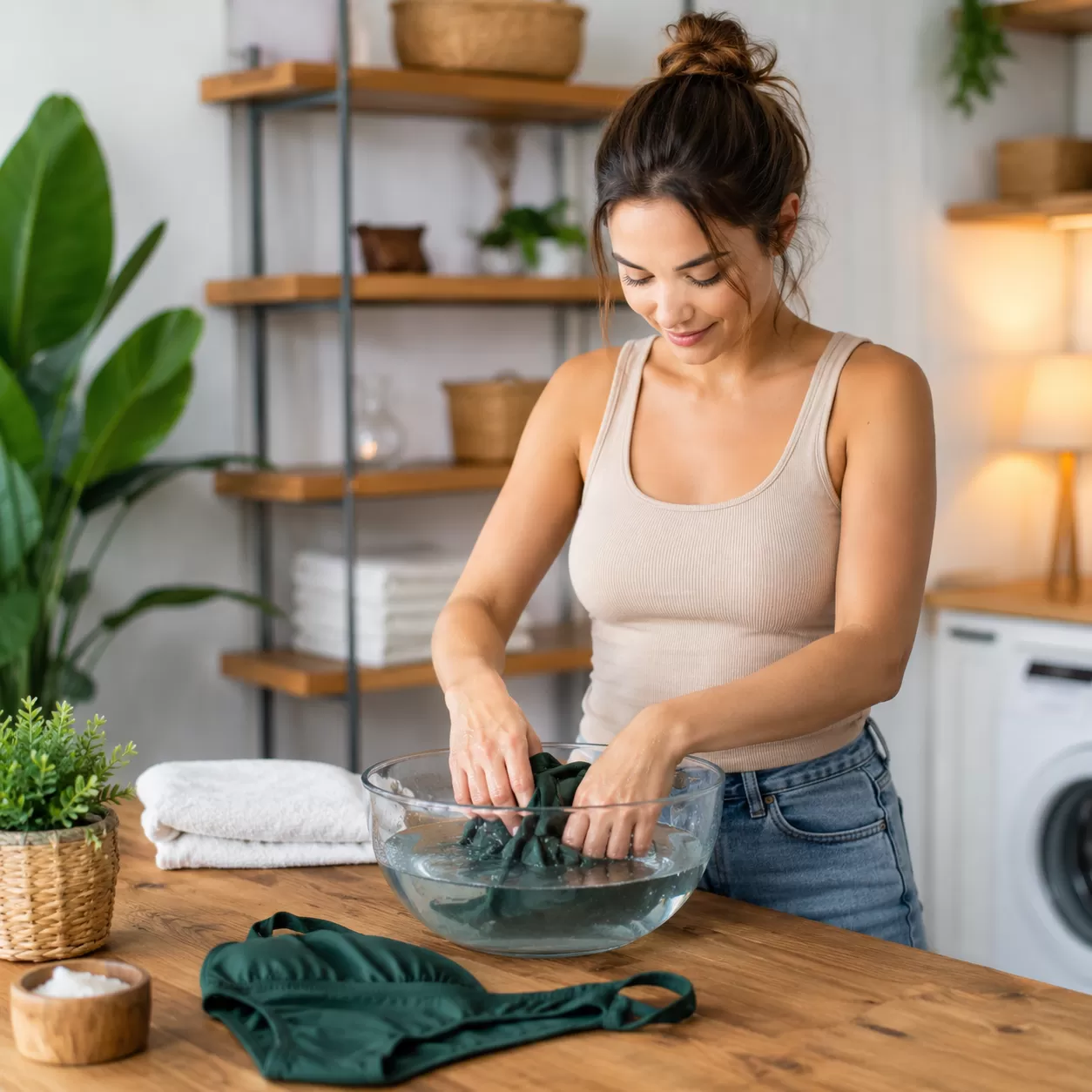
If your favorite bikini or one-piece is a bit too loose, you don’t have to replace it just yet. You can easily fix a swimsuit that’s too big by using controlled heat to tighten the fabric.
Because most swimwear is made of synthetic fibers, precision is key to avoiding damage. Here are four reliable ways to safely shrink your swimsuit at home.
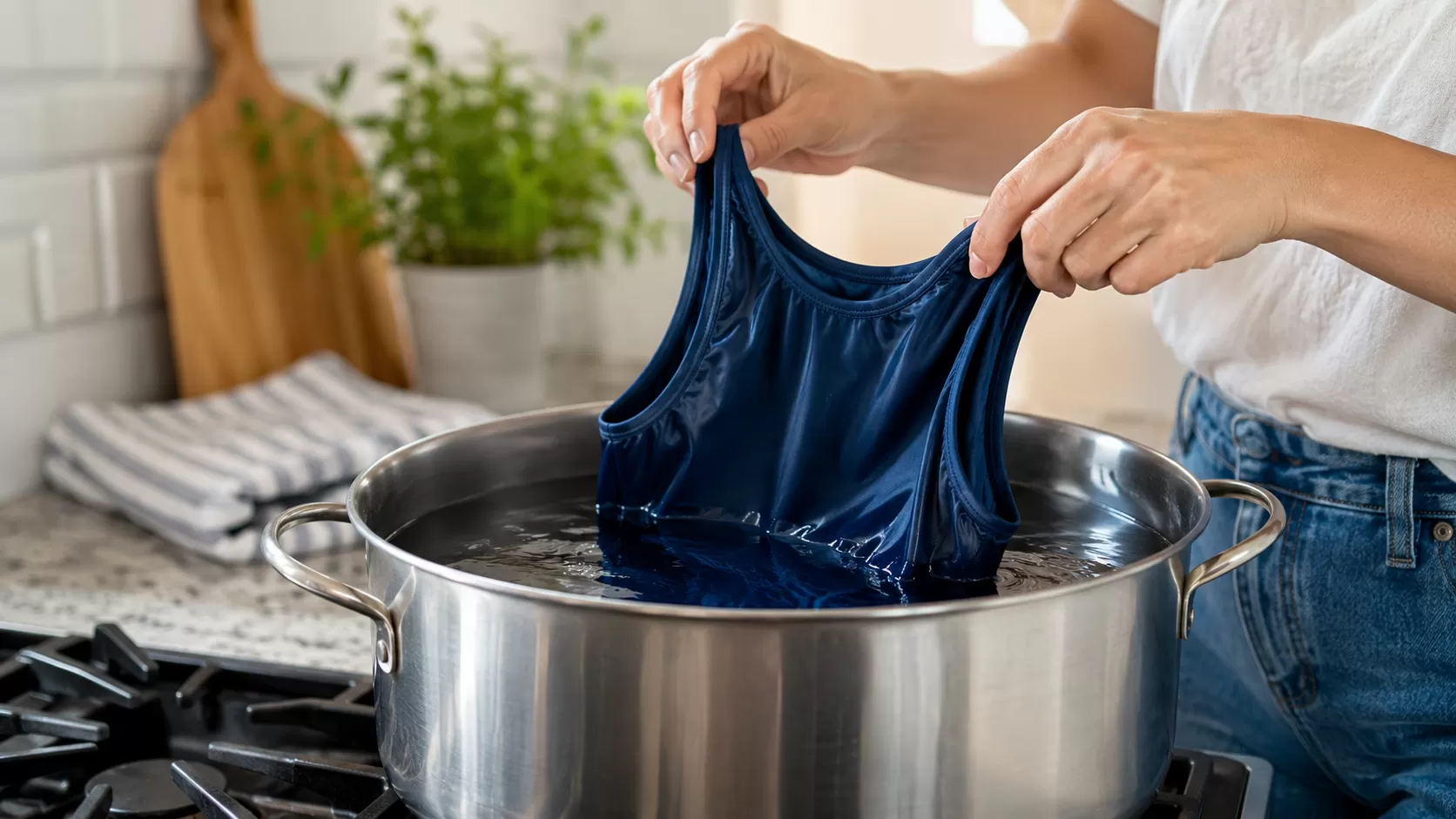
Method 1: The Boiling Water Soak [Best for Uniform Shrinkage]
The boiling water method is ideal if your entire swimsuit is loose and needs an all-over size reduction.
- Bring water to a boil: Fill a large pot with enough water to fully submerge the swimwear, then bring it to a rolling boil.
- Soak the suit: Turn off the heat source and place the swimsuit into the hot water. Use a wooden spoon to press it down completely.
- Time it right: Leave nylon and spandex fabric in the water for 10 to 15 minutes. For a polyester swimsuit, extend the time to 20 to 25 minutes as polyester resists heat more effectively.
- Cool and dry: Carefully remove the suit, let it cool completely, and lay it flat on a clean towel to dry.
Method 2: The Controlled Dryer Method
If you are looking for how to shrink a swimsuit quickly, using a household clothes dryer is your best bet for fast, even results.
- Step 1: Wash the swimsuit in the washing machine using a warm water cycle.
- Step 2: Place the wet suit inside a mesh laundry bag to protect the delicate straps and hardware from snagging.
- Step 3: Toss the bag into the dryer and set it to medium-high heat.
- Step 4: Run the cycle for 20 minutes, checking the suit every 5 minutes to monitor the progress and prevent the synthetic fibers from melting.
Method 3: The Target Iron Technique [Best for Specific Loose Areas]
When only the butt, bust, or waist area is stretched out, you don’t want to shrink the entire garment. The target iron technique lets you focus heat exactly where you need it.
| Step | Action | Key Detail |
|---|---|---|
| 1 | Prep the surface | Lay the clean, damp swimsuit flat on an ironing board. |
| 2 | Add protection | Place a thin protective towel or cotton cloth directly over the loose section. Never let the iron touch bare swimwear fabric. |
| 3 | Apply heat | Set your iron to a medium heat setting with the steam turned off. |
| 4 | Press down | Move the iron in smooth, circular motions over the towel for 1 to 2 minutes, checking the fit frequently. |
Method 4: The Hair Dryer Method
If you want to know how to shrink a swimsuit without a dryer while maintaining total control over the process, a standard hair dryer works beautifully.
- Soak the suit: Submerge the swimwear in hot water for 10 minutes to prep the fibers for shrinkage.
- Remove excess water: Gently press the suit between two dry towels. Do not wring or twist the fabric, as this ruins the synthetic fibers’ elasticity.
- Hang and blow dry: Hang the damp suit on a plastic hanger. Set your hair dryer to its high heat setting.
- Focus the airflow: Hold the dryer 6 inches away from the fabric and move it continuously over the loose areas until the suit is completely dry. This technique delivers maximum swimwear shape retention without the rough tumbling of a machine.
Source: ASTM D5489 – Standard Guide for Care Symbols for Care Instructions on Textile Products; Textile Research Journal, Vol. 91, 2021.
Expected Shrinkage Results by Methods
The following table summarizes the expected outcomes for each method based on fabric type. Use this as a quick reference to choose the right approach for your swimsuit.
|
Method |
Nylon/Spandex |
Polyester |
Cotton Blend |
|
Boiling Water Soak |
0.5–1 size |
0.25–0.5 size |
1–1.5 sizes |
|
Controlled Dryer |
~0.5 size |
~0.25 size |
0.5–1 size |
|
Target Iron |
0.5–1 cm local |
0.25–0.5 cm local |
0.5–1.5 cm local |
|
Hair Dryer |
0.25–0.5 size |
Minimal |
0.25–0.5 size |
Source: Estimates based on AATCC Test Method 135 dimensional change data and common swimwear fabric compositions (80/20 nylon-spandex, 100% polyester, 60/40 cotton-lycra).Note: Actual results depend on the garment’s age, prior wear, construction quality, and exact fabric blend. These figures represent typical outcomes under controlled conditions and should be treated as approximations, not guarantees.
Mistakes That Ruin Swimsuit
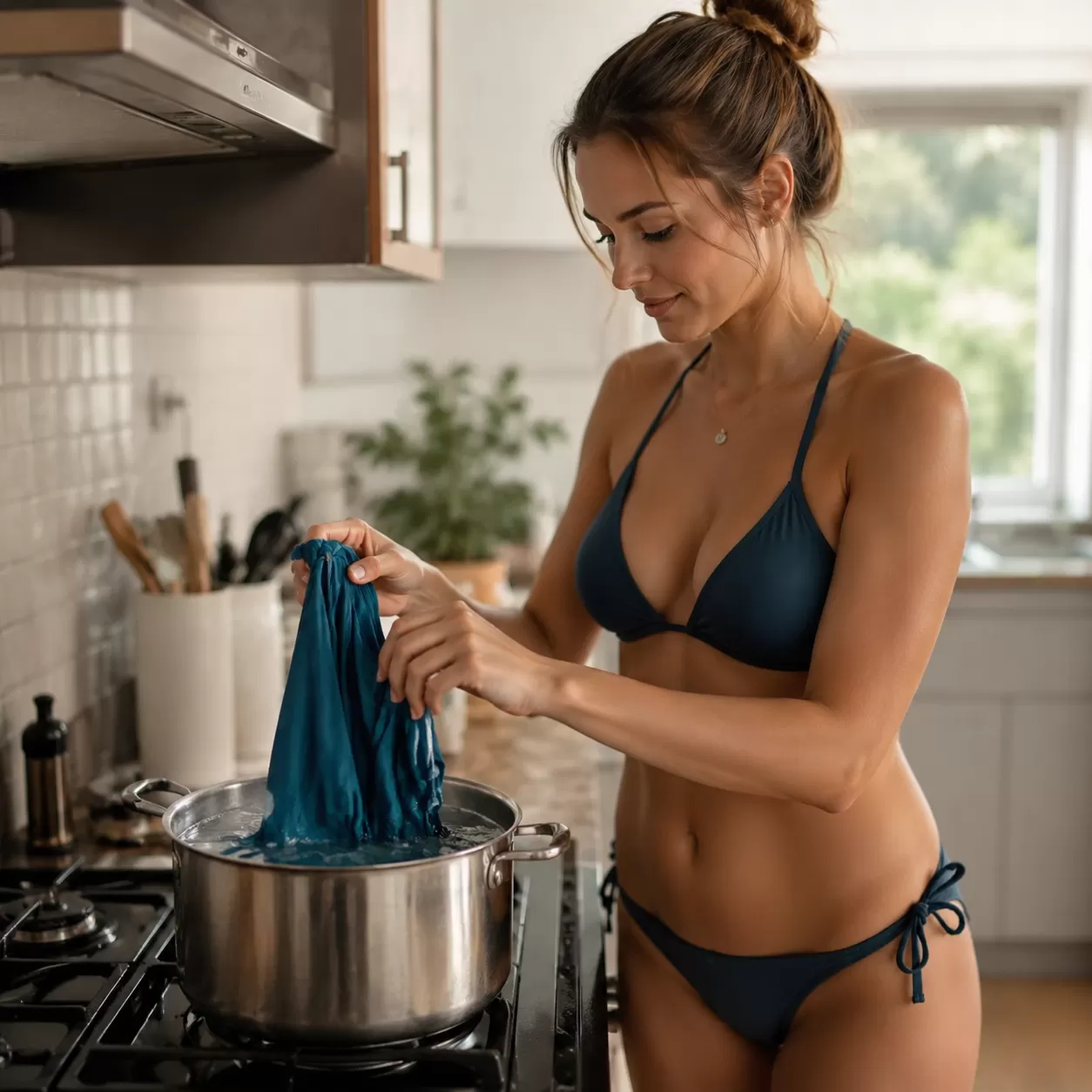
When you are figuring out how to shrink swimsuit fabrics that are a bit too loose, it is incredibly easy to take things a step too far. One wrong move can permanently destroy the synthetic fibers’ elasticity, leaving you with a completely stretched out bathing suit instead of a tighter fit.
To protect your swimwear, avoid these three critical mistakes at all costs.
a)Direct High Heat Exposure
While heat is the secret to shrinking fabric, direct and uncontrolled high heat will melt the delicate elastane fibers.
- Never use a heat gun or direct blowtorch: This will literally liquefy the synthetic material.
- Avoid high-heat iron settings: Placing a hot iron directly onto naked spandex and nylon fabric will burn holes right through it.
- Skip the commercial laundromat dryer: These industrial machines run much hotter than household units and can easily warp your suit’s shape.
b)Wringing and Twisting
It is natural to want to squeeze out excess water after a boiling water method soak, but aggressive wringing is a guaranteed way to ruin your swimwear shape retention.
Warning: Twisting, wringing, or pulling the fabric while it is hot snaps the internal elastic bonds. Once those micro-fibers break, the suit will lose its stretch permanently, and there is no way to fix a swimsuit once the elasticity is gone.
Instead, lay the suit flat on a clean towel, roll the towel up like a burrito, and press down gently to absorb the moisture.
c)Drying in Direct Sunlight
Leaving your swimsuit to dry outside on a hot, sunny deck might seem like a quick way to shrink it, but UV rays are incredibly destructive.
- Color Fading: Direct sunlight bleaches vibrant colors and patterns within hours.
- Fiber Degradation: Intense UV light breaks down the chemical bonds in nylon and polyester, making the fabric brittle and loose.
- The Bottom Line: Always dry your swimwear indoors or in a shaded, well-ventilated area to maintain fabric integrity.
Alternative Solutions: No-Heat Hacks
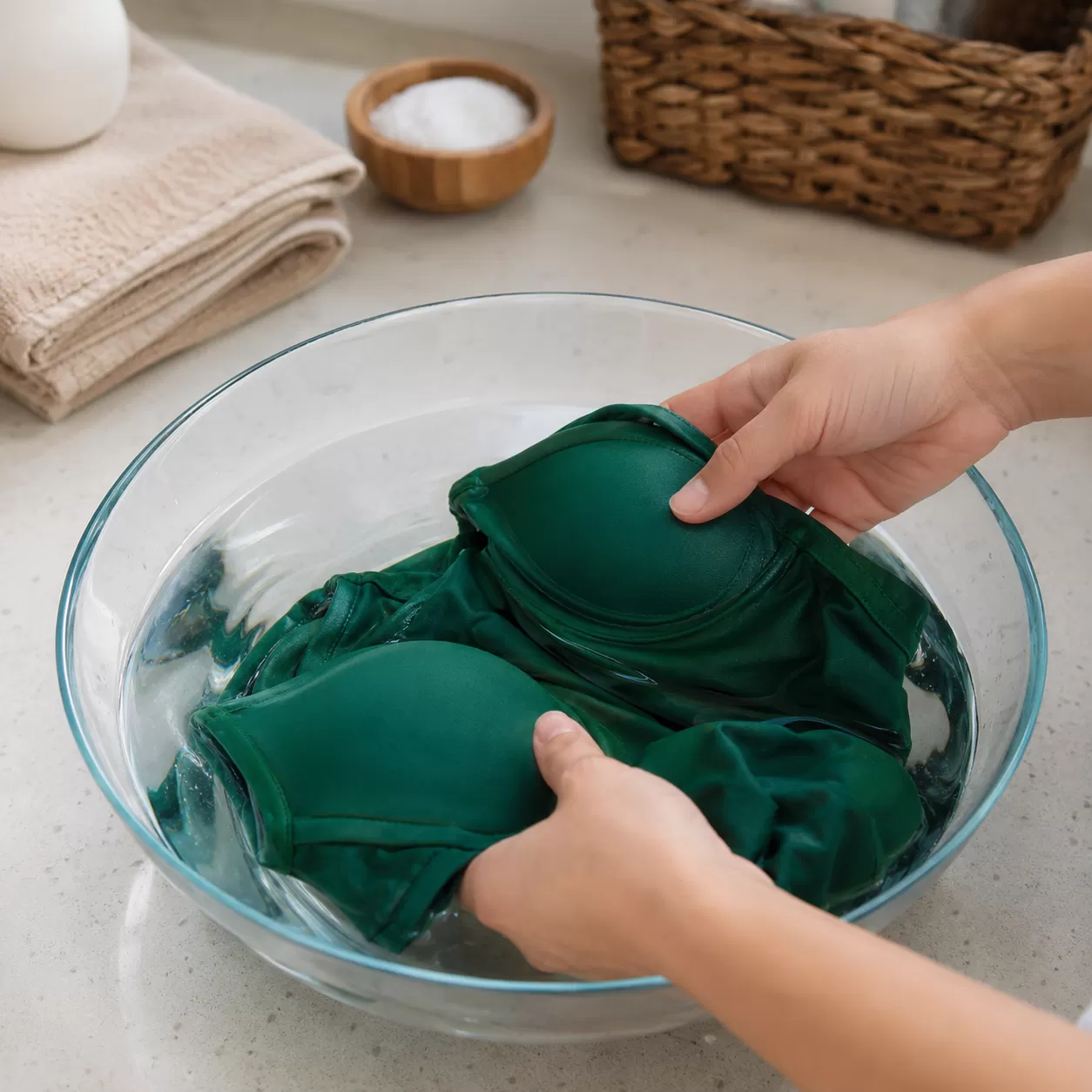
If you are dealing with a stretched out bathing suit and want to avoid the risk of heat damage altogether, you don’t have to rely on a dryer or boiling water. There are several highly effective, heat-free ways to how to fix a swimsuit that’s too big without compromising the integrity of the fabric.
Minor Tailoring & Sewing Darts
When a swimsuit fits perfectly everywhere except for one or two loose areas, a quick session with a needle and thread is your best option. Taking your suit in manually ensures a custom fit without affecting the synthetic fibers elasticity.
- Sewing Darts: Pinch the excess fabric at the waistline or underarms, turn the suit inside out, and sew a straight diagonal line along the pinch. This is one of the easiest clothing alterations for swimwear that creates an instant, secure cinch.
- Adjusting Bikini Straps: If the top is sagging, simply cut the straps where they meet the back band, shorten them to your desired length, and sew them back down using a tight zigzag stitch for maximum stretch.
Creative Styling Hacks
You can easily learn how to make a swimsuit tighter using a few clever styling tricks that require absolutely zero sewing or alteration skills.
- The Criss-Cross Method: For tie-back bikinis or halter tops, cross the straps over your chest or behind your back before tying them. This instantly pulls the cups closer together for a firmer hold.
- Knotting: If your one-piece or tankini is too long in the torso or loose at the hips, gather a small section of fabric at the side hip and tie it into a chic, tight knot to instantly pull the fabric taut.
Using Bikini Inserts
Sometimes the issue isn’t the overall size, but a lack of volume to fill out the cups. Using bikini inserts is a foolproof way to fix a gaping swimsuit top.
- Silicone Inserts: These waterproof inserts slide easily into the existing cup pockets. They add instant volume, fill out loose fabric, and won’t absorb water or weigh you down.
- Sewn-In Foam Pads: For swimsuits without built-in pockets, you can pin standard foam swimsuit pads inside the lining and tack them down with a few quick stitches to permanently improve swimwear shape retention.
Tired of a Stretched-Out Bathing Suit? The Berlook Difference
Trying to shrink a swimsuitis a temporary fix for a permanent problem. Once synthetic fibers lose their elasticity, getting that perfect, snug fit back is an uphill battle. Berlook swimwears are designed to skip the stretching drama entirely.
Berlook Standard
According to AATCC testing, premium chlorine-resistant polyester retains over 95% of tensile strength after 200+ hours of chlorine exposure, compared to approximately 70–80% for standard blends.
|
Feature |
Standard Swimwear |
Berlook Standard |
|
Fabric Core |
Standard synthetic blends |
Premium chlorine-resistant fabric |
|
Shape Retention |
Stretches out after 15–25 wears |
Engineered for 50+ wears with minimal loss |
|
Heat Resistance |
Degrades above 70 °C (158 °F) |
Maintains integrity up to 85 °C (185 °F) |
|
Chlorine Resistance |
70–80% tensile strength after 200 hrs |
95%+ tensile strength after 200 hrs |
Frequently Asked Questions
How many times can I safely shrink a swimsuit?
For nylon/spandex blends, limit shrinking attempts to 2–3 cycles. Each heating cycle stresses the elastane fibers, and repeated treatments cause cumulative, irreversible damage. For polyester, you may attempt 3–4 cycles with minimal degradation due to its higher thermal stability. Cotton blends are the most forgiving and can tolerate 4–5 cycles, though watch for over-shrinkage.
Will chlorine damage the swimsuit during the shrinking process?
Chlorine will absolutely cause chlorine and fabric damage if it is left in the material during the heating process. High heat bonds chemicals to synthetic fibers, which accelerates color fading and breaks down the spandex. Always wash your suit thoroughly with fresh water to remove all chemical residue before attempting any heat-shrinking methods.
What temperature water should I use to shrink my swimsuit?
Use a kitchen thermometer for accuracy. For nylon/spandex: 70–80 °C (158–176 °F). For polyester: 85–95 °C (185–203 °F). For cotton blends: up to 95 °C (203 °F). Never use actively boiling water (100 °C / 212 °F) directly on spandex-containing swimwear.
A Comprehensive Guide on How to Wash Swimwear and Dry It
Every time you step into the swimming pool or ocean, your swimwear takes a beating. Chlorine, saltwater, sunscreen, and natural body oils embed themselves directly into the fabric. If left to sit, these elements act as abrasives, slowly eating away at the synthetic performance fibers.
To preserve swimwear elasticity and keep your suits looking vibrant, an immediate cold water rinse is non-negotiable. From there, we learn how to wash swimwear the right way.
How to Hand Wash Swimwear (The Best Method)
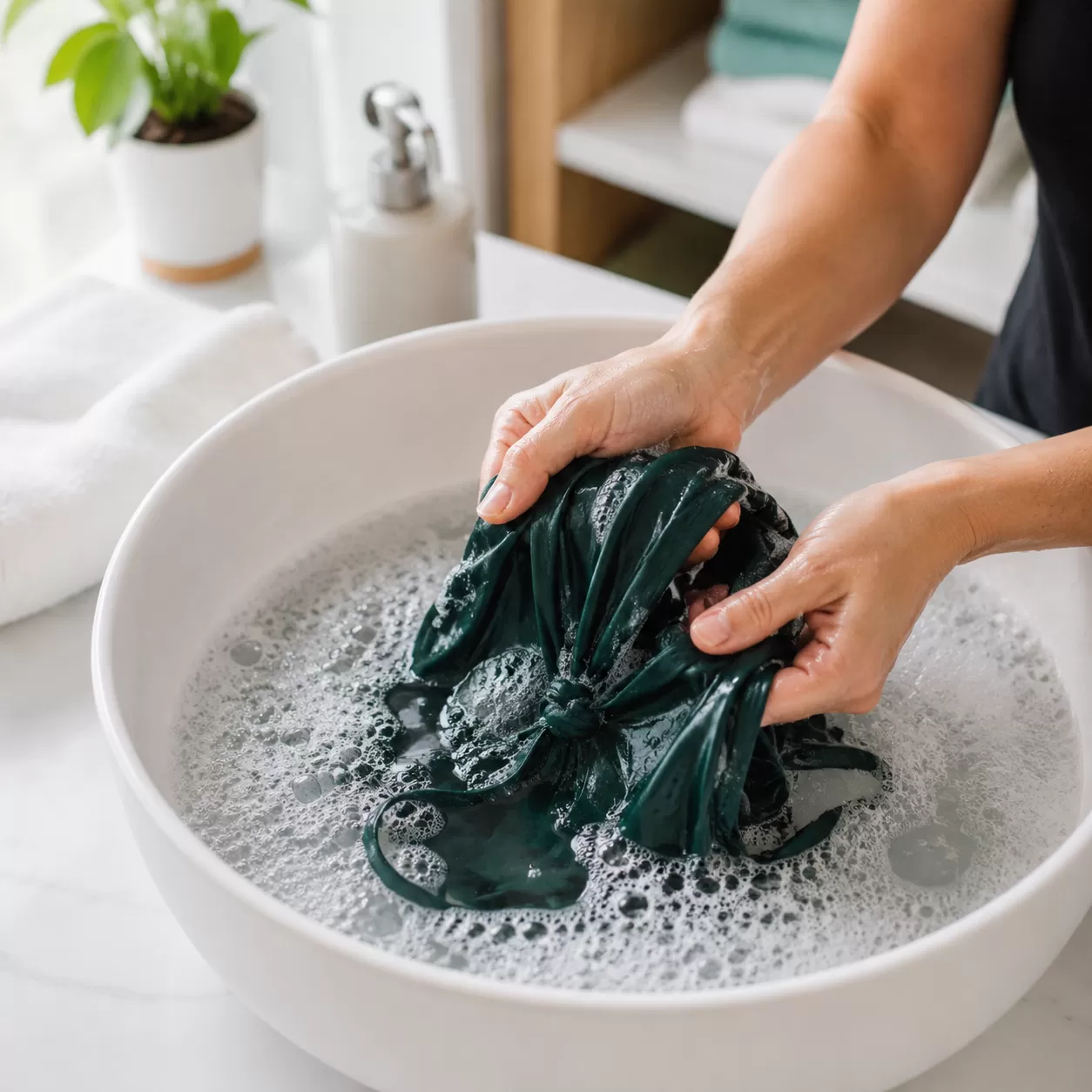
Why Hand Washing Reigns Supreme
Hand-washing bikinis and one-pieces is the absolute best way to preserve swimwear elasticity. While the washing machine is convenient, the friction and spinning can permanently stretch out spandex and nylon fabric care fibers. Taking a few minutes to hand wash your suits keeps them fitting like new, prevents fading, and ensures you get the most out of your favorite pieces.
Step-by-Step Hand Washing Protocol
Follow this simple, routine-tested guide on how to clean a bathing suit safely by hand:
-
Step 1: Fill the Basin
Fill a clean sink or basin with cool or lukewarm water. Avoid hot water at all costs, as heat breaks down the elastic bonds in swimwear fabrics. -
Step 2: Add the Right Soap
Mix in a tablespoon of mild liquid detergent or a specialized delicate wash. Never use harsh detergents, bleach, or fabric softeners, as they strip the fabric coatings and ruin the stretch. -
Step 3: Soak and Swish
Submerge your swimsuit and gently swish it through the soapy water for a few minutes. Let it soak for 15 to 20 minutes to allow the soap to break down embedded sunscreen oils and sweat. -
Step 4: The Clean Rinse
Drain the soapy water and refill the basin with clean, cold water. Submerge the suit and gently press the fabric to release the soap. Repeat this cold water rinse until the water runs completely clear and suds-free.
The Power of an Immediate Cold Water Rinse
Waiting until you get home to clean your swimwear is a recipe for faded colors and stretched-out fabric. A quick rinse right after you step out of the water flushes out harsh contaminants before they can lock into the fibers.
- Chlorine Neutralization: Prevents the chemical bleaching and breakdown of spandex and nylon fabric care structures.
- Salt Removal: Flushes away abrasive salt crystals that weaken fabric elasticity.
- Oil Extraction: Strips away body oils and sunscreens that cause yellowing and staining.
Pro-Tip: Make it effortless. Jump right into the beach or poolside shower with your swimsuit still on for a quick, immediate rinse. It takes less than a minute and extends the life of your suit significantly.
Can You Wash Swimsuits in the Washing Machine?
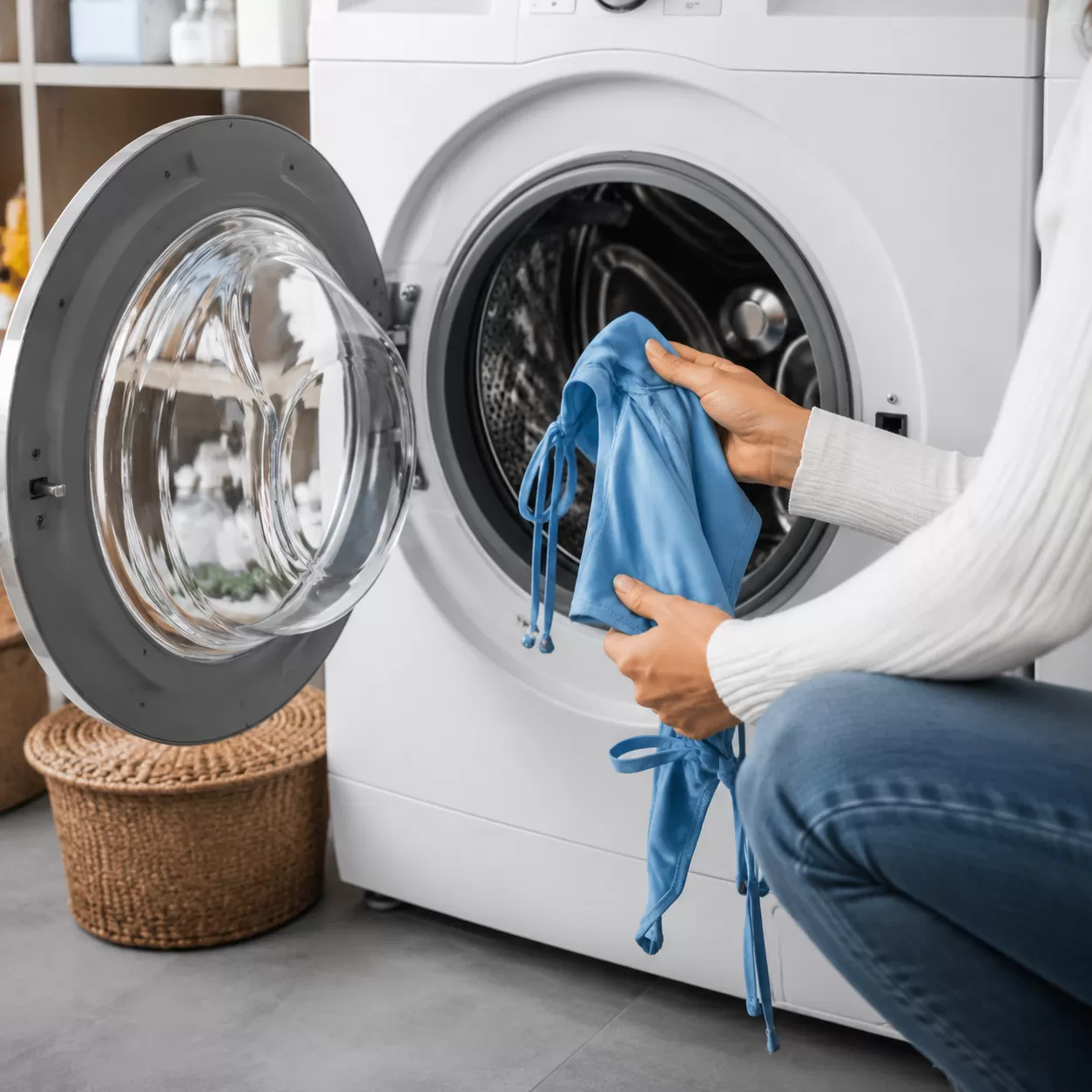
The short answer is yes—but only if you take strict precautions. While hand-washing is always the safest bet for preserving swimwear elasticity, we know that a washing machine delicate cycle is sometimes the only realistic option after a tired day at the pool or beach. If you choose to machine-wash, you must follow a strict checklist to prevent your favorite bikinis and trunks from stretching out or wearing out prematurely.
The Machine-Wash Checklist
To safely clean a bathing suit in the washer without destroying the delicate spandex and nylon fabric, always follow these rules:
- The Secret Weapon: Always use a mesh laundry bag. Tossing your swimwear loose into the drum is a recipe for disaster. A mesh bag acts as a shield, preventing straps from tangling around the agitator, snagging on hardware, or stretching out of shape.
- Select the Right Cycle: Set your machine to the delicate or hand-wash cycle. This ensures a low spin speed, which keeps the machine from violently wringing out the fabric and ruining its shape.
- Keep the Water Cold: Only use cold water. Hot water breaks down the elastic fibers in swimwear, leading to a saggy fit.
- Wash Swimwear Solo: Never wash your swimsuits with heavy clothing, denim, or abrasive beach towels. Coarse fabrics and heavy zippers will rub against the smooth nylon, causing pilling and fabric degradation. Turn your suits inside out and wash them only with other ultra-delicate items.
How to Dry Washed Swimsuit: Tumble Dryer vs. Air Drying
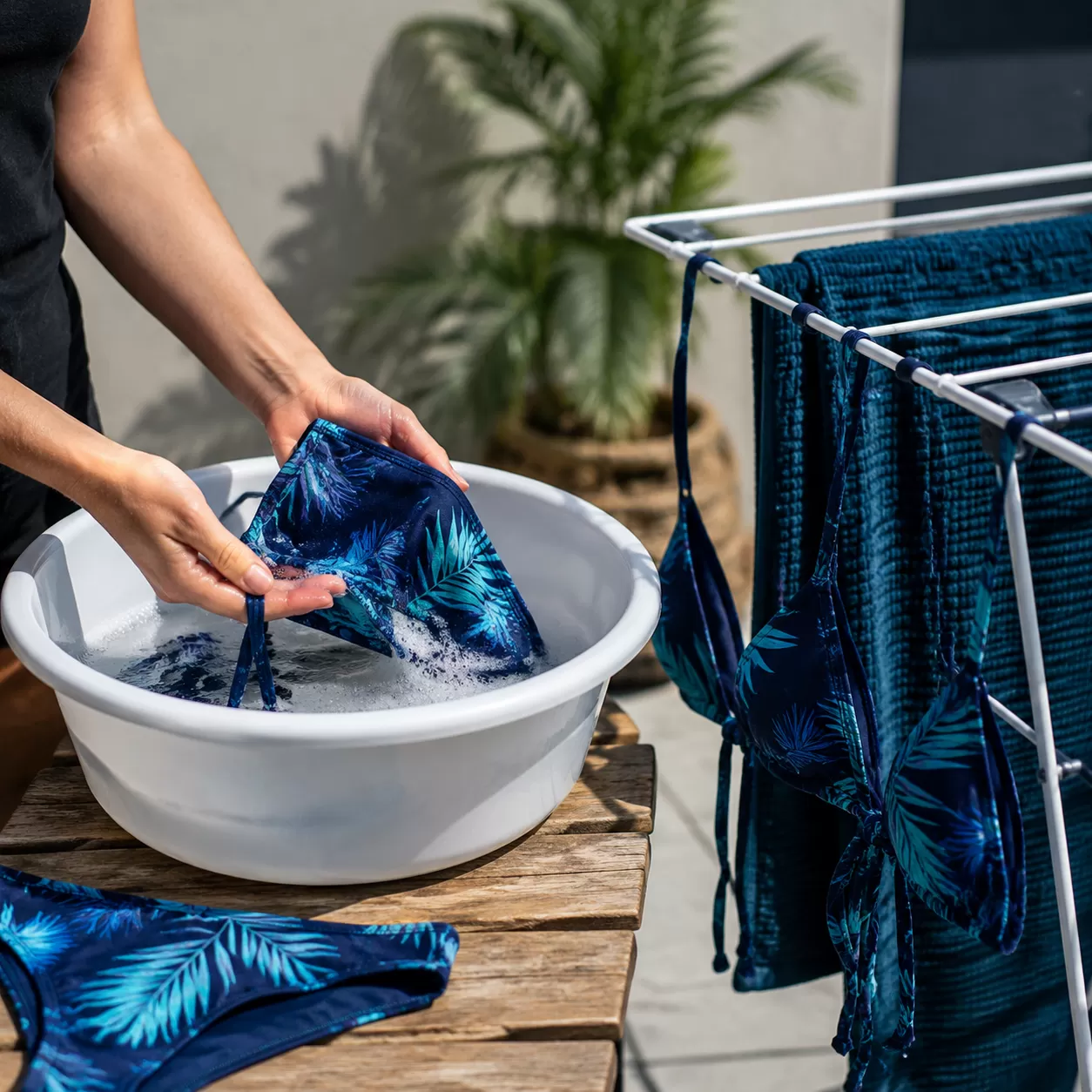
Can you put swimsuits in the dryer? The short answer is no. High heat is the ultimate enemy of spandex and nylon, destroying the elasticity and causing your favorite suit to sag and fade. To keep your swimwear looking and fitting like new, skip the dryer and follow this foolproof two-step drying method.
The Towel Roll Trick (How to Squeeze Out Water Safely)
Never wring or twist your swimsuit to get the excess water out. Twisting snaps the delicate synthetic fibers and permanently warps the shape. Instead, use the towel roll trick to safely prep your suit for air drying:
- Lay a clean, dry, lint-free towel flat on a hard surface.
- Place your freshly rinsed or washed bathing suit flat on top of the towel.
- Roll the towel up tightly from one end to the other, wrapping the swimsuit inside like a burrito.
- Gently press down on the rolled towel to absorb the bulk of the moisture.
- Unroll the towel and remove the suit. It will be damp but no longer dripping wet.
The Best Way to Air Dry
Once you’ve removed the excess water, it is time to finish the job correctly.
- Air dry flat: Always lay your swimsuit flat on a clean towel or a mesh drying rack.
- Avoid hangers: Never hang a wet bathing suit by its straps. The weight of the water pooling at the bottom will stretch out the fabric and ruin the fit.
- Keep out of direct sunlight: Find a shaded, well-ventilated indoor or outdoor spot. Direct sunlight bakes the fabric, bleaches the colors, and breaks down the elasticity.
Troubleshooting Common Swimwear Nightmares
Even with careful wear, your favorite suits can run into trouble. From stubborn yellow streaks to trapped beach grit, here is how to fix the most common issues and keep your beachwear looking brand new.
1.How to Get Sunscreen Stains Out
Sunscreen is essential for sun protection, but its ingredients—especially avobenzone—can leave nasty yellow stains on light fabrics. To get sunscreen stains out of swimwear, skip the bleach, which actually reacts with the chemicals and makes the stain worse.
- The Fix: Create a paste using equal parts baking soda and warm water.
- Application: Smudge the paste directly onto the stain and let it sit for 30 minutes.
- Wash: Gently scrub the area with a soft-bristled brush or toothbrush, then wash the suit as normal. For tough oil stains, a drop of dawn dish soap works wonders.
2.How to Remove Chlorine Smell and Brighten Fabrics
If your suit smells like a public pool even after a rinse, chlorine is trapped in the synthetic fibers. Over time, this chemical eats away at the fabric, causing colors to fade and whites to yellow.
- The Vinegar Soak: Submerge the suit in a basin of cold water mixed with one cup of white vinegar. Let it soak for 30 minutes. The vinegar neutralizes the chlorine, kills odor-causing bacteria, and naturally brightens the fabric without stripping the dye.
- The Baking Soda Bath: Alternatively, dissolved baking soda in a sink of cold water will effectively remove chlorine smell from swimsuit fabrics while restoring vibrancy.
3.How to Get Sand Out of Swimsuit Lining
Fine beach sand loves to get trapped inside the mesh weave of double-lined bikinis and one-pieces. Trying to rub it out while the suit is wet will only push the grains deeper into the fabric.
- Step 1: Let the swimsuit air dry completely.
- Step 2: Give the dry suit a aggressive shake to loosen the surface grains.
- Step 3: Use a hairdryer on the cool setting to blow the remaining sand out of the fabric pores, or gently stretch the dry fabric over a flat surface and vacuum it with a hose attachment.
Essential Do’s and Don’ts of Swimwear Longevity
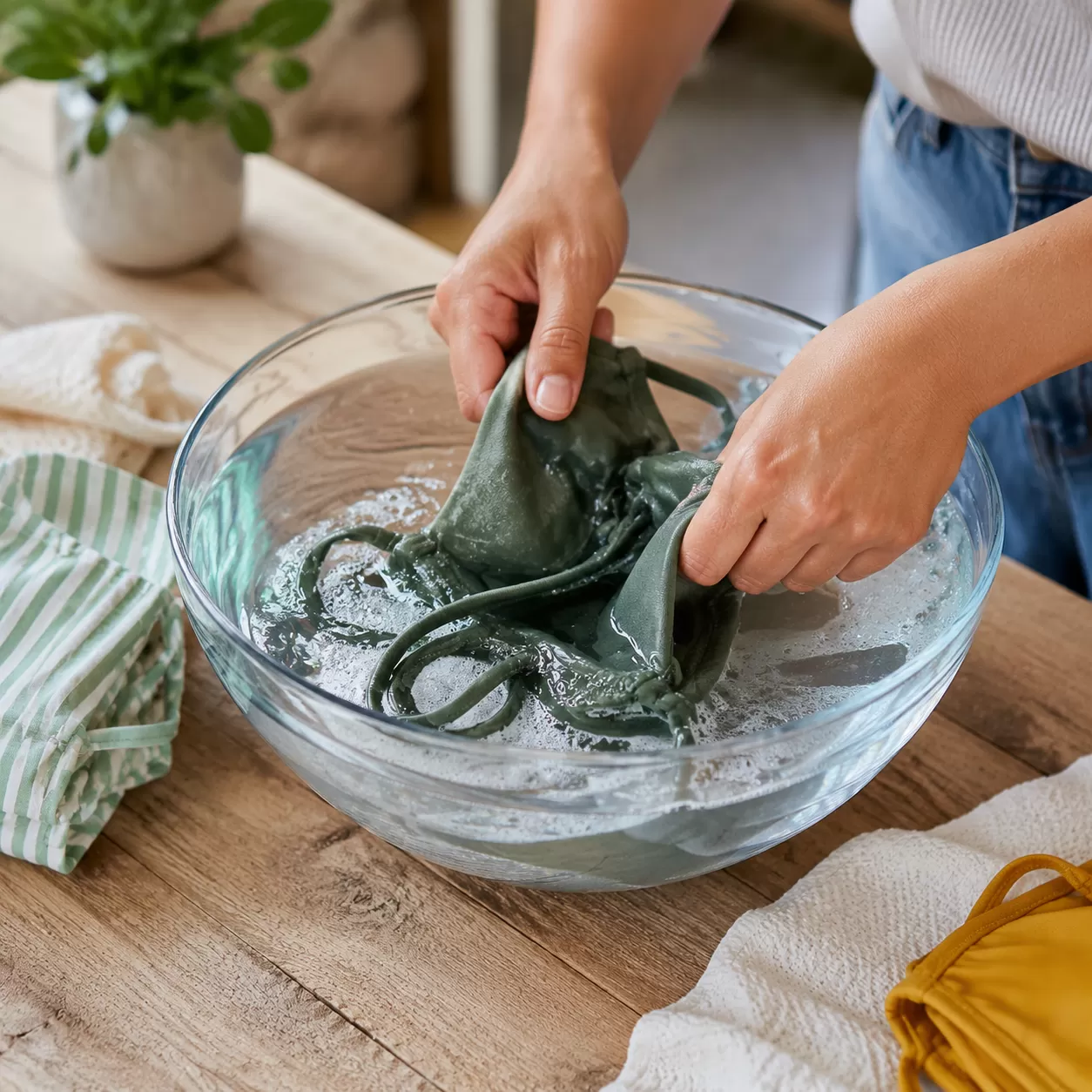
When you invest in high-quality bikinis and one-pieces, knowing how to wash swimwear is only half the battle. How you treat your suits between washes determines how long they maintain their shape and vibrant colors.
Follow these essential rules to keep your favorite pieces looking brand new all summer long.
The Berlook Care Note: Rotate Your Suits
Give it a 24-hour rest - Spandex is a memory fabric. It needs roughly 24 hours to completely snap back into its original shape after being stretched out during a swim. If you want to preserve swimwear elasticity, avoid wearing the exact same suit two days in a row. Always rotate your collection.
Avoid Rough Surfaces
- Don’t sit directly on concrete or wood: Rough pool ledges, wooden docks, and textured concrete surfaces are the ultimate enemies of smooth spandex and nylon fabric care.
- Do sit on a towel: Snags and fabric pilling happen instantly on abrasive surfaces. Always lay down a soft beach towel before you sit down to protect the fabric.
Beware of Public Hot Tubs
- Don’t wear luxury suits in hot tubs: High-heat public hot tubs require massive amounts of chlorine to stay sanitary. This lethal combination of intense heat and heavy chemicals will quickly bleach bright colors and fry the elastic fibers.
- Do use a designated “tub suit”: Keep your favorite luxury swimwear safe. Dedicate an older, older-rotation suit specifically for hot tub sessions so you don’t ruin your best gear.
Storing Your Swimwear for the Off-Season
When summer fades, how you store your bikinis and one-pieces determines if they will survive until next year. Proper off-season storage preserves fabric elasticity and prevents your favorite pieces from stretching out or rotting in the dark.
Never Store a Damp Suit
Before packing anything away, ensure your swimwear is 100% bone-dry. Even a tiny amount of trapped moisture will breed mildew, ruin the fabric, and cause foul, musty odors that are nearly impossible to wash out later. Give your suits an extra day of air drying just to be completely sure.
Lay Flat in a Breathable Space
When it comes to long-term storage, ditch the hangers and the plastic bins.
- Lay them flat: Storing your swimsuits flat in a fabric organizer or a breathable dresser drawer is the best way to maintain their shape.
- Do not hang: Hanging swimsuits by their straps for months at a time causes gravity to pull at the wet-strength fabric, permanently stretching out the shoulders and torso.
- Avoid plastic bags: Sealed plastic containers trap residual moisture and humidity, which destroys spandex over time. Stick to cotton storage bags or lined drawers.
FAQs About How to Wash Swimwear
Can you use regular detergent on swimwear?
Standard laundry detergent is too harsh for high-performance swimwear fabrics. Heavy-duty formulas and powder detergents break down the elasticity of spandex and fade bright colors. Instead, choose a mild liquid detergent or a specialized swimsuit wash to keep your suits in perfect shape.
How often should you wash a bathing suit?
You should rinse your swimsuit in cold water after every single wear to remove chlorine, salt, and oils. However, you only need to deep clean it with a mild soap every three to five wears—unless you’ve been sweating heavily or applying heavy layers of sunscreen.
Will vinegar ruin a swimsuit?
No, white vinegar will not ruin your suit if used correctly. In fact, a tablespoon of white vinegar mixed into a cold water soak is an excellent way to remove chlorine smell from a swimsuit and neutralize odor-causing bacteria without damaging the fabric.
How do you fix a crunchy swimsuit?
A crunchy swimsuit is usually caused by dried-out chlorine or detergent buildup. To restore its softness:
- Soak: Submerge the suit in a basin of lukewarm water mixed with one tablespoon of baking soda.
- Swish: Let it sit for 30 minutes, then gently swish the fabric.
- Rinse and Dry: Rinse thoroughly with cold water and air dry flat out of direct sunlight.
What Is Swimwear Made Out Of? Here Is A Full Guide
Understanding what swimwear is made out of is the single most useful thing you can do before you buy. The right material will hold its shape through chlorine, saltwater, and sunscreen season after season. The wrong one will look tired by August.
At BERLOOK, every swimsuit is built from recycled polyamide and spandex — chosen for performance, longevity, and a dramatically lower environmental footprint. This guide explains exactly why, and what every fabric on a swimsuit label actually means.
The Main Swimwear Fabrics Explained
Modern swimsuits are almost always made from synthetic fabrics — specifically blends of two or three materials engineered to perform in water. Natural fibers like cotton absorb water heavily, lose their shape when wet, and degrade quickly in chlorine and saltwater. Synthetics are built for exactly the conditions swimwear faces.
The five fabrics you'll encounter most in women's swimwear are nylon (polyamide), polyester, spandex (also called elastane or Lycra®), PBT polyester, and — increasingly — recycled eco alternatives.
- Nylon (Polyamide/ Typical blend: 74–82% nylon / 18–26% spandex)
Soft, silky, and incredibly comfortable against skin. The go-to for fashion swimwear, bikinis, and one-pieces. Dries quickly, holds vibrant prints beautifully, and has excellent stretch and recovery. Less chlorine-resistant than polyester — ideal for beach and casual pool use. "Nylon" and "polyamide" on a label mean the same thing.

- (Typical blend: 80–90% polyester / 10–20% spandex)
The workhorse of swimwear. Highly resistant to chlorine, UV rays, and fading. Naturally hydrophobic, so it dries fast and holds its shape through repeated pool use. Slightly firmer in feel than nylon, but the top choice for frequent swimmers and active water sports.

- Spandex / Elastane / Lycra® (Usually 7–26% of the blend)
The stretch ingredient in every swimsuit. Even a small percentage delivers four-way elasticity that moves with your body and springs back to shape. Without it, a swimsuit simply wouldn't fit. Lycra® is the trademarked brand name by The LYCRA Company — spandex and elastane are the generic equivalents.

- PBT Polyester - Performance & competitive swimwear
A high-performance polyester used in competitive and athletic swimwear. Exceptionally chlorine-resistant and color-fast — it outlasts standard polyester under heavy pool use. If you train in chlorinated pools daily, look for PBT in the fabric composition.

- Recycled Polyamide (ECONYL® · REPREVE® · rPET)
Made from regenerated nylon or recycled polyester sourced from ocean waste, fishing nets, and plastic bottles. Performs identically to virgin synthetics — same stretch, softness, and durability — with a fraction of the environmental cost. The direction the entire swimwear industry is moving.

What about cotton in swimwear?
Cotton is soft and breathable, but it absorbs water heavily, takes a long time to dry, loses shape when wet, and degrades quickly in chlorine and saltwater. It works well for beach cover-ups and loungewear — not for active swimming.
Fabric Comparison: At a Glance
Not all swimsuit fabrics perform equally. Here's how the main materials compare where it matters most.
| Fabric | Softness | Chlorine Resistance | UV Protection | Best For |
|---|---|---|---|---|
| Recycled Polyamide / Spandex (BERLOOK) | High | Moderate | Moderate | Fashion, beach, casual |
| Virgin Nylon / Spandex | High | Moderate | Moderate | Fashion, beach use |
| Polyester / Spandex | Medium | High | High | Lap swimming, pool training |
| PBT Polyester | Medium | Very High | High | Competitive / daily training |
| ECONYL® (recycled nylon) | High | Moderate | Moderate | Eco beach & casual swim |
| Cotton blend | High | Low | Low | Cover-ups & lounging only |
Pro Tip:
Always check the fabric label before buying. A BERLOOK swimsuit typically reads "Recycled Polyamide 74%, Spandex 26%." The higher the spandex percentage, the more stretch and shape recovery you'll get. For pool training, look for 80%+ polyester in the blend for better chlorine resistance.
Sustainable & Recycled Swimwear Fabrics
Sustainability has moved from niche to mainstream in swimwear, and the fabric innovation happening here is genuinely impressive. BERLOOK sits at the center of this shift — our entire swimwear range is made from recycled materials, not as a trend but as a founding commitment.
Recycled Polyamide — The BERLOOK Standard
Recycled polyamide is nylon regenerated from post-consumer waste — discarded fishing nets, industrial plastic, and fabric scraps — restored to original purity. Every BERLOOK swimsuit is made from it. The performance is identical to virgin nylon: same softness, same stretch, same color vibrancy — with a significantly smaller environmental footprint.
ECONYL® — Regenerated Nylon
Some of our reversible swimwear styles feature ECONYL®, a branded regenerated nylon developed by Aquafil from ocean waste and landfill-bound nylon — fishing nets, carpet flooring, and industrial plastic — restored to virgin-quality fiber. It can also be regenerated again at end of life, making it part of a true circular system.
REPREVE® — Recycled Polyester
Made from recycled plastic bottles, REPREVE® is durable, fade-resistant, and chlorine-tolerant. Some BERLOOK styles incorporate recycled polyester blends for specific structural applications — you'll see it listed on the product label.
How to Choose the Right Swimwear Fabric for You
The best swimsuit fabric depends entirely on how and where you wear it. Here's a simple framework.
If you love the beach and casual pool days
Recycled polyamide-spandex blends — like those used across all BERLOOK bikinis and one-pieces — are your sweet spot. Soft, flattering, and vibrant through a full season of beach and casual pool use.
If you train in a pool regularly
For heavy chlorine exposure, look for polyester-spandex or PBT polyester rated as chlorine-resistant. For casual training, BERLOOK suits hold up well in pools with moderate use — just rinse immediately after each swim.
If sustainability matters to you
All BERLOOK swimwear is made from recycled polyamide. For a reversible, double-duty eco option, our ECONYL® reversible styles are a particularly strong choice — two looks, one suit, zero virgin materials.
If you need extended sizing
Our plus size collection uses the same premium recycled polyamide blends as the rest of the range — designed with the same four-way stretch and shape retention, across a wide range of styles and cuts.
What fabric weight should you look for?
Most quality fashion swimwear falls between 180–200 g/m². Lighter fabrics may lack structure or coverage. Heavier fabrics (200–220 g/m²+) are typically found in competitive or structured supportive styles. BERLOOK sits in the quality mid-range: enough weight for great coverage, light enough for all-day comfort.
How to Care for Your Swimsuit?
Even premium recycled polyamide breaks down prematurely without proper care. Chlorine, saltwater, sunscreen, and body oils all degrade fibers — but a few consistent habits can dramatically extend the life of your suit.
- Rinse immediately after every use.
Chlorine and saltwater continue breaking down fabric fibers even after you leave the water. A quick rinse in cool, clean water after every swim is the single most effective care habit — especially important for recycled polyamide after chlorine exposure.
- Hand wash only, with a mild detergent.
Machine washing — even on gentle — stretches seams and weakens elastic fibers. A gentle hand wash in cool water is all your suit needs. Avoid bleach and fabric softeners; softeners in particular break down the spandex that gives BERLOOK suits their shape.
- Never wring your suit out.
Twisting distorts and weakens fibers permanently. Instead, gently press water out between two towels, then lay the suit flat to dry in a shaded spot.
- Air dry flat, away from direct sun.
UV exposure fades color and weakens fiber structure over time. Never use a tumble dryer — heat is one of the fastest ways to destroy elastane and cause shrinking or misshaping.
- Rotate between two suits.
Alternating between two swimsuits gives each one time to recover its stretch and shape between uses. This single habit can double the effective lifespan of each piece — a great excuse to pick up a second style in the BERLOOK sale.
- Apply sunscreen before putting on your suit.
Many sunscreens — especially avobenzone-based formulas — cause yellowish staining on swimwear. Apply at least 30 minutes before putting your suit on and let it fully absorb into your skin first.
- Store dry, flat, and in a cool place.
Never pack a damp swimsuit into a plastic bag — trapped moisture leads to mould and accelerates fabric deterioration. Once completely dry, store it flat or gently folded in a cool drawer or breathable fabric bag.
Frequently Asked Questions
What is BERLOOK swimwear made of?
BERLOOK swimwear is made primarily from recycled polyamide (recycled nylon) blended with spandex — typically 74% recycled polyamide and 26% spandex for the outer fabric, and 82% recycled polyamide and 18% spandex for the lining. Some metallic and statement styles incorporate a small percentage of metallic fiber. All fabrics are chosen for performance, softness, and sustainability. Browse the full range at berlook.com.
Is nylon or polyester better for swimwear?
It depends on use. Nylon (polyamide) is softer, more flattering, and better suited to fashion, beach, and casual pool swimwear — it's what BERLOOK uses across its range. Polyester is tougher and more chlorine-resistant, making it better for frequent lap swimmers or competitive training. Neither is universally superior; they're designed for different situations.
What does "recycled polyamide" mean on a swimsuit label?
Recycled polyamide is nylon regenerated from post-consumer waste — discarded fishing nets, industrial plastic, and fabric scraps — rather than produced from virgin petroleum. It performs identically to conventional nylon in stretch, softness, and durability, with a significantly lower environmental footprint. It's the core fabric in every BERLOOK swimsuit.
What does Lycra® or spandex mean on a swimsuit label?
Lycra® is a trademarked brand name for spandex/elastane fiber — they all refer to the same material. It's the stretchy component in every swimsuit, typically making up 18–26% of the fabric blend, delivering the four-way elasticity that allows your suit to move freely and return to its original shape after wear.
Are recycled swimsuits as good quality as conventional ones?
Yes — in every measurable way. Recycled polyamide is restored to its original purity during regeneration, meaning it performs identically to virgin nylon in stretch, durability, softness, and color retention. BERLOOK's range is proof: over 2.9 million plastic bottles recycled, no compromise on quality.
How long should a quality swimsuit last?
With proper care, a swimsuit made from recycled polyamide should last multiple seasons. Rinsing after every use, hand washing only, and rotating between suits are the three habits that make the biggest difference. Check out the BERLOOK sale to pick up a second suit for rotation.
Ready to Find Your Perfect Suit?
Every BERLOOK swimsuit is made from recycled polyamide — soft, stretchy, sustainable, and built to last. Free shipping on orders over $79.
How to Sew a Bathing Suit: A Beginner-Friendly Guide
Swimwear is made from highly elastic materials that stretch in multiple directions and constantly return to shape. This means every stitch, seam, and edge must work with movement, not against it. A normal straight stitch or rigid seam simply cannot handle this level of flexibility.
Another factor is exposure. Bathing suits are repeatedly exposed to water, sunlight, and friction. This combination makes construction quality extremely important. If the structure is weak, the suit loses shape quickly or becomes uncomfortable when wet.
This is why swimwear sewing is considered slightly advanced even though the design may look simple. If you understand how the material behaves, the entire process becomes more predictable and manageable. And once you’ve experienced what a well-constructed swimsuit feels like, like the pieces in our swimwear collection designed for real comfort and structure, you start to understand exactly what you’re trying to recreate.
Understanding Swimwear Fabric: The Foundation of a Good Bathing Suit
Fabric choice is the most critical decision in the entire process of sewing a bathing suit. If the fabric is wrong, no amount of skill in stitching can fix the final result.
The most commonly used materials include nylon-spandex, polyester-spandex, and high-quality lycra blends. These fabrics are designed specifically for elasticity and water performance.
A proper swimwear fabric must meet three essential conditions.
- First is four-way stretch. This means the fabric stretches horizontally and vertically. This is necessary because the body moves in multiple directions during swimming and beach activity.
- Second is recovery. After stretching, the fabric must return to its original shape without sagging or loosening over time.
- Third is moisture behavior. While swimwear will get wet, the fabric should not become heavy or lose structure when exposed to water.
Lining fabric is also important. It improves comfort against the skin, adds structure, and prevents transparency when the swimsuit is wet. Many professional swimwear designs use a second layer specifically for stability and durability.
Choosing fabric is not just a technical step. It defines how wearable, long-lasting, and comfortable your bathing suit will be in real conditions.
Tools You Need Before Sewing Swimwear

Before starting, preparation is essential. Swimwear sewing requires precision tools because stretch fabrics react differently compared to normal textiles.
The most important tool is a stretch or ballpoint needle. This needle is designed to move between fibers instead of piercing them, which prevents skipped stitches and fabric damage.
You also need a zigzag stitch or stretch stitch setting on your sewing machine. Straight stitches should never be used for swimwear because they break when the fabric stretches.
Polyester thread is recommended because it has flexibility and strength under tension. Additional tools include fabric scissors for clean edges, measuring tape for accuracy, and swimwear elastic for structure around openings.
Pins or fabric clips are also necessary, but clips are often preferred because pins can distort stretch fabric.
Having the correct tools ready before starting reduces errors and ensures smoother construction.
Understanding Swimwear Patterns and Fit Logic
A bathing suit pattern is designed differently from regular clothing patterns. The most important concept here is negative ease.
Negative ease means the pattern is intentionally smaller than the body measurements. This might sound incorrect at first, but it is necessary because stretch fabric expands when worn. Without negative ease, the swimsuit would feel loose and unstable in water.
Most basic swimwear patterns include a front piece, a back piece, and lining components. More advanced designs may include panels, shaping seams, or adjustable elements.
For beginners, it is always better to start with simple bikini or one-piece patterns. These help you understand how stretch behaves before moving into complex construction.
Pattern accuracy is extremely important because even small measurement errors affect symmetry, fit, and comfort. It’s also why professionally designed swimwear, like our structured bikini and one-piece styles, feels balanced right away, because every detail is already refined for fit and movement.
Step-by-Step Guide: How to Sew a Bathing Suit
Step 1: Cutting the Fabric Accurately

- Start by laying the fabric flat on a smooth surface. Ensure it is not stretched or distorted before cutting.
- Align the stretch direction according to the pattern instructions. This step is critical because incorrect orientation will affect how the swimsuit fits the body.
- Place pattern pieces carefully and secure them with weights or clips. Cut slowly and precisely using sharp scissors.
- Always cut both outer fabric and lining together to maintain consistency.
Accuracy at this stage determines how well the final garment aligns and fits.
Step 2: Preparing Elastic for Structural Support

Elastic is responsible for keeping the swimsuit secure around openings such as legs, waist, and neckline.
- Measure elastic slightly shorter than the fabric edge to create controlled tension.
- Divide both fabric and elastic into equal sections before attaching. This ensures even distribution and prevents uneven gathering.
Uneven elastic application is one of the most common causes of poor fit in homemade swimwear.
Step 3: Constructing the Main Body

- Use a zigzag stitch or stretch stitch to sew the main panels together.
- This type of stitch allows the seam to expand without breaking.
- Avoid pulling the fabric while sewing. Let the machine guide the material naturally to prevent distortion.
At this stage, the basic structure of the bathing suit is formed. Stability and alignment are more important than speed.
Step 4: Attaching the Lining Properly

- Place the lining inside the main fabric with wrong sides facing each other.
- Align edges carefully and sew using stretch stitches.
Lining improves comfort and prevents transparency when the fabric is wet. It also helps stabilize the outer layer, making the swimsuit feel more secure during movement.
Step 5: Applying Elastic to Edges

- Attach elastic to leg openings, neckline, or armholes depending on the design.
- Stretch the elastic slightly as you sew to maintain consistent tension.
- Once attached, fold it inward and stitch again for a clean, finished look.
Proper elastic application is what separates amateur results from professional-quality swimwear.
Step 6: Final Assembly and Fit Adjustments

- After completing construction, inspect all seams carefully.
- Trim excess threads and check for uneven tension or distortion.
- If possible, try the swimsuit on to evaluate fit and comfort. Stretch fabric behaves differently when worn, so small adjustments may be necessary.
A well-constructed bathing suit should feel secure, flexible, and balanced without constant adjustment.
5 Common Mistakes When Sewing a Bathing Suit
Avoid these common errors:
- Using straight stitches instead of stretch stitches
- Choosing non-stretch fabric
- Uneven elastic tension
- Ignoring fabric stretch direction
- Over-tightening seams
These mistakes affect both comfort and durability.
5 Expert Tips for Better Swimwear Results
- Pre-wash fabric before sewing
- Test stitches on scrap fabric first
- Maintain consistent seam allowance
- Use high-quality swimwear elastic
- Sew slowly for better accuracy
These small adjustments significantly improve the final outcome.
Why Stitch Quality Matters More Than Stitch Type Alone
Most guides focus on telling you to use zigzag or stretch stitches, but what matters just as much is how you apply them.
Even the correct stitch type can fail if the tension is inconsistent or if the fabric is being pulled while sewing. Swimwear construction requires a steady rhythm rather than forceful stitching.
When stitching curves such as leg openings or necklines, the fabric should be guided gently without stretching it out of shape. If you stretch while sewing, the seam may look fine initially but will distort when worn.
Another important detail is stitch density. Too tight, and the fabric becomes rigid in that area. Too loose, and the seam loses strength.
Professional-looking swimwear is not defined by fancy stitches. It is defined by consistent, controlled stitching that respects fabric behavior.
Final Thoughts
Learning how to sew a bathing suit is a skill that combines technical sewing ability with an understanding of fabric behavior. The key to success is not complexity but precision. Every step, from fabric selection to elastic application, contributes directly to how the final swimsuit performs in real conditions.
A well-made bathing suit should feel stable, flexible, and comfortable without needing constant adjustment. With practice, patience, and attention to detail, even beginners can create swimwear that performs at a professional level.
Ready to find your perfect bathing suit?
Explore flattering bathing suits designed for every beach day, vacation, and poolside moment.
Shop Bathing SuitsFAQ - How to Sew a Bathing Suit Correctly
Q:What fabric is best for sewing a bathing suit?
Nylon-spandex or polyester-spandex blends are best because they offer stretch, durability, and water resistance.
Q:Can I sew a bathing suit without a serger?
Yes, you can sew a bathing suit without a serger. A regular sewing machine works fine as long as you use a zigzag stitch or stretch stitch. The key is using stretch-friendly settings so the seams can move with the fabric.
Q:What is the easiest swimwear style for beginners to sew?
The easiest styles are simple bikini sets or basic one-piece swimsuits with minimal panels. These designs have fewer curves and seams, making them easier to align and stitch accurately.
Q:How do I stop swimwear fabric from slipping while sewing?
Swimwear fabric can be slippery because of its stretch. Using fabric clips instead of pins helps keep layers stable. You can also sew slowly and avoid stretching the fabric while feeding it through the machine.
Q:Can I sew swimwear with a normal sewing machine?
Yes, but you must use a stretch needle and zigzag stitch to handle elastic fabrics properly.
Q:Do I need lining for a swimsuit?
Yes, lining improves comfort, prevents transparency, and adds structure.
Q:Why does my homemade swimsuit lose shape?
This usually happens due to incorrect fabric choice, poor elastic tension, or using straight stitches.
Q:Is sewing a bathing suit difficult for beginners?
It is moderately challenging but manageable if you start with simple patterns and follow proper stretch fabric techniques.
