
wearing-tips
The Best Swimsuits for Moms: What Is It & How to Choose?
A swimsuit for moms has to do more than look good. It needs to perform. Between bending down to scoop up a toddler, carrying heavy beach gear, and actually trying to relax, standard fast-fashion swimwear simply cannot keep up.
Whether you are picking swimwear for a mom in your life or shopping for yourself, there are a lot of factors to weigh. That is why we put together this practical guide, grounded in fabric science, recognized textile standards, and real-world wear. Let's dive in.
Things to Know Before You Buy
As a mom, looking great at the pool does not have to be complicated. There are three core elements to keep in mind when buying a swimsuit: fabric quality, secure construction, and a fit that moves with you.
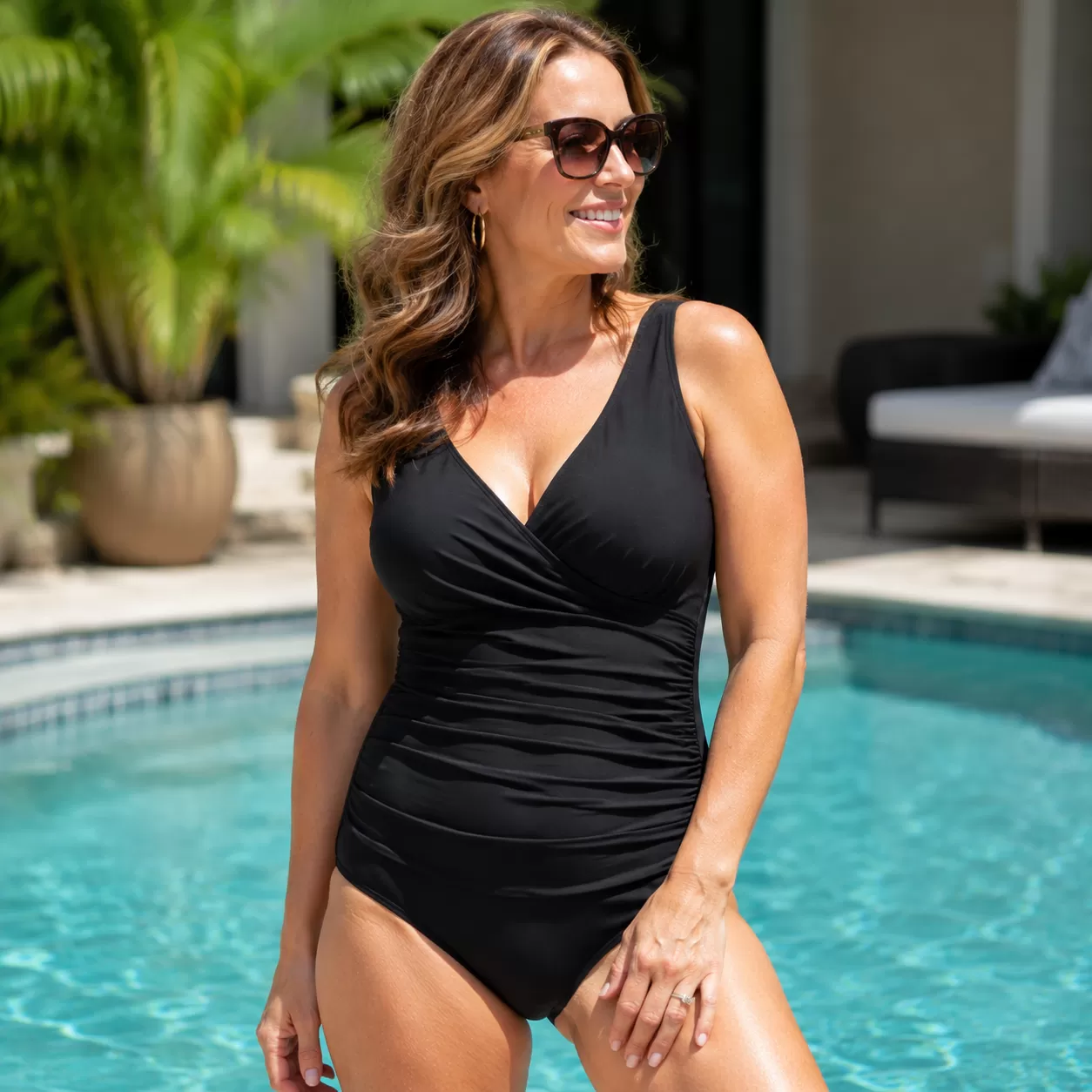
About Fabric Integrity
Cheap, generic spandex feels fine on the rack, but the moment it hits the water the fibers stretch out, absorb moisture, and start to sag. This leaves you constantly pulling up your bottoms or adjusting your top. The culprit is usually how the fabric is finished and how its elastane behaves in chlorine and salt water.
Here is the part most buying guides skip: nylon and polyester behave differently in the water. Nylon (polyamide) blends feel softer and have a more luxurious hand-feel, which is why fashion swimwear favors them, but they are slightly more susceptible to chlorine and UV degradation over time. Polyester and PBT blends are more chlorine-resistant and hold color longer, which is why they dominate competitive swimwear. Neither is "better" outright; it depends on how you will use the suit. (Sources: Joy Sportwear fabric comparison; May I Swimwear chlorine-resistance guide.)
If you swim in chlorinated pools regularly, look for a fabric built with a chlorine-resistant elastane such as LYCRA® XTRA LIFE™ or Creora® HighClo™. Independent guidance notes this typically adds only a small cost premium but significantly reduces the loss of elasticity that causes suits to "bag out." (Source: Sustainable swimwear fabrics guide.)
When you read a product page, a quality fabric usually delivers:
- Gentle Smoothing: A soft, supportive hold that feels like a second skin rather than restrictive shapewear.
- Shape Retention: Premium fabrics snap back to shape after wear. As a benchmark, a well-finished chlorine-resistant recycled fabric can withstand roughly 200+ hours of chlorinated-water exposure before elastic degradation shows. (Source: Recycled-fabric durability testing.)
- Quick-Drying Properties: Synthetic fibers absorb little water, so the suit stays lightweight rather than waterlogged.
A quick test you can do yourself: before committing to a brand, take a fabric swatch (or an inexpensive sample suit), soak it in a chlorine solution overnight, then compare its stretch, feel, and color to an untreated piece. Textile suppliers recommend exactly this kind of real-world prototyping rather than trusting marketing copy alone. (Source: Spandex By Yard fabric guide.)
About Activity Security
A supportive swimsuit should be effectively malfunction-proof. If you plan to chase toddlers at the beach or dive into the waves, here is what actually keeps everything in place:
- Wider Strap Widths: Wider straps distribute the weight of the bust more evenly across your shoulders, which reduces painful digging and the back rolls that thin elastic straps can create.
- Fixed Cups: Removable pads tend to twist or get lost in the washing machine. Fixed, sewn-in cups stay in place for consistent shape and coverage.
- Full-Coverage Bottoms: A stay-put cut that stays anchored under the glutes, no matter how active you get.
Moving Without Restriction
Rigid, suffocating wires do not make most moms feel confident. Instead, look for tummy-control swimwear built around design choices that work with your natural shape. Here is how the most common features actually function:
| Design Element | How It Works | The Benefit |
|---|---|---|
| Targeted Compression Zones | Higher-density knit panels placed across the lower stomach. | Creates a secure, supported feel where you want it most. |
| Double-Lined Fabric | Front-to-back interior layering that eliminates sheerness. | Smooths lines without relying on heavy wires. |
| Lateral Ruching | Intentional fabric folds running across the torso. | Visually camouflages texture while adding breathing room. |
Choosing the Right Swimsuit for a Mom Pooch
Finding a swimsuit that makes you feel confident after having kids should not mean squeezing into suffocating shapewear. The goal is comfort, flexibility, and targeted support that lets you move freely.
Try Tummy Control
Tummy-control swimwear uses flexible, everyday smoothing knits. These fabrics offer gentle compression that holds you in without digging into your skin, so you can chase kids or lounge comfortably. Note that "compression" here means light shaping support, not medical-grade compression.
Try a Ruched One-Piece
Lateral fabric gathers help camouflage lower-belly insecurities. Ruched one-piece swimsuits create an optical effect that draws the eye outward and across rather than to the center.
- How it works: The layered fabric mimics natural shadows, softening the lines of a postpartum belly.
- The result: More peace of mind, whether you are sitting down or building sandcastles.
Spotlight: Berlook Textured Tummy-Control One-Pieces
We designed our textured tummy-control collection with these needs in mind. The pieces use a double-lined, compressive swim fabric with elegant ruching that smooths the silhouette while staying lightweight and breathable. For full transparency, the table below describes the features and how they are intended to perform; we encourage you to check each product page for the exact fabric composition and any certification details before buying.
| Feature | What It Does for You |
|---|---|
| Double-Lining | Reduces sagging when wet and adds a smoothing layer. |
| Multi-Directional Stretch | Moves with your body instead of restricting it. |
| Textured Earth Tones | A chic, minimalist look that reads less "generic mom print." |
Tip: If ruching is not your style, look for a diagonal wrap design. Asymmetrical lines and strategic color-blocking cut across the torso diagonally, which can make the frame look longer.
This structure shifts the visual focus up and away from the lower stomach for a sleeker look, without adding extra fabric thickness.
Two-Piece Swimsuits for Moms
You can absolutely wear a bikini after having kids. The secret is choosing modern cuts designed to support a changing body rather than fight against it. The best two-piece swimsuits for moms balance security, comfort, and style, so you can move freely without constantly adjusting fabric.
Tankini
Tankinis have come a long way since the oversized versions of the 2000s. Today's silhouettes are sleeker, more intentional, and more supportive.
- Cropped & Longline Tops: Pair with high-waisted bottoms for the coverage of a one-piece with the convenience of a two-piece.
- Peplum Details: Flare gently above the hips for an effortless way to soften the look of a mom pooch.
- Built-In Support: Tops with hidden underwires or thick power-mesh shelf bras lift and hold.
High-Waisted Bikini Bottoms
A good high-waisted bottom is a real upgrade for postpartum bodies. Unlike older styles that cut off mid-stomach, a well-designed high rise hits just above the belly button.
- Supports the Lower Tummy: Gentle, reliable hold right where you want it.
- Defines the Natural Waist: Draws the eye inward for a balanced silhouette.
- Stays Put: Resists rolling down or slipping when you lift, bend, or carry gear.
High-Leg vs. Low-Leg
Finding the right leg cut is about balancing coverage with proportion.
| Cut Style | Visual Impact | Coverage Level | Best For |
|---|---|---|---|
| Moderate High-Leg | Elongates the thighs and torso | Cheeky to moderate | A longer, leaner look |
| Traditional Low-Leg | Offers maximum hip coverage | Full coverage | Active beach days with full peace of mind |
For most moms, the sweet spot is a mid-to-high leg cut that lengthens the look of the legs while keeping the rear fully covered.
Berlook's High-Waisted Recycled Bikinis
Our high-waisted recycled bikinis combine a vintage-inspired look with recycled textile construction.
- Tummy-Smoothing Panels: Built-in compression panels offer targeted lower-belly support without squeezing too tightly.
- Recycled Fabrics: Made from recycled nylon intended to retain shape and elasticity when wet. (For context on how recycled nylon such as ECONYL® compares to virgin fiber, see this manufacturer fabric overview.)
- Tailored Fit: Soft, flexible waistbands designed to lay flat without digging in.
Why Bust Support Matters After Baby
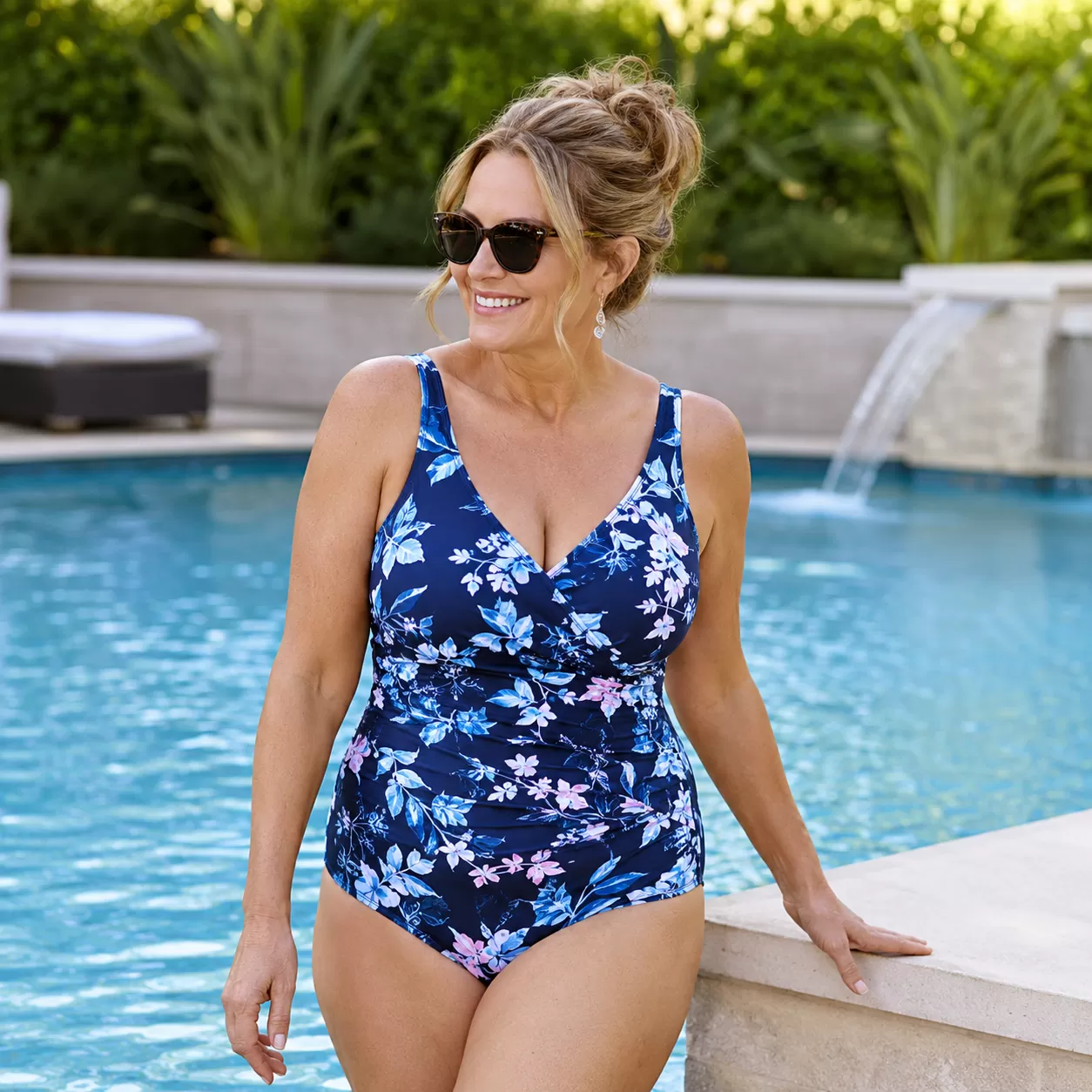
Pregnancy and nursing change your chest. When you shop for a mom-friendly swimsuit, look for one that lifts, holds, and stays secure through changing cup sizes without digging or sagging.
Underwire vs. Power-Mesh Shelf Bras
The right internal support depends on your cup size and comfort preferences:
- Underwire Support: Best for maximum lift and separation, especially for larger cup sizes. It provides a familiar, bra-like structure.
- Power-Mesh Shelf Bras: Ideal for flexible, wire-free comfort. Power-mesh panels compress and hold the bust against the body without poking wires.
- Fixed Cups: Sewn-in cups beat removable inserts; they will not fold or bunch in the wash.
Thick & Adjustable Straps
Narrow, elastic straps are the enemy of all-day comfort. To reduce shoulder digging and back rolls, look for tops and one-pieces with wide, adjustable shoulder straps.
- Weight Distribution: Wider straps spread the weight of the bust across the shoulders and back.
- Customized Fit: Adjustable straps let you tighten the lift as the fabric naturally relaxes over time.
Plunge vs. Square Necklines
Balancing style and security comes down to matching the neckline to your activities.
| Neckline Style | Best Used For | Major Benefit |
|---|---|---|
| Square Neck | Chasing toddlers, swimming laps, active beach days | Strong protection against wardrobe malfunctions and fuller coverage. |
| Plunge Neck | Lounging, resort vacations, low-impact tanning | A modest-yet-flattering look that elongates the neck while keeping the bust contained. |
Postpartum Swimwear for Every Stage
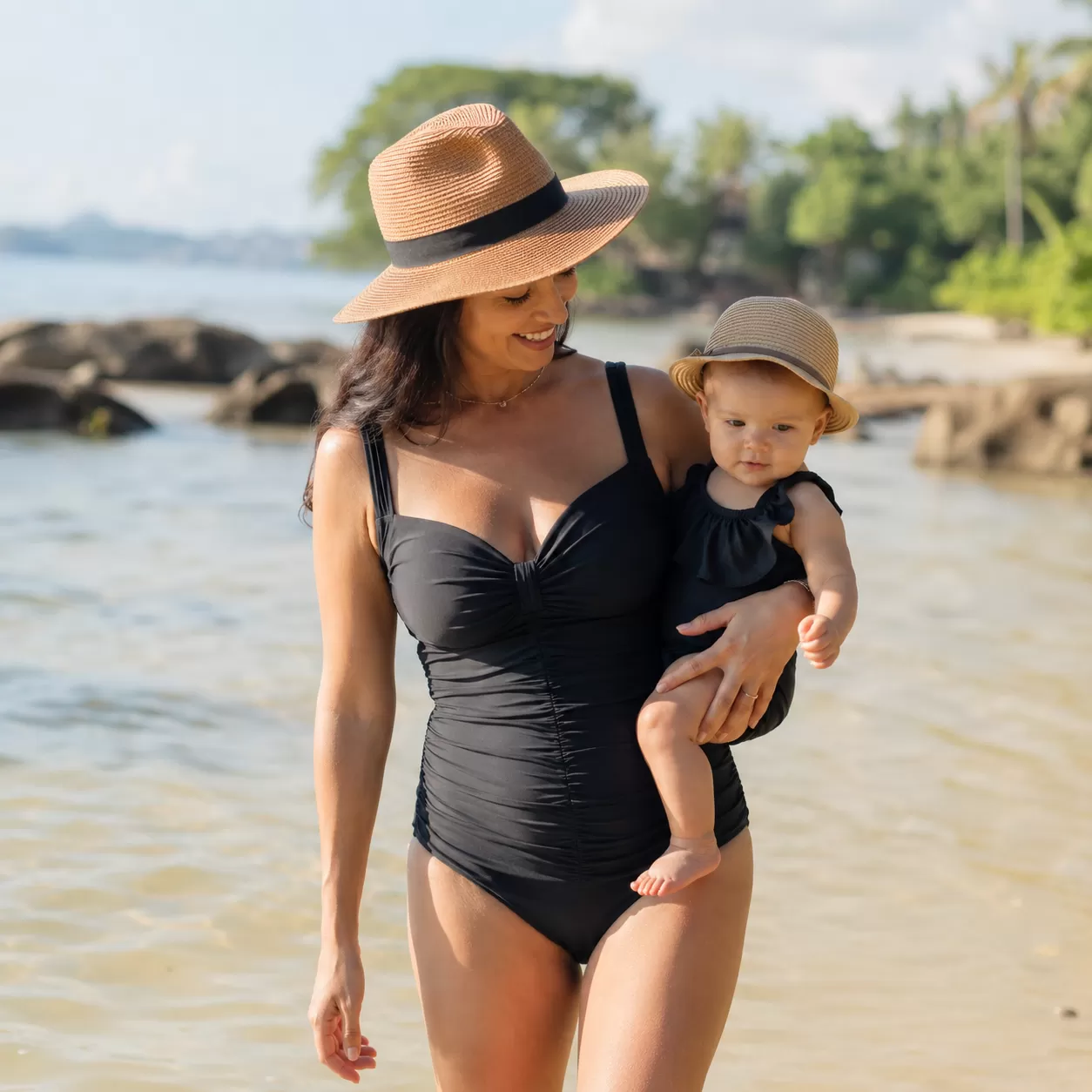
Motherhood changes your body, your lifestyle, and what you need from a swimsuit. Here is a stage-by-stage breakdown.
The Fourth Trimester (0–6 Months Postpartum)
Your body is healing and your weight can fluctuate daily. This stage is about maximum comfort without sacrificing style. (A reminder rather than a sales point: if you had a C-section or any complication, check with your provider before swimming, and wait until any incision is fully healed.)
- Fabric Focus: Ultra-soft, highly elastic fabrics such as crinkle styles.
- The Benefit: These materials stretch to accommodate fluid weight shifts and changing bust sizes without digging in.
- The Goal: A gentle, low-pressure suit that feels like a second skin.
The Toddler-Chaser Stage (Ages 1–4)
Once your little one is on the move, your swimwear has to work harder. You need a suit built for bending, lifting, and carrying gear.
- Active Silhouettes: High-neck one-pieces, secure tankinis, and full-coverage bottoms.
- Stay-Put Security: Fixed cups and wide, adjustable straps reduce wardrobe malfunctions.
- The Reality: You can confidently chase toddlers at the beach or splash in the pool knowing things stay where they should.
The Relaxed Resort Stage
When the kids are older, or you finally get that well-deserved getaway, it is time to elevate your pool-day look. Here is how to approach it:
| Style Element | What to Look For | Why It Works |
|---|---|---|
| The Silhouette | Plunging necklines or sleek asymmetrical wraps | Adds modern elegance while keeping supportive coverage |
| The Palette | Minimalist earth tones and vintage florals | Moves away from generic "mom prints" toward a high-end look |
| The Pairing | Sheer linen button-downs, knit sarongs, or wide-leg pants | Transitions your swimwear from the lounge chair to the beachside restaurant |
Don't Overlook Sun Protection
One factor missing from most "best mom swimsuit" lists is UV protection, even though moms often spend hours outdoors supervising kids. Coverage style matters, but so does the fabric's UPF rating.
UPF (Ultraviolet Protection Factor) measures how much UV radiation a fabric lets through to your skin, and unlike SPF it accounts for both UVA and UVB rays. According to the Skin Cancer Foundation, a UPF of 30–49 offers very good protection and UPF 50+ rates as excellent, blocking at least 98% of UV rays; a fabric must reach UPF 50 to earn the Foundation's Seal of Recommendation. (Source: The Skin Cancer Foundation on sun-protective clothing.)
If sun safety is a priority, look for densely woven fabric, darker or treated colors, and a stated, third-party-tested UPF rating rather than a vague "sun-protective" claim. UPF clothing only protects the skin it covers, so pair your suit with a broad-spectrum sunscreen, a wide-brimmed hat, and shade during peak hours (roughly 10 a.m. to 2 p.m.). (Source: Skin Cancer Foundation seal explainer.)
Sustainable Style Moms Can Feel Good About
Finding the best swimsuit for moms should not mean choosing between protecting the planet and looking great at the pool. Sustainable construction and high-performance, mom-life functionality can go hand in hand, but only if the materials are genuinely certified.
Eco-Conscious Fabrics, Verified
The single most useful thing you can do as a buyer is look for certification rather than green-sounding language. Independent guidance is consistent on this point: GRS (Global Recycled Standard) certification is the baseline for any recycled-content claim, and OEKO-TEX® STANDARD 100 verifies the fabric is free of harmful chemicals. Without certification, a "sustainable" label is just marketing. (Sources: MFG Merch fabric guide; May I Swimwear certification overview.)
- Recycled Nylon (e.g., ECONYL®): Often made from reclaimed fishing nets and fabric scraps; favored for fashion swimwear thanks to its soft hand-feel and stretch.
- Recycled Polyester (rPET): Made from post-consumer bottles; more chlorine-resistant and better at holding prints and color, which suits high-use and graphic styles.
- What to Verify: Ask for GRS-certified content and OEKO-TEX® STANDARD 100 on the product page or hangtag.
Timeless Aesthetic Over Trendy "Mom Prints"
You do not have to settle for loud floral graphics and saggy cuts. Modern motherhood deserves modern design.
- Minimalist Earth Tones: Solids like terracotta, olive, and deep sage that complement a range of skin tones.
- Subtle Florals: Vintage-inspired prints that read elegant rather than dated.
- Classic Silhouettes: Clean lines and retro-modern cuts that work whether you are lounging or chasing kids.
Longevity Built for Real Life
A cheap fast-fashion swimsuit loses its shape after a few wears. Here is what actually happens to low-quality suits versus a well-finished, chlorine-resistant fabric. (Background on chlorine's effect on polymer and elastane fibers: recycled-fabric chlorine durability testing.)
| Stress Factor | What Happens to Cheap Suits | How Quality Fabric Responds |
|---|---|---|
| Chlorine Exposure | Discolors fabric and breaks down standard spandex | Chlorine-resistant elastane helps lock in color and stretch |
| Saltwater & Sand | Stretches out seams and degrades texture | A tight-knit weave resists sand trapping and sagging |
| Machine Washing | Elastic snaps and straps lose retention | Higher-grade fabric retains shape and elasticity longer |
The Bottom Line
The best swimsuit for a mom is the one that fits your real life: the fabric finish that survives your pool, the support that handles a changing body, the UV protection for long days outside, and certifications that back up the sustainability claims. Use the checks above, ask brands for the specifics, and try the fabric in real conditions before you commit.
Disclosure: Berlook products are referenced as examples within our own collections. We encourage you to verify each product's fabric composition and certifications independently before purchasing. External links are provided for reference and are not endorsements of those retailers.
Prevent Swimwear Camel Toe: A Complete How-to Guide
Recall that you slip into a new bathing suit, look in the mirror, and notice that awkward, prominent front wedgie. Swimwear cameltoe is incredibly common, but it is completely preventable. It is not a body flaw; it is a direct result of poor garment construction and incorrect sizing.
This guide explains the four causes behind a bathing suit camel toe, and gives you a store-side checklist plus six fixes you can use today.
Click to run a 30-second in-store check before purchase
|
1. Hold it to the light. If you can see clearly through the unstretched fabric, it is too sheer on its own and needs a lining. 2. Stretch and release a section. It should snap straight back. Slow recovery means it will bag out and crease when wet. 3. Check the front seam. Run a finger down the crotch; a hard raised seam is a warning sign. Prefer flat, bonded, or seamless fronts. 4. Find the lining. A wide, smooth gusset is what keeps the front flat. A narrow, flimsy one will not. 5. For one-pieces, check torso length. If the straps already feel tight when the crotch sits comfortably, the torso is too short for you. |
Why Does Camel Toe Happen?
We use this framework and detailed explanations throughout the guide so that you can match a symptom to its cause and its fix.
|
Root cause |
What is physically happening |
The fix in one line |
|
Thin or low-recovery fabric |
Lightweight knit collapses and clings when wet instead of smoothing across the body. |
Choose a heavier, double-lined knit (see specs below). |
|
Vertical tension (wrong torso length) |
A too-short one-piece pulls upward through the crotch. |
Match torso length, not just waist size. |
|
A prominent centre seam |
A stitched front seam guides fabric inward along its line. |
Pick seamless or bonded-edge bottoms. |
|
Excess fabric bunching |
Too much loose material pools at the lowest point and folds in. |
Fit the waist correctly; avoid sizing up blindly. |
Figure 1. The four mechanical causes of a front crease, with the corresponding fix.
Thin & Cheap Fabrics
Fabric weight and recovery do most of the work in a smooth fit. Weight is measured in GSM (grams per square metre), and recovery is the fabric's ability to snap back to its original shape after being stretched. Low-grade single-layer knits score poorly on both: they stretch out when wet and cling to every contour.
- Why weight matters: Fashion swimwear typically sits around 180–200 GSM and relies on a lining for opacity, while denser performance fabric runs roughly 250–320 GSM for shape retention when wet. Thin fabric below about 150 GSM tends to go sheer and unsupportive once submerged.
- Why recovery matters: Recovery comes mainly from the elastane (spandex) content. Most quality swim fabric is a four-way-stretch blend of 80–90% nylon or polyester with 15–20% spandex; that ratio is what lets a suit move with you and then return to shape instead of bagging out.
A flimsy swimwear crotch lining and a low-recovery shell are the single most common cause of a front crease, because the fabric simply collapses inward instead of bridging the area.
What good fabric specs look like
|
Property |
Avoid |
Look for |
Why |
|
Fabric weight (GSM) |
Under ~150 GSM, unlined |
~180–200 GSM lined, or 250–300 GSM performance |
Heavier, denser knit stays opaque and holds shape when wet. |
|
Spandex / elastane |
Under ~10% |
~15–20% |
Higher elastane gives four-way stretch with strong recovery. |
|
Construction |
Single layer |
Double-lined / front gusset |
A second layer adds structure and a flat barrier. |
|
Stretch recovery |
Bags out after a few wears |
Snaps back fully |
Tested under ASTM D2594; good knits recover ~85%+ after load. |
Figure 2. Target fabric specifications. GSM and elastane ranges reflect commonly cited industry figures for nylon- and polyester-spandex swim fabrics; recovery is assessed using the ASTM D2594 stretch-and-growth method for knitted fabrics.
Incorrect Sizing and Torso Pull
Buying the wrong size is one of the biggest swimwear sizing mistakes you can make, especially with one-piece options.
- Vertical Tension: If a one-piece swimsuit is too short for your torso, the straps pull the entire suit upward. This creates a severe vertical pull directly through the crotch.
- Too Snug Bottoms: Choosing bikini bottoms that are a size too small forces the fabric to dig in tightly, creating an instant bikini wardrobe malfunction.
Poor Design and Flawed Seams
The way a swimsuit is stitched plays a massive role in how it sits against your skin.
- The Dreaded Center Seam: Traditional bikini bottoms feature a prominent seam running right down the middle of the crotch. This line naturally guides fabric inward.
- Weak Swimwear Crotch Lining: A flimsy, narrow lining fails to provide a flat barrier, allowing the outer fabric to ride up freely.
Excessive Material Bunching
Sometimes, the issue is actually having too much fabric in the wrong places.
- Horizontal Folding: When a suit is too long or loose in the waist, the extra material has nowhere to go. It pools and gathers at the lowest point.
- Wet Fabric Sag: Preventing fabric bunching becomes even harder once you hit the water, as loose, wet fabric naturally sags and folds into body creases.
6 Expert Tips to Prevent and Fix Swimsuit Camel Toe
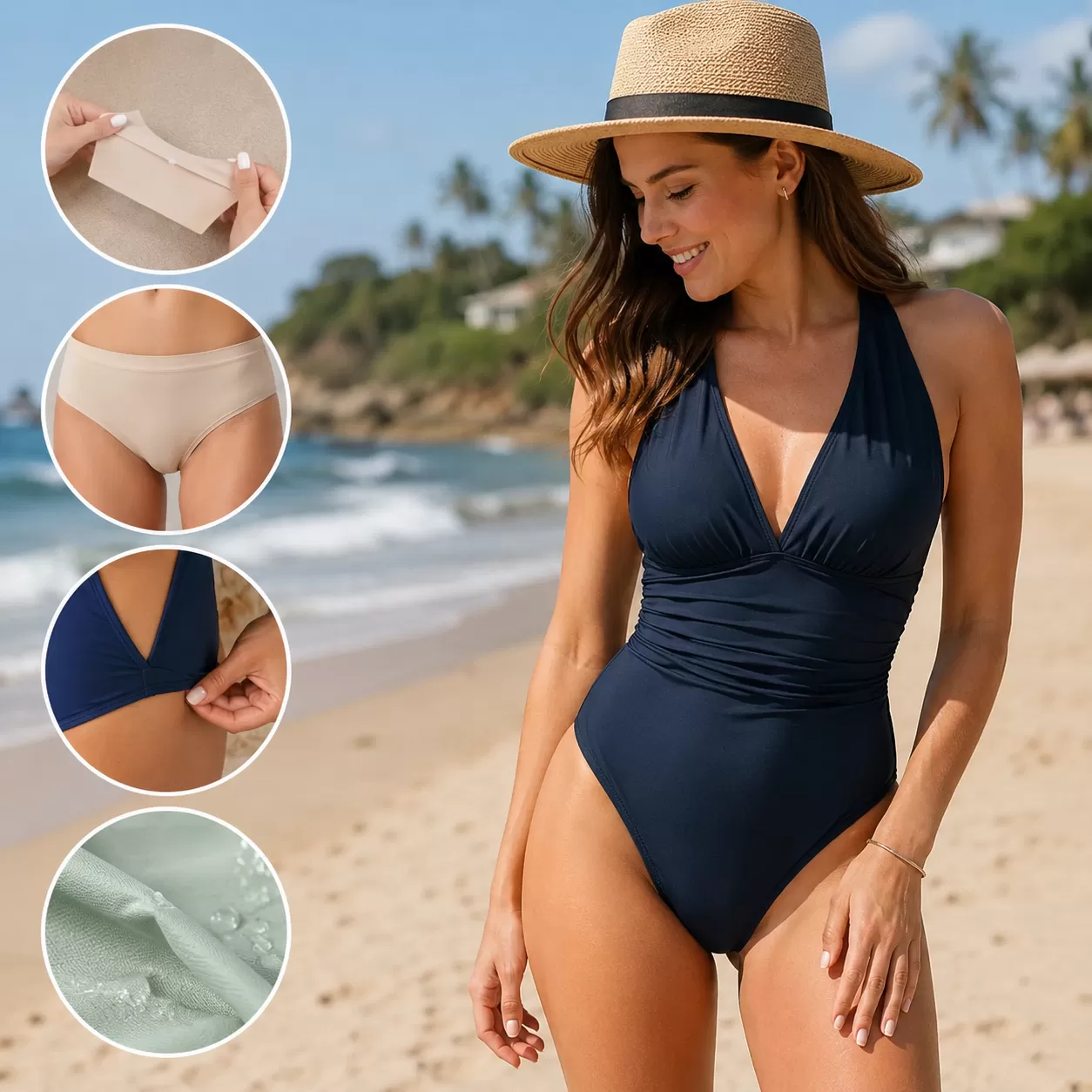
Dealing with an uncomfortable fit at the beach or pool can instantly ruin your day. Here are six practical, expert-approved strategies to ensure your swimwear fits flawlessly every single time.
1. No use of the centre seam
The simplest structural fix is to avoid the vertical front seam entirely. Seamless bikini bottoms distribute fabric evenly across the front without a line cutting into the skin.
- Look for bonded or welded edges instead of traditional stitched seams to keep the front flat and smooth.
2. Prioritise double layers and a wide gusset
Thin fabric is the enemy of a clean fit, so check the interior construction before you buy.
- Double-lined panels add structure and thickness that stop the fabric from shifting.
- A wide front lining or built-in gusset acts as a flat shield that stays smooth even when the fabric is wet.
- A premium nylon- or polyester-spandex blend in the ranges above retains its shape over repeated wear.
3. Get the fit right (torso and waist)
Many sizing problems happen because we focus on waist or hip measurements and ignore length.
- One-piece tip: If the torso is too short, the straps drag the whole suit up. Check that you can run a hand under the crotch panel without the straps biting into your shoulders.
- Between sizes? For length, size up; for the waist, fit it correctly rather than oversizing, because excess fabric causes its own bunching.
4. Use pattern, colour, and texture
For extra peace of mind, let visual cues help. Solid, light, shiny fabric reflects light in a way that highlights every fold.
- Darker shades such as black, navy, and deep olive naturally hide shadows and fit lines.
- Bold prints such as florals, abstracts, and geometrics break up the eye's read of any contour.
- Ribbed or textured fabric adds physical depth that makes minor fit issues far less visible.
5.Do Clever Styling
Choosing flattering swimsuit styles designed to camouflage or redirect fabric tension makes a massive difference.
| Style Feature | How It Helps Prevent Camel Toe |
|---|---|
| Ruched bikini bottoms | Gathered fabric adds volume and prevents tight pulling across the front. |
| Swim shorts and cover-ups | Provides complete, worry-free coverage for active beach days. |
| High-waisted bottoms | Shifts the fabric tension to the waist rather than pulling from the crotch. |
Quick DIY Hacks for an Emergency
Sadly, if you are already at the beach and notice a fit issue, use these quick, comfortable beachwear solutions to fix it on the spot:
- The Pantyliner Hack: Trim a thin pantyliner and stick it horizontally into the crotch lining of your dry suit to create an instant, firm barrier.
- Waterproof Inserts: Slide a removable bikini top pad into the bottom gusset for a quick, reusable shield that handles water perfectly.
- Adjust the Straps: If you are wearing a one-piece or a halter bikini bottom, loosen the vertical straps slightly to instantly relieve the upward pull.
The Ultimate Solution: How Berlook Approaches the Problem
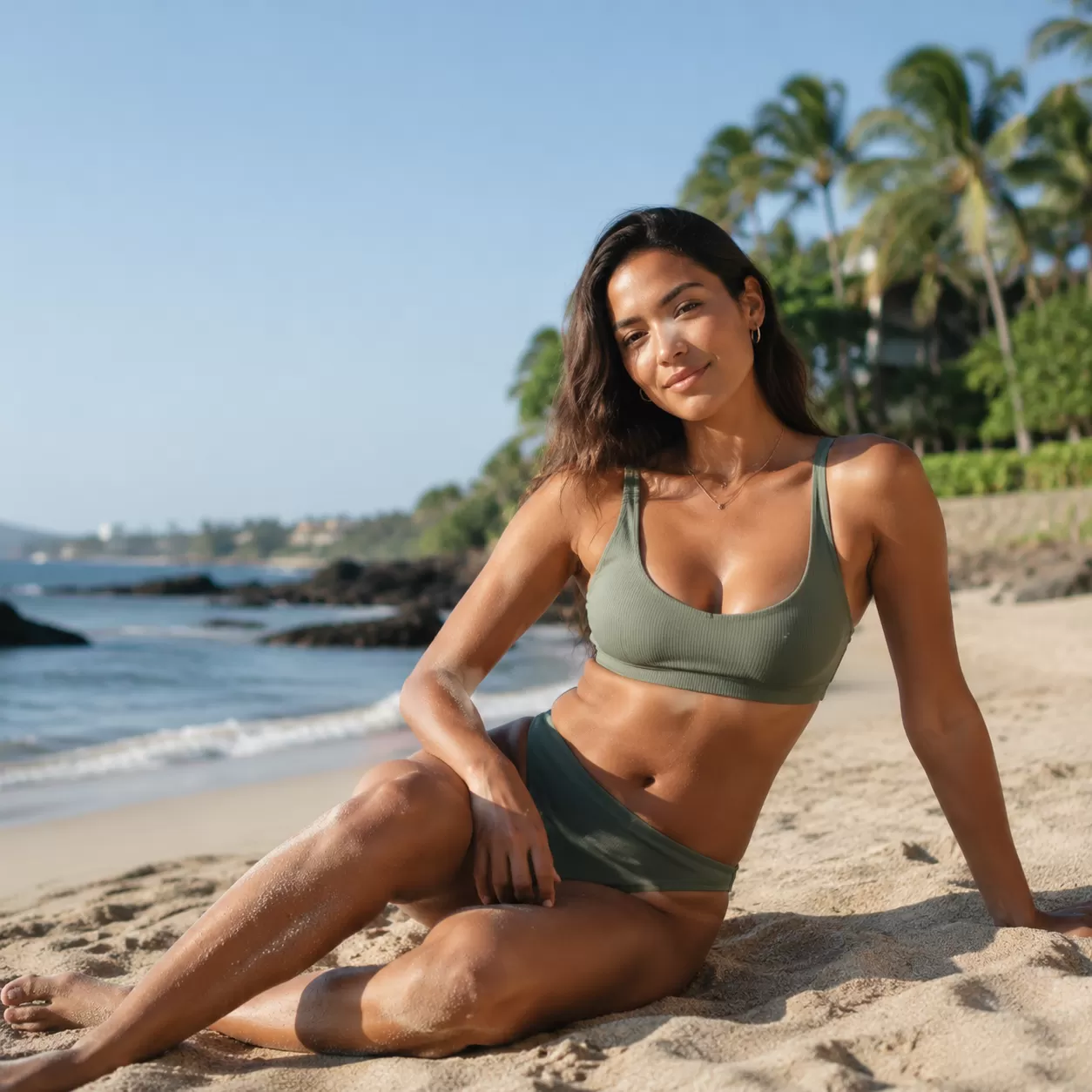
We designed Berlook to take the constant annoyances and self-consciousness out of a beach day. The construction choices below follow directly from the four root causes above.
Built for comfort
Our suits use a heavier, premium nylon-spandex knit chosen for a balance of stretch and support.
- Premium weight: We avoid the thin, cheap fabric that causes pulling, working in the denser end of the range described in Figure 2.
- Shape retention: The fabric holds its structure even when fully wet.
- Second-skin feel: Comfortable for all-day wear without digging in.
Thoughtful construction
We address the root causes directly by rethinking how each piece is cut and lined.
|
Feature |
Which root cause it solves |
|
Seamless / bonded front |
Removes the centre seam that guides fabric inward. |
|
Double-lined panels |
Adds structural thickness to prevent bunching and sheerness. |
|
Wide front lining |
Gives full coverage and stays flat against the body. |
|
Ruched bottoms |
Masks the area while adding a stylish lift. |
|
Torso-mapped one-pieces |
Balances torso length and waist rise to remove vertical pull. |
Sustainable materials
Comfortable swimwear should not come at the planet's expense. Berlook blends durable, heavier-weight construction with recycled nylon and ocean-bound plastics, so you get the shape retention that prevents fabric shifting along with a lower-impact material choice.
FAQs About Preventing Cameltoe in Swimsuits
Why does my bathing suit camel toe only happen when it gets wet?
Water heavy-loads the fabric. When cheap or thin materials absorb water, they lose their elasticity, sag, and cling tightly to your body. This suction effect pulls the fabric right into delicate areas, causing a bathing suit camel toe that wasn’t visible when dry.
Can a larger size prevent fabric bunching and cameltoe?
Going up a size rarely fixes the issue and often makes it worse. Sizing up creates excess material, leading to preventing fabric bunching problems. Loose, wet fabric shifts around easily and pools in the crotch area. Focus on finding a proper one-piece swimsuit fit guide or exact bottom measurements rather than just buying a bigger size.
Do seamless swimwear bottoms completely eliminate the problem?
High-quality seamless swimwear bottoms drastically reduce the risk, but they are not a 100% guarantee on their own. For complete protection, look for a combination of design elements:
- No-seam bikini bottoms to eliminate front cutting.
- A thick, high-quality swimwear crotch lining.
- Double-lined swimsuits that maintain structure under tension.
What is the quickest emergency fix for a bikini wardrobe malfunction?
If you are caught off guard at the beach, you can fix a bikini wardrobe malfunction fast with these comfortable beachwear solutions:
- The Pantyliner Hack: Dry the inside of the suit and stick a thin pantyliner vertically across the crotch guard to create an instant firm barrier.
- Waterproof Tape: Apply a small strip of apparel tape directly to the inside fabric to flatten the area.
- Quick Camouflage: Tie on swim shorts and cover-ups, or opt for ruched bikini bottoms that naturally hide lines.
Last reviewed: May 2026.Written by the Berlook design and product team, drawing on our in-house swimwear pattern-making and fabric-sourcing experience.
What Is Tankini Swimwear - Latest Guide to Fit and Coverage
The tankini swimwear was born out of a women's swimwear designer Anne Cole. She innovatively paired a tank-top-style upper with standard bikini bottoms, namely TANKINI.
This single design innovation gave women a modern one-piece alternative that didn't compromise on style or comfort.
How a Tankini Is Constructed
A tankini is a two-piece swimsuit that pairs a tank-top-style upper with bikini or swim bottoms — the top covers the midriff fully or partially, giving the coverage of a one-piece while retaining the two-piece convenience of separate sizing, easy bathroom access, and mix-and-match flexibility.
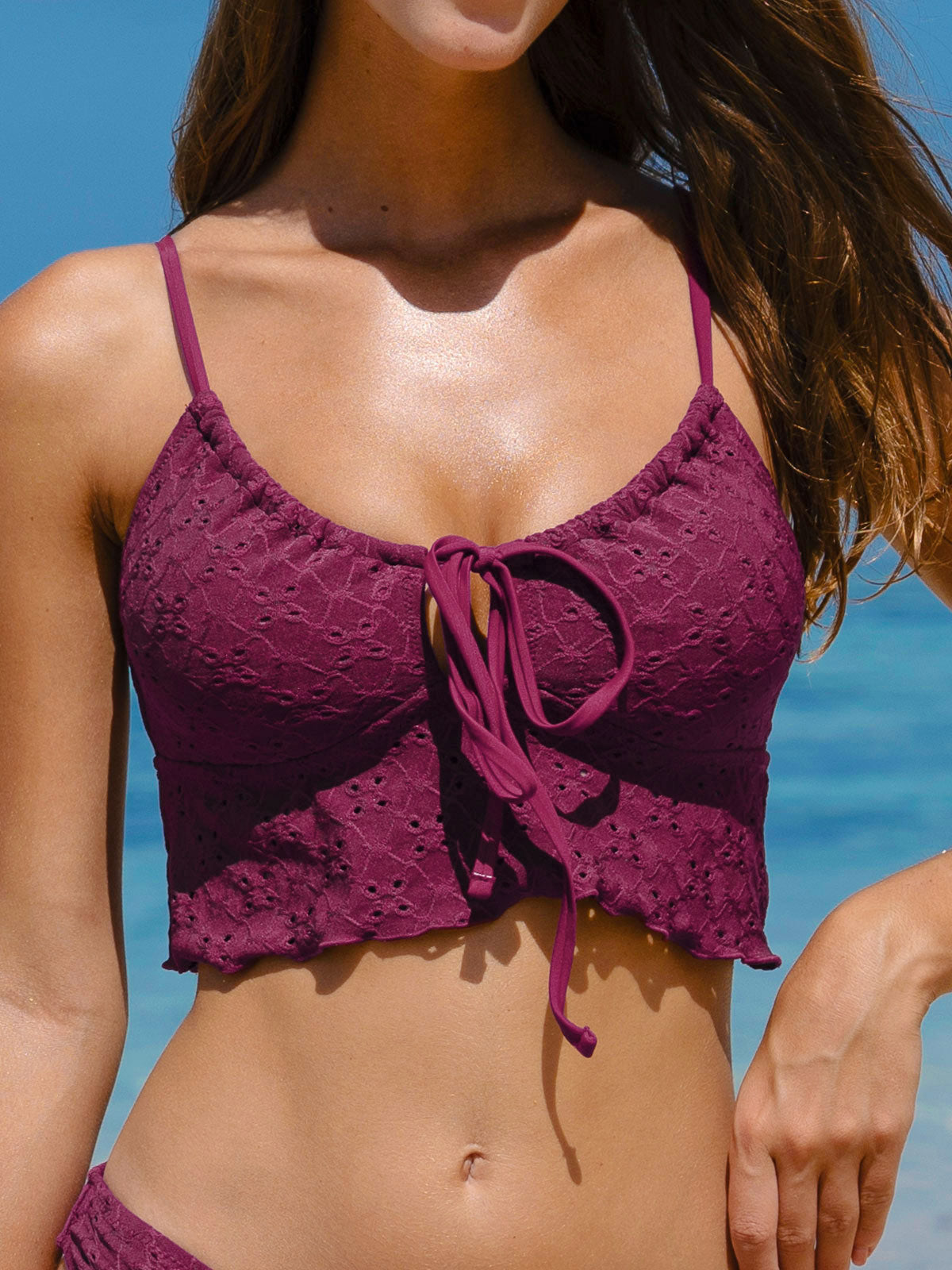
Editor's Pick
Burgundy Textured Tankini Top
A flattering, secure style made for comfort, support, and beach-day confidence.
Shop This Style →Best Match
Blue Shimmer Gold-Accented Tankini Top
Pair it with your favorite bikini top for an easy, confident swimwear look.
View Product →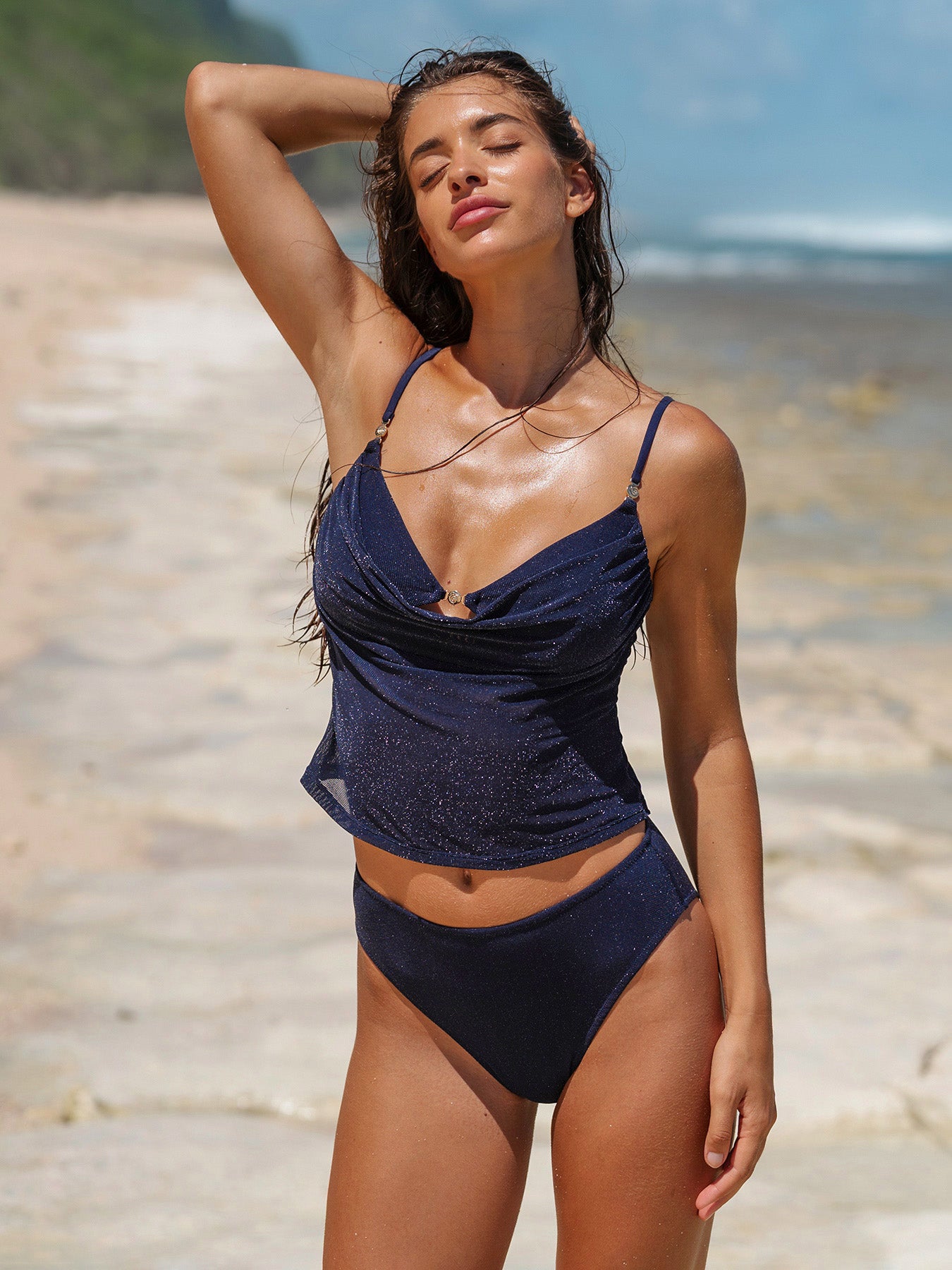
Further sepaking, the detailed features of tankini are:
- The top: A stretch-knit panel that extends from the bust or neckline down to anywhere between the natural waist and the high hip. The hem length is the primary variable that distinguishes tankini styles from one another.
- The bottom: Any standard bikini, swim short, high-waist, or skirt bottom. The top and bottom are independent garments — this is what enables mix-and-match sizing.
- Lining: Quality tankini tops include a built-in shelf bra or structured lining at the bust. Premium pieces use bonded or molded cup construction; budget pieces use a simple fabric shelf.
- Fabric: Most tankinis use a polyester-elastane (Lycra/spandex) blend. Higher-end pieces use recycled nylon or PBT (polybutylene terephthalate) yarn — a chlorine-resistant fiber that holds shape and color far longer than standard polyester under pool conditions.
Tankini vs. Bikini vs. One-Piece
A direct comparison:
|
Criteria |
Tankini |
Bikini |
One-Piece |
|
Pieces |
2 (tank top + bottoms) |
2 pieces |
1 piece |
|
Midriff Coverage |
Full or partial — your choice |
Minimal |
Full |
|
Sizing |
Top & bottom sized independently |
Top & bottom independent |
Single size; torso fit tricky |
|
Bathroom Ease |
Easy — no full removal |
Easy |
Requires full removal |
|
Active Movement |
High — stays secure |
Moderate — risk of shifting |
High — fully connected |
|
Style Flexibility |
High — mix & match freely |
High — wide variety |
Limited |
Although we know the differences among them, but how do we know when to choose a tankini? You can decide by where you'd wear them. The principle is simple:
Scenario 1: Active pool days & water sports
Provides secure fit for lap swimming, beach volleyball, or paddleboarding without wardrobe malfunction risk.
Scenario 2: Chasing kids at the beach
Complete peace of mind when bending, lifting, and running after little ones.
Scenario 3: Resort transitions
Toss on a skirt or shorts and move seamlessly from the water to boardwalk dining.
Scenario 4: Hard-to-fit proportions
Ideal if you need a different size for your top and bottom — something no one-piece can offer.
10 Types of Tankini Tops
The word 'tankini' covers a far wider range of silhouettes than most people realise. The hem length, neckline, strap configuration, and structural details combine to create distinct styles — each with different coverage levels, support architectures, and aesthetic identities. Here is the full taxonomy.
1. Longline Tankini Top

Coverage: Highest — hem falls to the high hip or beyond, fully covering the midriff and often the lower back.
Best for: Maximum coverage preference, tummy confidence, sun protection across the torso, postpartum wear, and women who want the appearance of a one-piece with two-piece convenience.
Key detail: Because the hem extends below the natural waist, longline tops must be cut with enough hem circumference to allow movement without pulling up during activity. Look for a relaxed or A-line hem — a straight-cut longline will ride up.
2. Cropped Tankini Top

Coverage: Medium — hem sits at or just above the natural waist, exposing a small strip of midriff.
Best for: Women who want coverage without a full tank length; athletic builds who want to show a defined waist; and anyone mixing with high-waisted bottoms for a coordinated, navel-covered look.
Key detail: The cropped tankini is the most versatile silhouette for mix-and-match pairing. A cropped top with high-waist bottoms gives the same coverage as a longline while allowing more proportional play.
3. Rash Guard Tankini

Coverage: Maximum — this style extends the tank concept into a structured, often long-sleeved or three-quarter-sleeve form, frequently rated UPF 50+.
Best for: Sun protection priority, water sports, families, post-surgical recovery, and women with photosensitivity conditions or a history of skin cancer.
Key detail: Unlike a standard tankini, the rash guard hybrid prioritises UV blocking over silhouette. Look for flatlock seams (seams lying flat, not standing up) — standard raised seams cause skin abrasion during repetitive paddle strokes or swimming laps.
4. Wrap Tankini Top

Coverage: Medium — the wrap construction creates a V-shaped front opening that can be cinched tighter or left looser depending on comfort preference.
Best for: Hourglass figures who want to highlight a defined waist; women who want adjustable neckline depth; and those transitioning between poolside and resort dining since the wrap silhouette reads as intentionally styled.
Key detail: The wrap style naturally creates bust enhancement through diagonal fabric tension. For larger busts, confirm the top has an internal tie or button closure — a wrap held only by external ties can shift in water.
5. Ruched or Shirred Tankini Top

Coverage: Medium to high — the gathered fabric creates visual texture that simultaneously camouflages and defines.
Best for: Rectangle and oval body shapes that want to create the illusion of curves; women who find flat-panel tanks unflattering; and post-pregnancy bodies where fabric needs to accommodate shape variation without clinging.
Key detail: Ruching works through fabric volume — the gathers draw the eye away from the body contour beneath. Vertical ruching lengthens; horizontal ruching adds width. Choose vertical ruching along the front panel for a slimming, elongating effect.
6. Blouson Tankini Top

Coverage: High — the fabric blouses out from the chest or underbust band, creating a loose, flowing silhouette over the midriff.
Best for: Apple and oval shapes who want comfortable, non-clinging coverage over the midsection; women who prefer a relaxed, resort-casual aesthetic over a structured, athletic look.
Key detail: The blouson effect depends on the fit of the elastic or band that holds the fabric in place — usually at the underbust or natural waist. If this band sits too low, the top looks shapeless; too high, and it shortens the torso. The band should sit at your natural underbust line for the most flattering drape.
7. Bandeau Tankini Top

Coverage: Medium — a strapless or minimal-strap configuration with a full-length tank panel below.
Best for: Avoiding tan lines; inverted triangle shapes who want to reduce shoulder emphasis; women who want the aesthetic of a strapless suit without the coverage anxiety of a strapless bikini.
Key detail: Strapless bandeau tankinis require either boning, silicone grip tape at the top edge, or an underwire in the panel to stay in place during activity. A bandeau tankini without these structural features is a lounging suit, not an activity suit.
8. Halter Tankini Top

Coverage: Medium to high — the halter neckline concentrates weight at the neck, with a tank panel providing full midriff coverage below.
Best for: Triangle (pear) shapes who want to draw attention upward; women with smaller busts who want bust-enhancing lift; resort-to-beach transitions where the halter reads as intentionally fashionable.
Key detail: Halter styles distribute bust weight through a single neck tie or fixed neck band — comfortable for B–C cups, potentially fatiguing for D+ cups over a full beach day. For larger busts, look for halter tops with additional side-body support straps rather than neck-only attachment.
9. Underwire Tankini Top

Coverage: Medium to high — identical hem range to other tankini styles, but with a structured underwire channel built into the bust.
Best for: D-cup and above; women who find soft-cup swim tops insufficient; anyone who wears underwire in everyday bras and finds swimwear without it uncomfortable.
Key detail: Swimwear underwire is not the same as lingerie underwire — it must be coated or fully encased in the fabric channel to prevent corrosion from salt water and chlorine. When evaluating an underwire tankini, press the wire channel: a good wire will be smooth and fully enclosed with no exposed metal at the channel ends.
10. High-Neck Tankini Top

Coverage: High — the racerback eliminates traditional shoulder straps; the high-neck closes the neckline entirely.
Best for: Active water sports (lap swimming, paddleboarding, surfing); women who experience shoulder strap slipping; anyone prioritising maximum security over styling.
Key detail: The racerback configuration moves the shoulder load to the centre-back panel rather than two independent shoulder straps. This is structurally stronger for repetitive overhead movement — specifically freestyle and backstroke swimming, and paddle sports. If active use is your primary scenario, racerback or high-neck is the category to shop first.
Who Tankinis Are For?
The beauty of tankini swimwear is its ability to balance proportions while keeping you completely comfortable. I design our collection to celebrate real bodies, ensuring every cut serves a structural purpose.
Here is how to choose the perfect full coverage bathing suit top based on your specific shape.
The Triangle (Pear Shape)
If you carry your weight primarily in your hips and thighs, the goal is to draw the eye upward and balance your lower half.
- Best Styles: Halter necklines, vibrant patterns, and tops with eye-catching chest details.
- The Strategy: Pair these eye-catching tops with dark, solid bikini bottoms to instantly balance your proportions.
The Inverted Triangle
For broader shoulders and narrower hips, you want a tank top style that offers excellent framing and security.
- Best Styles: Clean square necklines and thick, supportive shoulder straps.
- The Strategy: Avoid spaghetti straps that can dig in. Instead, opt for clean lines that streamline your upper body while providing effortless bust support swim tops.
The Rectangle / Athletic Frame
If your bust, waist, and hips are relatively aligned, you can use clever fabric manipulation to create the illusion of curves.
- Best Styles: Ruched, cinched, or blouson-style tankini tops.
- The Strategy: Side tie adjustments and gentle gathering break up straight lines, adding soft, feminine dimension exactly where you want it.
The Oval / Apple Shape
For those who carry weight around the midsection, a one-piece alternative should offer both comfort and confidence.
- Best Styles: Asymmetric cuts, gentle shirring, and built-in tummy control swimwear linings.
- The Strategy: Look for strategically placed tummy-smoothing fabrics that skim the body rather than cling to it, giving you a smooth, comfortable fit all day long.
The Hourglass
If you have a naturally defined waist with a balanced bust and hips, your goal is to highlight that natural alignment.
- Best Styles: Fitted, structural cuts and wrap-style tops.
- The Strategy: Embrace mix and match swimwear by pairing a contoured top with high-waisted swim bottoms to accentuate your waistline beautifully.
Extra Tip: Address Bust Support & The D-Cup Dilemma
Finding a full-coverage bathing suit that actually supports a larger bust is one of the most common and least well-solved problems in swimwear.
A standard tank top construction often falls short for D-cup wearers. Quality tankini tops address this with architecture built directly into the garment:
- Underwire options: Provides the same lift and structure as an everyday bra. Look for fully encased, corrosion-resistant wire.
- Molded cups: Shape, modesty, and contouring without shifting.
- Built-in shelf bras: Wide elastic bands that sit flat against the ribcage for reliable wireless support.
- Thick adjustable shoulder straps: Distributes weight evenly and prevents neck strain and strap dig-in.
How to Choose a Tankini in 5 Steps
Choosing the right tankini involves five sequential decisions. Work through them in order — each one narrows your options meaningfully.
Step 1 — Decide Your Primary Use Case
Your primary use case determines which structural features are non-negotiable, and which are nice-to-have.
|
Primary Use |
Non-Negotiable Feature |
Recommended Style |
|
Lap swimming / competitive |
Stays in place during stroke; no drag |
Racerback tankini + performance bikini bottom |
|
Paddle sports / surfing |
Arms free; no strap slipping |
Racerback or high-neck + athletic shorts |
|
Beach lounging |
Comfort over hours; UV coverage |
Longline or blouson + any bottom |
|
Resort / pool socialising |
Looks intentional; easy transitions |
Wrap, halter, or cropped + high-waist |
|
Family / kids beach day |
Active coverage; bathroom speed |
Longline with wide straps + shorts |
Step 2 — Choose Your Coverage Level
Tankini coverage is primarily determined by hem length. Know which level you want before shopping, because it is the most important filter:
- Full midriff coverage (longline / blouson): Hem at high hip; full torso covered. Choose this if you want the look of a one-piece with two-piece convenience.
- Natural waist coverage (standard tankini): Hem at natural waist; a small gap between top and bottom when you move. The most common configuration.
- Cropped coverage: Hem above the natural waist; a visible strip of midriff exposed when styled with low- or mid-rise bottoms. Pair with high-waist bottoms for complete coverage if preferred.
Pro tip: Coverage and bottoms work together.
Step 3 — Identify Your Support Requirement
Be honest about what your bust needs from a swimsuit — then look specifically for those structural features:
|
Cup Size |
Minimum Support Required |
What to Look For |
|
AA – B |
Shelf bra or light lining |
Most styles work; bandeau and halter give aesthetic lift |
|
C |
Shelf bra with wide band or soft cup |
Any style with built-in shelf bra and adjustable straps |
|
D |
Molded cup or underwire |
Underwire tankini or molded cup construction; thick adjustable straps |
|
DD / E+ |
Underwire with side-body support |
Underwire tankini with side panels; avoid halter-only attachment |
Step 4 — Get the Fit Right
Tankini tops and bottoms are sized independently — this is the format's primary advantage. Use it:
- Measure both: Take your bust and underbust for the top; your hip and waist for the bottom. If one measurement falls in a different size bracket than the other, size up in that category.
- Check strap adjustability: Straps should be fully adjustable. If a strap cannot be shortened enough to prevent the bust panel from pulling away from your chest, the top is too large.
- Test the hem: When you raise your arms above your head, the hem should move but not ride up past your natural waist (for standard coverage) or hip (for longline coverage). If it does, size down in the top or choose a style with a longer hem.
- Sit and bend: The top should remain in the same position when you sit down or bend forward. A top that gapes at the bust or rides up at the hem when seated is the wrong style or size.
|
⚠ The most common tankini fit mistake: Buying the top and bottom as a set in a single size because they come packaged together. Always check that your bust measurement and hip measurement correspond to the same size. If they don't, buy the top and bottom separately and size each appropriately — most quality tankini brands sell separates. |
Step 5 — Choose Your Bottom Style
The bottom silhouette completes the look and significantly affects both coverage and styling flexibility:
|
Bottom Style |
Best With |
Styling Note |
|
High-Waisted Bikini |
Cropped tankini top |
Creates a waist-defined silhouette; retro-modern aesthetic |
|
Classic Bikini Bottom |
Longline or standard top |
Maximum versatility; choose cut (brief, cheeky, full) based on comfort preference |
|
Athletic Swim Shorts |
Racerback or high-neck top |
Best for active sports; provides thigh coverage for water activities |
|
Swim Skirt |
Any top style |
Resort and boardwalk transitions; most flattering with a fitted (not blouson) top |
|
High-Waisted Shorts |
Longline or cropped top |
Maximum active coverage with a contemporary silhouette |
Frequently Asked Questions
Is a tankini considered a two-piece swimsuit?
Yes. A tankini delivers the same two-piece layout as a traditional bikini — separate top and bottom — but replaces the standard bikini top with a tank-style cut. You get the easy-wearing benefits of a two-piece with full-coverage midriff protection.
Does a tankini offer enough tummy control and support?
Many modern tankini tops include built-in tummy-control technology — mesh lining, ruched panels, or structured shelf bras. For bust support, quality pieces offer molded cups, underwire, and thick adjustable straps, making it straightforward to find a well-supported option for any cup size.
Can you swim laps or do water sports in a tankini?
Yes — with the right style. For active water sports, choose a racerback or high-neck tankini with performance bikini bottoms or swim shorts. The separate sizing of top and bottom means the suit can fit your measurements precisely, minimising movement and drag in the water.
How Does Period Swimwear Work? Everything You Need to Know
Summer days at the beach should feel carefree — but for many people, period anxiety gets in the way. Period swimwear is a category of specialized garments engineered to absorb menstrual flow while you swim, without relying on tampons or menstrual cups.
This guide explains the textile science behind the technology, addresses common limitations honestly, and offers practical guidance to help you decide whether period swimwear is right for your needs.
Key Takeaways
- Period swimwear uses a multi-layer fabric construction: moisture-wicking inner layer, absorbent core, and hydrophobic outer barrier.
- The outer layer repels external water while the inner layers absorb menstrual fluid — opposing fiber treatments on separate layers.
- Most styles hold approximately 1–2 regular tampons' worth of fluid (roughly 5–12 ml); capacity varies by brand and style.
- Best suited for light-to-medium flow. For heavy flow, works well as a backup layer or with more frequent changes.
- Realistic wear time is 2–6 hours, depending on personal flow rate — not a universal figure.
- Cold-water rinsing immediately after use is essential to protect the absorbent layers.
The Science Behind How Period Swimwear Works
The most common question is: how does period swimwear absorb blood but not water? At first glance, a fabric that selectively absorbs one fluid while repelling another seems counterintuitive. The answer lies in how different textile layers are treated at the fiber level.
Understanding the Multi-Layered Fabric System
High-quality period swimwear — including styles from Berlook — relies on a three-to-four layer construction, each layer serving a distinct role:
- Inner (skin-facing) layer: A moisture-wicking knit — typically polyester microfiber or a polyester-elastane blend — pulls fluid away from the skin and channels it inward, keeping this layer relatively dry against the body.
- Absorbent core: Usually a tightly woven or needle-punched nonwoven fabric, often incorporating cellulose or superabsorbent polymers. Its fiber density determines capacity limits.
- Barrier / leak-proof layer: A thin laminated or tightly woven hydrophobic membrane sits between the absorbent core and the outer shell, preventing absorbed fluid from migrating outward into the water.
- Outer shell: The main swimsuit fabric — typically nylon-spandex or polyester-spandex — treated with a Durable Water Repellent (DWR) finish that causes external water to bead off rather than penetrate.
The Difference Between Absorption and Water Repellency
A common misconception is that the entire swimsuit absorbs everything it contacts. In practice, internal absorption and external water repellency are achieved through opposing fiber chemistry applied to separate layers:
- The inner and core layers are hydrophilic — they attract and hold water-based fluids like menstrual blood.
- The outer shell is treated to be hydrophobic — it actively resists wetting.
These properties coexist because they are applied to structurally separate layers. The gusset — the reinforced liner area — is where all four layers overlap, making it the most technically engineered part of the garment.
Why Period Swimwear Does Not Swell or Become Heavy in Water
Standard absorbent materials like disposable pad cellulose are hydrophilic throughout their entire structure. Submerge one in water and it absorbs everything indiscriminately, becoming heavy and bulky.
Period swimwear avoids this because the absorbent core is encased within hydrophobic layers on both sides. External water is physically blocked from reaching it. The core fills gradually with menstrual fluid during use, but this happens slowly and selectively — typically adding just 5–12 ml over several hours — which is imperceptible in terms of fit or weight.
Addressing Common Questions About Functionality

Do Period Bathing Suits Actually Work for Swimming?
Yes — with important caveats. Period swimwear works reliably for most swimmers on light-to-medium flow days, containing flow through typical movement including lap swimming, diving, and active water play.
That said, "works" depends on expectation. Period swimwear is not designed to function identically to a tampon or cup. Under dynamic water pressure — a forceful dive or extended underwater swimming — some leakage into the water can occur if the absorbent core is at or near capacity. These suits work best when worn for finite sessions, not continuously all day without changing.
Can You Swim in Period Swimwear Without a Tampon?
For many people, yes — on light and medium flow days, period swimwear can serve as a standalone solution. For heavier flow, very active swim styles, or longer uninterrupted sessions, pairing the swimwear with a menstrual cup or tampon provides more reliable protection. Your experience will depend on anatomy, flow rate, and activity level.
Does Period Swimwear Work for Heavy Flow?
This is where honest expectations matter most. The absorbent core in most styles is rated to hold approximately 5–12 ml of fluid — roughly equivalent to 1–2 regular tampons. Published capacity figures vary significantly between brands, and many do not disclose testing methodology or conditions.
| Flow Level | Est. Hourly Volume | Recommended Approach | Practical Confidence |
|---|---|---|---|
| Light (1–4 ml/day) | < 1 ml/hr | Standalone | High |
| Medium (4–8 ml/day) | ~1 ml/hr | Standalone; change every 3–4 hrs | High |
| Heavy (8–16+ ml/day) | 2–4 ml/hr | Pair with cup/tampon, or change frequently | Moderate |
| Very Heavy / Flooding | Unpredictable surges | Swimwear as backup only | Lower — close monitoring needed |
Flow volumes are approximations drawn from clinical menstruation research (Hallberg et al., 1966; ACOG guidance), not swimwear brand specifications. Individual cycles vary substantially.
Spotlight on Berlook Swimwear Technology

Berlook integrates its period-proof liner system directly into swimsuit silhouettes — bikini bottoms, one-pieces, and swim shorts — so the garment looks and fits like standard swimwear from the outside.
Design Philosophy
The brand's approach centres on keeping the protective gusset as thin and form-fitting as possible — a genuine engineering challenge, given that absorbent cores add bulk. Berlook achieves this by using high-density, low-profile core materials rather than thicker pad constructions common in some period underwear styles. The result is a suit that avoids visible lines or unusual silhouette under normal wear conditions.
Key Features of Berlook Period-Proof Liners
- Moisture-wicking inner fabric to minimise skin contact with absorbed fluid
- Absorbent core rated for light-to-medium flow — specific ml capacity varies by style; check individual product listings
- Leak-resistant barrier layer to prevent bleed-through to the outer shell
- Chlorine- and saltwater-resistant outer fabric to preserve DWR treatment across multiple uses
Important usage note
Berlook swimwear is designed for everyday recreational swimming — not competitive or high-intensity aquatic sport. Users engaged in competitive lap swimming or surfing should treat these garments as a supplementary layer rather than a primary containment method.Comfort and Security During Water Activities
The gusset construction uses stretch fabrics to maintain close contact with the body during movement, which is important for leak resistance — a loose gusset creates gaps where fluid can escape before being absorbed. For this reason, accurate sizing matters; most period swimwear brands recommend sizing for a snug fit rather than sizing up.
Practical Usage and Maintenance Tips
How Long Can You Wear Period Swimwear?
Wear duration depends on your flow rate, not a fixed-hour rule. Most users find 2–4 hours realistic on medium flow days; on light flow days, up to 4–6 hours may be comfortable. The "4–8 hours" figure sometimes cited by brands represents the outer capacity limit — not a general recommendation.
Practical signals that it's time to change or rinse:
- You feel dampness or warmth at the gusset
- You've been swimming actively for over 3 hours on a medium flow day
- You're approaching the end of a long beach or pool session
Keeping a second suit in your bag is the simplest strategy for longer outings.
Best Practices for Rinsing and Washing
The absorbent core is the most chemically sensitive part of the garment. Chlorine, salt, heat, and enzyme-based detergents all degrade it over time. Follow these steps:
- Rinse immediately in cold fresh water after every use. Cold water prevents proteins in menstrual fluid from setting into the fibres; warm water can cause staining and odour that become difficult to remove.
- Hand wash or use a mesh laundry bag on a delicate, cold-water machine cycle with a mild, fragrance-free detergent. Avoid enzyme-based detergents, which degrade absorbent fibre structures over time.
- Never use bleach or fabric softeners. Bleach degrades elastic and DWR coatings. Fabric softeners coat fibres with a hydrophobic film, reducing the inner layer's wicking ability.
- Air dry only, away from direct sunlight. UV exposure and dryer heat degrade spandex elasticity and DWR treatments, shortening the garment's usable lifespan.
Storage and Longevity
Store your suit fully dry and flat or loosely folded in a cool, dry location. Compressing the gusset under weight for extended periods can create permanent creases in the core material, which may create thin spots in protection. With correct care, most period swimwear is designed to retain performance for 2–3 seasons of regular use, though this varies by brand and use frequency.
How Period Swimwear Compares to Alternatives
| Product | Works Underwater? | Capacity | Reusable | Best For |
|---|---|---|---|---|
| Tampon | Yes | Medium–High | No | All flow levels; competitive swimming |
| Menstrual cup | Yes | High | Yes | Heavy flow; longer sessions |
| Period swimwear | Yes (light–medium flow) | Low–Medium | Yes | Casual swimming; backup protection |
| Standard pad | No | Medium–High | No | Out-of-water only |
| Period underwear | No (not water-rated) | Low–Medium | Yes | Daily wear; not intended for swimming |
Conclusion
Period swimwear addresses a real need: comfortable, discreet menstrual protection for recreational water activities. The multi-layer construction — combining hydrophilic core materials with hydrophobic outer treatments — is well-engineered for light-to-medium flow management during typical swim sessions.
The key is matching the product to your actual needs. On light or medium flow days, a well-fitting suit from a brand like Berlook can serve as a standalone option. On heavier days, it works most reliably as a supplementary layer alongside an internal product.
Before purchasing, check individual product capacity specifications, size guides, and washing instructions. Capacity figures and wear-time ranges are approximations — treat them as starting points, calibrated to your own experience.
Frequently Asked Questions
Do period bathing suits actually work?
Yes, within the right conditions. Period swimwear works reliably for light-to-medium flow during recreational swimming sessions of a few hours. It uses a multi-layer construction — moisture-wicking inner fabric, an absorbent core, and a water-repellent outer barrier — to contain menstrual flow while repelling pool or ocean water. It is less reliable for heavy flow, extended sessions without changing, or competitive aquatic activity.
How does period swimwear absorb blood but not water?
The two functions are achieved by different layers with opposing fibre treatments. The inner and core layers are hydrophilic (they attract and hold fluid), while the outer shell is treated with a Durable Water Repellent (DWR) coating that causes external water to bead off. Because these are structurally separate layers, external water is blocked before it reaches the absorbent core.
Can you swim in period swimwear without a tampon?
On light or medium flow days, many people find period swimwear sufficient as a standalone solution. For heavy flow, more vigorous swimming styles, or sessions longer than 2–3 hours, pairing the swimwear with a menstrual cup or tampon provides more reliable protection. Individual results vary based on anatomy and flow rate.
Does period swimwear work for heavy flow?
Most period swimwear styles hold approximately 5–12 ml of fluid — equivalent to 1–2 regular tampons. This is sufficient for many light and medium flow users, but heavy flow can exceed this capacity within a couple of hours. For heavy flow days, period swimwear works best as a backup layer to an internal product, or with more frequent suit changes.
How long can you wear period swimwear?
Wear time depends on your personal flow rate. On light flow days, 4–6 hours is realistic for many users; on medium flow, 2–4 hours is a practical guideline before rinsing or changing. The capacity limits of the suit — not a fixed time — are what determine when a change is needed. Monitor comfort, not the clock alone.
Why doesn't period swimwear expand or get heavy in water?
The absorbent core is encased on both sides by hydrophobic fabric layers, blocking external water from reaching it. Unlike disposable pads, which are hydrophilic throughout and absorb any water they contact, the core in period swimwear only fills from the body-facing side. The total volume added from menstrual fluid (typically 5–12 ml over a session) is too small to produce a noticeable change in weight or fit.
What are the best practices for washing period swimwear?
Rinse immediately in cold fresh water after every use to prevent proteins from setting into the fibres. Machine wash on a delicate cold cycle in a mesh laundry bag with mild, fragrance-free detergent — avoid enzyme-based cleaners, bleach, and fabric softeners, all of which degrade the technical fabrics. Always air dry in shade; heat and UV exposure shorten the lifespan of both the elastic and the water-repellent finish.
Safe Swimwear Colours for Visibility in 2026
Most people choose a swimsuit based on style, trends, or skin tone. But do you know the swimwear colour could actually save a life?
The truth is, underwater visibility drops dramatically just inches below the surface, and those trendy, muted tones can completely vanish. Whether you are focusing on water safety for kids at a backyard pool or practicing open water safety at the beach, your gear matters.
That is why we are diving into the data—including the groundbreaking Alive Solutions swimsuit test—to break down how high-visibility bathing suits pierce through water surface agitation and prevent tragedies.
From the unmatched safety of a neon swimsuit to the dangerous camouflage of dark blues and greens, this guide will change the way you shop for summer.
Let’s dive right in.
The Science: Swimwear Colours Change Underwater
When you look at a swimsuit on a hanger, you see its true shade. But the moment that fabric submerges, everything changes. Water acts as a powerful natural filter, absorbing light waves and altering how human eyes perceive color. If you want to keep your family secure around the water, understanding safe swimwear colours starts with the physics of light absorption.
Light Absorption Patterns
Water absorbs different wavelengths of light at varying rates. Red is the longest wavelength on the visible spectrum and the very first to disappear underwater, often turning into a dull gray or black just a few feet below the surface. As depth increases, orange, yellow, and green fade away next.
- 0–5 Feet: Reds begin to dull rapidly.
- 5–10 Feet: Oranges and yellows lose their vibrancy.
- 10+ Feet: Most standard colors morph into dark shadows or blend entirely into the background.
Fluorescent vs. Standard Dyes
To combat this disappearing act, the type of fabric dye matters immensely. Standard pigments rely on reflected ambient light, making them highly susceptible to fading underwater. Fluorescent dyes, however, work differently. They absorb invisible ultraviolet light and re-emit it as lower-energy visible light. This is why neon swimwear appears to glow; it actively creates its own visibility, making high-visibility bathing suits essential for quick identification during an emergency.
The Illusion of Surface Agitation
An open, calm pool is easy to see through, but real-world swimming conditions are rarely still. Wind, splashing, and swimming create surface agitation, which acts like a frosted glass lens.
- Turbulence: Waves and bubbles reflect light away from the eye, masking anything beneath them.
- The Camouflage Effect: Dark or muted tones instantly blend into the shadows created by ripples.
- The Neon Advantage: Only highly vibrant, fluorescent shades can punch through the distortion of churning water to remain visible to parents and lifeguards.
The Safe Swimwear Colour Spectrum
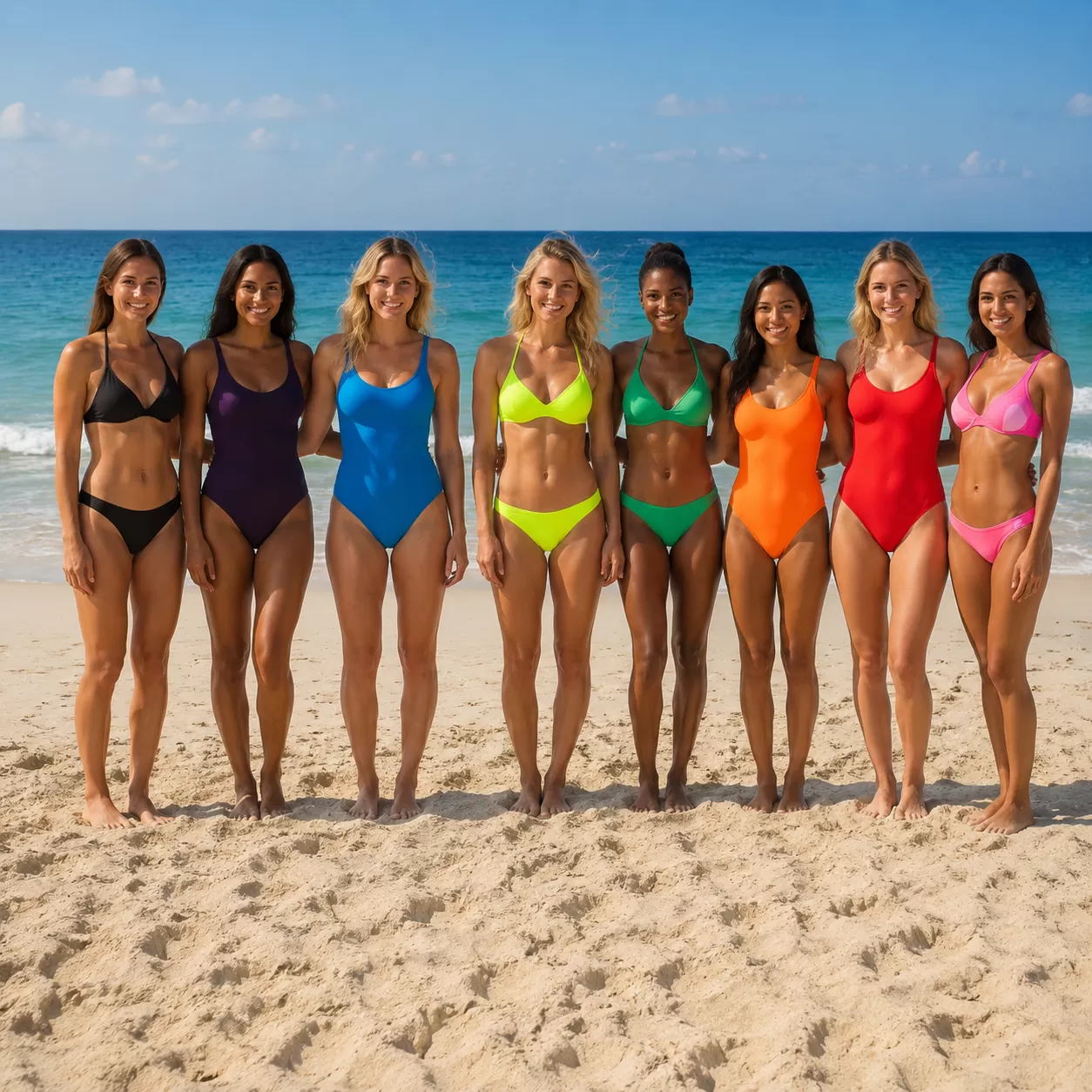
When we look at safe swimwear colours, the data shows a massive divide between shades that save lives and shades that blend into the background. Choosing the right hue isn’t just about fashion; it is a critical choice for underwater visibility and drowning prevention. Through rigorous testing, we have categorized how different shades perform when submerged.
The Unrivaled Winners (High-Visibility Outperformers)
For maximum safety in the water, neon swimwear is the undisputed champion. These shades remain highly visible even through water surface agitation and at greater depths.
- Neon Orange: The absolute top performer across all environments, including pools and open water.
- Neon Pink: Highly visible in traditional blue-bottomed pools, offering an excellent contrast.
- Neon Lime Green & Bright Yellow: Excellent choices for high-visibility bathing suits that stand out instantly to lifeguards and parents.
The Dangerous Losers (Low-Visibility Camouflage)
Many popular fashion colors completely disappear underwater, making it nearly impossible to spot a swimmer in distress. Muted tones vs. neon testing proves that dark and natural tones act as camouflage.
| Risk Level | Colors to Avoid | Why They Are Dangerous |
|---|---|---|
| Extreme Risk | White, Light Blue | They blend perfectly with pool liners, clouds, and water reflections, making the swimmer invisible. |
| High Risk | Dark Blue, Black, Grey | These shades look exactly like shadows or debris at the bottom of a pool or lake. |
| High Risk | Dark Green, Brown | They match underwater algae, silt, and weeds, completely erasing the swimmer from view. |
Note: People often ask, is purple a safe swim color? The answer is generally no. While it looks bright on the rack, dark purple quickly mimics deep shadows underwater, while light lavender fades into the reflection of the water surface. Stick to neon shades for true water safety for kids and adults alike.
Choose Safe Swimwear Colours for Your Destination
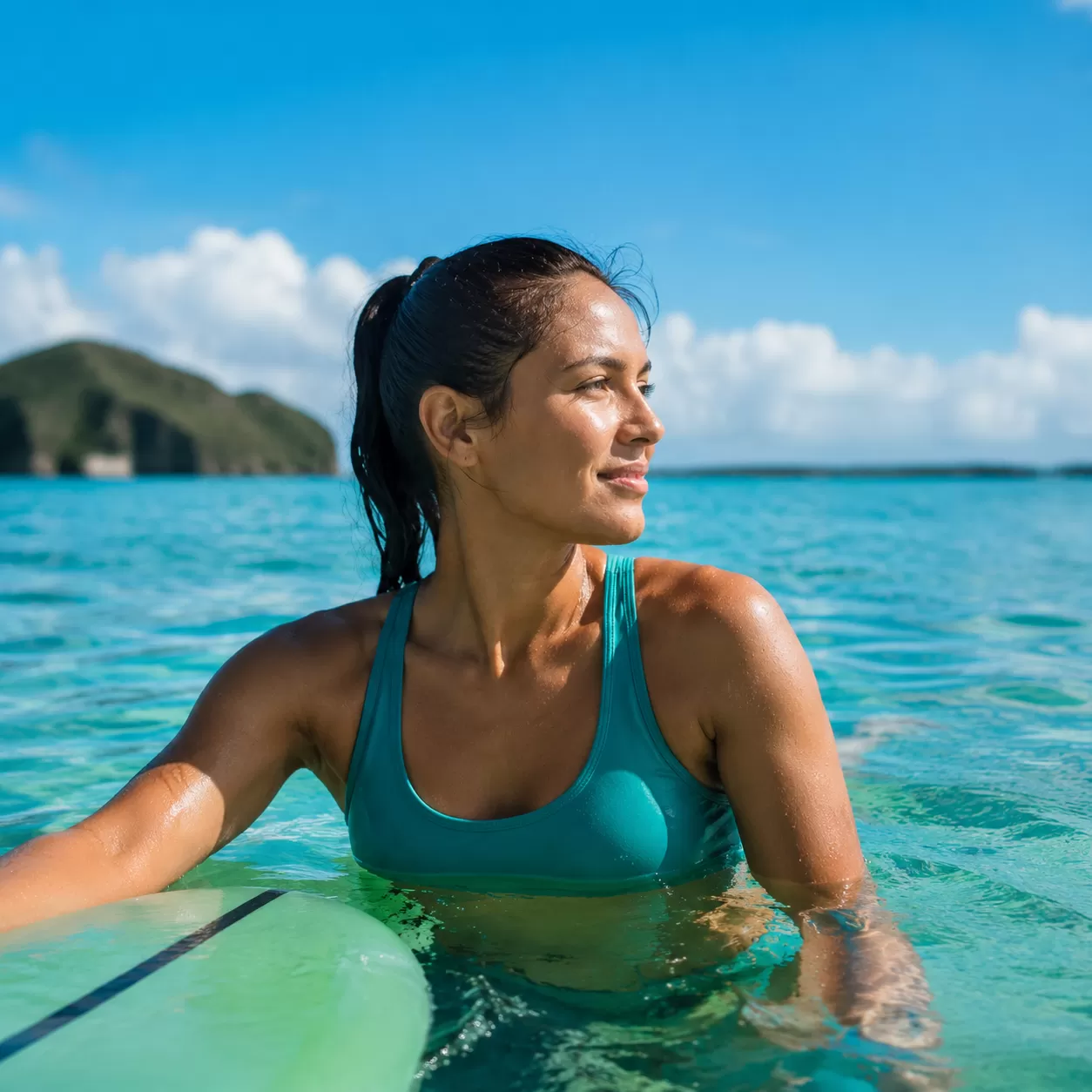
Where you swim matters just as much as what you wear. A shade that pops in a backyard pool can completely disappear in a lake or the ocean. To ensure maximum underwater visibility, we need to match our safe swimwear colours to the specific environment.
1. Backyard & Public Pools (Controlled, Light Bottoms)
Standard swimming pools with light blue or white bottoms offer the best contrast, but water surface agitation from splashing can still create blind spots.
- Top Picks: Neon pink and neon orange offer the highest visibility against light blue backgrounds.
- What to Avoid: Blue and white completely vanish. Muted tones vs. neon tests show that pastel shades blend into the reflected light on the pool floor, making drowning prevention much harder.
2. Lakes, Ponds, & Rivers (Murky Water, Silt, Algae)
Open water safety requires an entirely different strategy due to dark, green, or brownish water caused by tech-heavy silt and algae.
- Top Picks: Neon orange, neon green, and neon yellow are the absolute winners here. They cut through the murky depths and stay visible from the shore.
- What to Avoid: Do not wear blue, black, or grey. Even bright pink can look like a shadow once it drops a few feet below the surface in dark water.
3. Ocean & Beach Swimming (Surf, Waves, White Foam)
Beach and lake safety rules change when you add breaking waves and white foam into the mix. The churning water reflects light, creating a massive camouflage effect.
- Top Picks: Neon pink and neon yellow perform best against the deep blue ocean and white surf.
- What to Avoid: White swimwear disappears instantly in the foam. Dark blues and greens blend directly into the ocean water, rendering high-visibility bathing suits useless if someone gets pulled under by a current.
| Environment | Best Safe Swimwear Colours | Colours to Avoid |
|---|---|---|
| Chlorinated Pools | Neon Pink, Neon Orange | White, Light Blue, Pastels |
| Lakes & Rivers | Neon Orange, Neon Green, Neon Yellow | Black, Grey, Dark Blue, Pink |
| Ocean & Beaches | Neon Pink, Neon Yellow, Neon Orange | White, Blue, Dark Green |
Smart Styling: Balancing Aesthetics with Safety
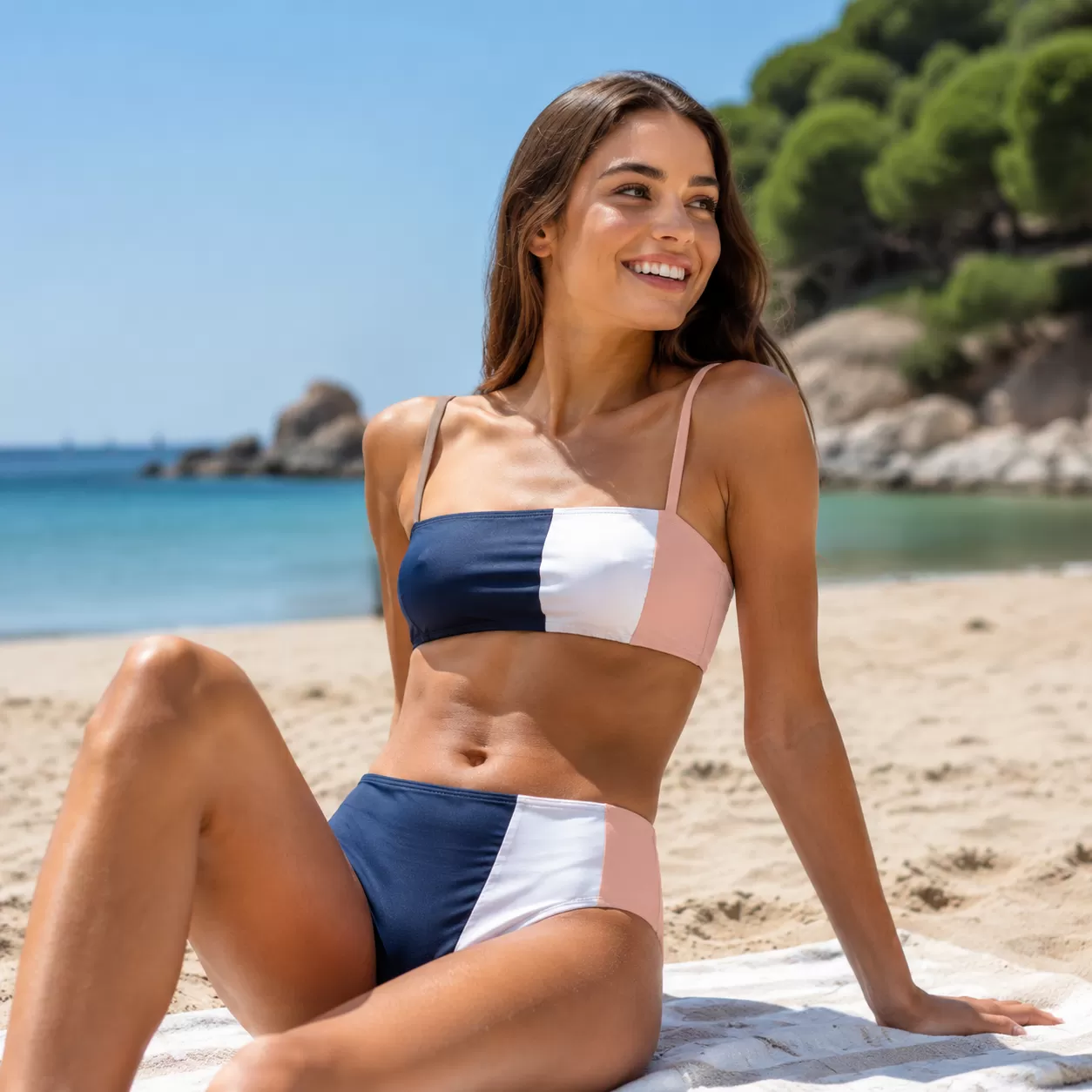
We believe you shouldn’t have to sacrifice your personal style to stay safe. Choosing safe swimwear colours doesn’t mean wearing a boring, utilitarian uniform. It’s entirely possible to look great while prioritizing underwater visibility and drowning prevention.
The Color-Blocking Strategy
One of the best ways to stay stylish and visible is through strategic color-blocking. By pairing a high-contrast neon top with darker bottoms, you get the best of both worlds.
- Top-Half Focus: Keep the brightest, neon swimwear colors closest to the surface (shoulders and chest) where they are easiest to spot through water surface agitation.
- High Contrast: Mix a fluorescent swimsuit piece with a solid neutral to create a sharp visual contrast that pops in both chlorinated pools and murky open water.
The Myth of Busy Patterns
Many swimmers assume that loud, busy prints make them stand out. In reality, complex patterns can have a camouflage effect underwater.
- Visual Distortion: Small, intricate prints tend to bleed together underwater, making a swimmer blend into the background.
- The Solid Advantage: Solid, high-visibility bathing suits create a clear, unmistakable silhouette that the human eye can easily track in an emergency.
- Bold Graphics over Fine Prints: If you love patterns, choose large-scale, high-contrast geometric shapes rather than tiny floral or abstract prints.
Final Thoughts - Berlook’s Sustainable Brights
| Fabric Feature | Safety & Sustainability Benefit |
|---|---|
| Recycled Nylon | Reduces waste while maintaining a ultra-smooth, premium fit. |
| Fade-Resistant Dyes | Ensures your safe swimwear colours stay neon and highly visible season after season. |
| UPF 50+ Protection | Combines aquatic safety with maximum sun defense for long beach days. |
Our experience proves that bright swimwear can be both life-saving and eco-conscious. By designing our pieces using recycled, high-quality fabrics that hold their color density even after hours in the sun and chlorine.
Choosing the right look is all about making smart, intentional choices that keep you or your family highly visible without compromising on a modern, coastal aesthetic.
Stylish Swimwear Alternatives for Modest Comfort and UPF
The beach or pool should be a sanctuary of relaxation, but for many of us, the pressure of a traditional, skin-baring swimsuit turns a sunny getaway into a source of stress.
You don't have to choose between personal comfort and a dip in the ocean. Whether you’re seeking full coverage for modesty, elite sun protection, or athletic swimwear that actually stays put during water sports, the “standard bikini” is no longer your only option.
In this guide, we’ve prepared the ultimate list of swimwear alternatives that bridge the gap between chic style and total confidence. From eco-friendly rash guards to versatile swim dresses, these pieces are designed to help you enjoy the water on your own terms.
Let’s dive right in.
Why Look for Swimwear Alternatives?
Standard bikinis and traditional one-pieces aren’t the perfect fit for everyone. Whether you are hitting the waves, lounging by the pool, or hanging out at a beachside cafe, the demand for swimwear alternatives is growing fast.
We see more people looking for functional, stylish options that offer better coverage and utility than a standard bathing suit.
Key Takeaways
| Feature | Traditional Swimwear | Swimwear Alternatives |
|---|---|---|
| UV Protection | Minimal | High (UPF 50+) |
| Activity Level | Low to Medium | High (Water Sports) |
| Coverage | Limited | Customizable / Full |
| Versatility | Poolside Only | Beach to Boardwalk |
Sun Safety & UV Protection
Your skin deserves premium protection. Traditional swimsuits leave too much skin exposed to harsh UV rays, forcing you to reapply sunscreen constantly. Choosing protective swim shirts and full coverage rash guards provides a built-in barrier against sun damage, keeping you safe during long days under the sun.
Modesty and Personal Comfort
Everyone deserves to feel confident at the beach. Many women prefer modest active swimwear that doesn’t sacrifice style for coverage. From swim leggings with skirt combos to full-coverage tops, these alternatives allow you to move freely without feeling overexposed.
High-Activity & Water Sports
If your beach day involves paddleboarding, beach volleyball, or surfing, standard swimwear often falls short. You need gear that stays put. Athletic swimwear tops and rugged board shorts for swimming offer the security and durability required for high-energy water sports.
Seamless Transitions
No one enjoys changing multiple times a day. Modern swimsuit alternatives for women are designed to look great both in and out of the water. These quick-dry pool outfits let you transition seamlessly from a morning swim straight to a casual lunch spot without needing a wardrobe change.
Top 6 Stylish & Functional Swimwear Alternatives
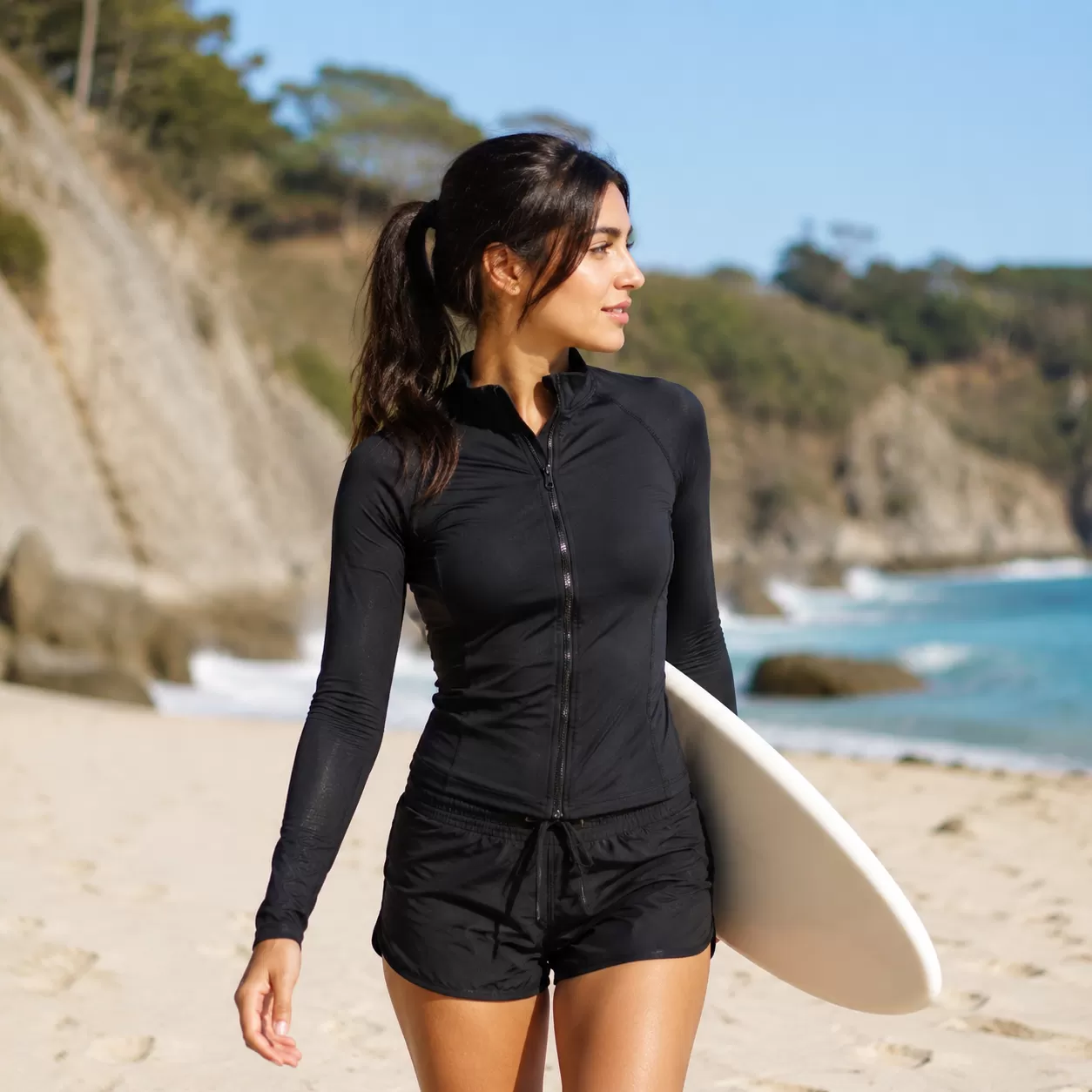
Finding the right balance between comfort, coverage, and style doesn’t mean you are locked into a traditional bikini or one-piece. We designed these six highly functional swimwear alternatives to cater to every body type, activity level, and personal style preference.
The Active Duo: Rash Guards & Swim Shirts
For those who spend more time surfing, paddleboarding, or chasing kids on the sand than lounging, protective swim shirts and full coverage rash guards are the ultimate setup.
- Built-in Sun Protection: Most options feature UPF 50+ fabric to block out harsh UV rays.
- Chafe Prevention: Flatlock seams prevent irritation during high-intensity water sports.
- Versatile Styling: You can easily layer these athletic swimwear tops over a bikini piece or a supportive sports bra.
The Feminine Solution: Swim Dresses & Rompers
If you want a one-piece look with a bit more thigh and hip coverage, two-piece swim dresses and one-piece swim rompers offer a classic, feminine silhouette without sacrificing water functionality.
- Built-In Briefs: Features an attached swim bottom underneath for complete security.
- Flattering Fits: Designed with A-line skirts or relaxed romper shorts that drape naturally.
- All-Day Wear: Transitions smoothly from a dip in the ocean to a casual boardwalk lunch.
Maximum Coverage: Swim Leggings & Capri Pants
When sun safety, modesty, or jellyfish protection is your top priority, swim leggings offer the most comprehensive lower-body coverage available.
| Feature | Swim Leggings | Traditional Leggings |
|---|---|---|
| Water Absorption | Lightweight, does not weigh you down | Heavy, retains water |
| UV Protection | Excellent (Typically UPF 50+) | Minimal to none |
| Drying Time | Ultra-fast quick-dry fabric | Slow, prone to sagging |
For a slightly sportier look, a swim leggings with skirt combo provides extra coverage around the hips while keeping your legs protected.
The Athleisure Cross-Over: Board Shorts & Sports-Bra Style Tops
Borrowing the best elements from gym gear, this combination is the go-to for anyone asking what can I wear instead of a swimsuit while staying entirely active.
- High-Waisted Swim Shorts & Board Shorts: Provide a secure fit around the waist with functional pockets and drawstring closures.
- Athletic Swimwear Tops: Offer maximum bust support, wide straps, and zero hardware to dig into your skin.
- Mix-and-Match Flexibility: Allows you to customize your top and bottom sizes independently for a perfect fit.
The Hybrid Choice: Tankinis & Blouson Tops
Tankinis bridge the gap between a two-piece and a full-coverage one-piece. A blouson-style tankini top features a banded bottom that cinches at the hips, creating a loose, forgiving fit around the midsection.
- Easy Restroom Breaks: Gives you the full coverage of a one-piece but separates easily.
- Adjustable Coverage: Can be paired with high-waisted shorts, bikini briefs, or swim skirts.
The Eco-Conscious Alternative: Water-Wicking Workout Wear
For a truly minimalist wardrobe, water-friendly workout clothes made from recycled nylon and polyester blends double as excellent swimsuit alternatives for women.
- Dual-Purpose Design: Crafted to handle both heavy sweat on land and chlorine in the pool.
- Sustainable Sourcing: Made using eco-friendly alternative swimwear practices, utilizing regenerated ocean plastics and recycled materials.
- Compressive Fit: Keeps everything held securely in place whether you are running on the beach or swimming laps.
Fabric Matters: What to Look For in Alternative Swimwear
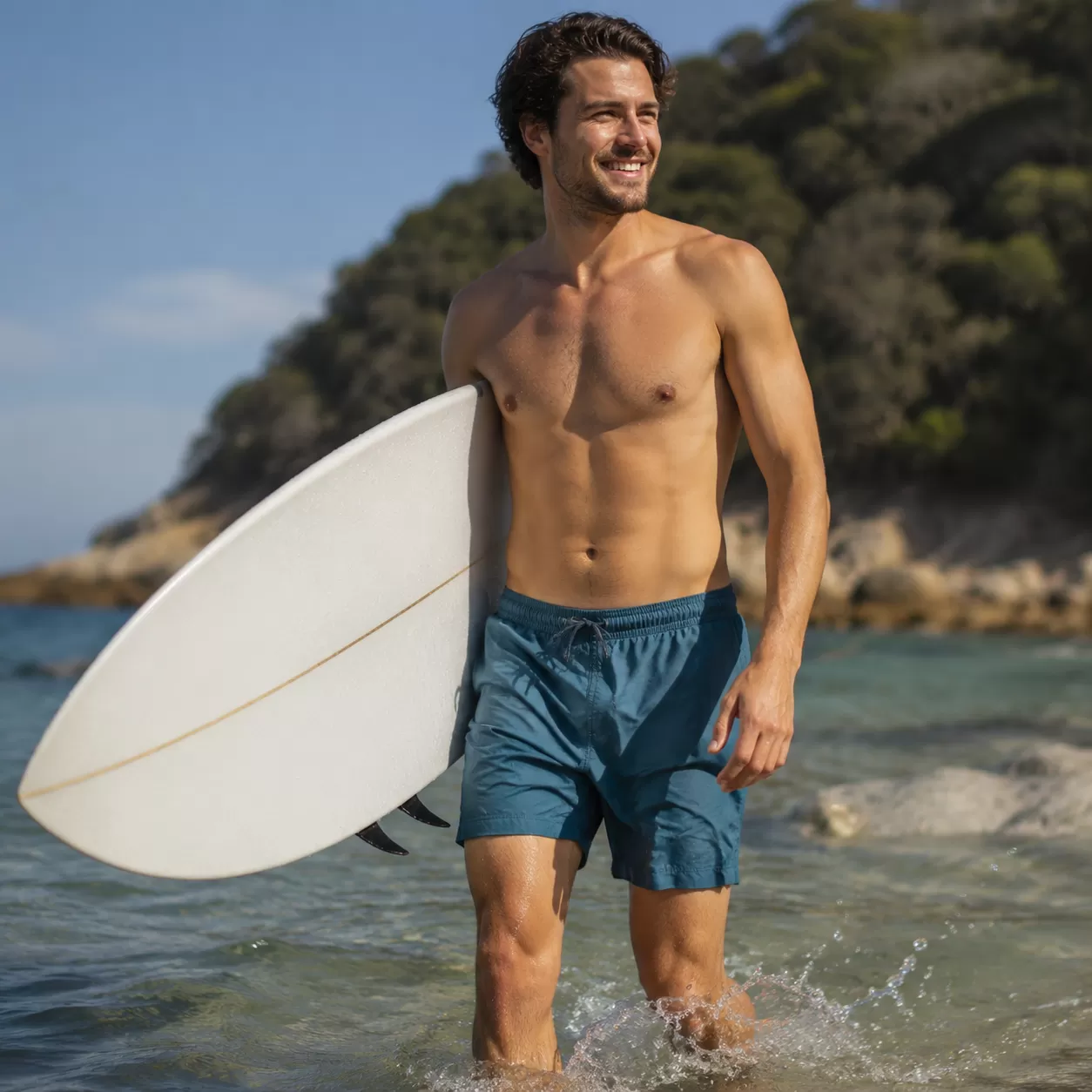
When you step away from traditional bikinis or one-pieces, fabric selection becomes your top priority. The right material transforms regular clothing into high-performing swimwear alternatives. To ensure your outfit handles the water safely and stays comfortable all day, look for these three non-negotiable fabric features.
Quick-Dry Technology
No one wants to sit around in soggy, heavy clothes after a dip. Choosing water-friendly workout clothes with advanced quick-dry technology is essential for a seamless transition from the pool to the beach lounge.
- Synthetic Fibers: Look for high-quality nylon, polyester, and spandex blends.
- Moisture Management: These fabrics pull water away from your skin and accelerate evaporation.
- Weight Control: They won’t sag, stretch out, or retain water weight while you swim.
Chlorine and Saltwater Resistance
Pool chemicals and ocean salt can ruin standard apparel after just a few wears. If you are picking out athletic swimwear tops or DIY quick-dry pool outfits, the fabric must be engineered to withstand harsh environments.
| Fabric Type | Performance in Water | Durability Factor |
|---|---|---|
| Chlorine-Resistant Polyester | High | Won’t fade, stretch, or thin out from pool chemicals. |
| Nylon-Spandex Blends | Medium-High | Excellent stretch recovery, best washed right after saltwater exposure. |
| Standard Cotton | Low | Absorbs water, sags, and degrades quickly. Avoid completely. |
Sustainability
Choosing eco-friendly alternative swimwear is a massive priority for modern US shoppers. We focus heavily on sourcing green performance fabrics that protect the planet without sacrificing durability.
- Recycled Nylon (Econyl): Made from abandoned fishing nets and ocean plastic, offering the exact same compression and strength as virgin nylon.
- Repreve Polyester: Created from recycled plastic bottles, providing excellent UV protection and chlorine resistance.
- Reduced Carbon Footprint: These sustainable fabrics use less water and energy during production, making your beach look entirely guilt-free.
Styling Your Swimwear Alternatives for a Complete Beach Look

Putting together a solid beach look with swimwear alternatives is all about blending function with personal style. You don’t have to sacrifice looking good just because you skip the traditional bikini. With the right pieces, you can easily transition from a dip in the ocean to a casual boardwalk lunch.
Here is how to elevate your alternative swim outfits using smart styling choices.
Footwear
The right shoes tie your entire water-friendly outfit together while keeping you safe from hot sand and slippery pool decks.
-
Slide Sandals: Opt for waterproof rubber or EVA slides. They are effortless to slip on and off and pair perfectly with board shorts for swimming.
-
Water Shoes: Modern water sneakers offer excellent grip and foot protection for high-activity days without looking bulky.
-
Platform Flip-Flops: A chunky flip-flop adds a touch of Y2K style to swimsuit alternatives for women, especially when paired with a swim dress.
Layering
Layering is the secret to mastering quick-dry pool outfits that work both in and out of the water.
-
Oversized Button-Downs: Throw a lightweight linen or cotton boyfriend shirt over athletic swimwear tops for an instant, relaxed vibe.
-
Utility Jackets: Lightweight, water-resistant windbreakers look great over full coverage rash guards when the beach breeze picks up.
-
Kimono Cover-Ups: A sheer, flowy cardigan adds movement and style to a fitted set of swim leggings.
Accessories
Accessories turn functional modest active swimwear into a curated fashion statement.
-
Wide-Brim Straw Hats: Essential for extra sun safety, these hats instantly elevate protective swim shirts into a classic resort look.
-
Polarized Sunglasses: Protect your eyes and add an athletic or chic edge to your outfit.
-
Waterproof Tote Bags: A trendy neoprene or mesh bag holds your gear and keeps your water-friendly workout clothes separate after a swim.
FAQs About Swimwear Alternatives
What can I wear instead of a swimsuit to a pool party?
You can opt for stylish swimsuit alternatives for women like a chic swim dress, a romper, or a sleek tankini paired with high-waisted swim shorts. Another great option is a lightweight, quick-dry pool outfit consisting of board shorts and a fitted rash guard. These choices keep you comfortable, look great poolside, and let you jump right into the water without a wardrobe change.
Can you wear regular workout clothes in the pool?
While you can technically wear them, it is not recommended unless they are specifically designated as water-friendly workout clothes. Standard gym gear absorbs too much water, gets heavy, and can sag. Cotton blends will also trap chlorine and track lint into the filtration system. For a seamless gym-to-pool transition, stick to athletic swimwear tops and swim leggings made from specialized nylon or polyester blends.
How do I choose alternative swimwear that is eco-friendly?
To find sustainable swimwear alternatives, look for brands that use recycled synthetic fabrics, such as ECONYL (regenerated nylon from ocean waste) or recycled polyester made from plastic bottles. Check for certifications like OEKO-TEX or Global Recycled Standard (GRS) to ensure the manufacturing process minimizes chemical use and environmental impact.
Bikini Body Guide: Feel Confident, Look Great in Any Swimsuit
If you searched for a “bikini body,” you might be hoping for a rule, a workout, or a secret styling trick — supported, comfortable, and ready to enjoy the day.
This guide is not about changing your body to fit a trend. It is about choosing swimwear that fits your proportions, supports the way you move, and helps you feel less distracted by adjusting, comparing, or second-guessing yourself.
Confidence Matters More Than Appearance
Two people can wear the same bikini and look completely different. Not because of body shape alone, but because of energy.
When you feel unsure, it shows in your posture. You adjust your outfit constantly, you avoid movement, and you become overly aware of yourself. But when you feel comfortable, something different happens. You relax. You move naturally. You stop thinking about how you look and start experiencing the moment.
That is what people notice. So instead of asking “How do I get a bikini body?” a better question is: “How do I feel comfortable enough in my body to enjoy wearing a bikini?” That shift alone changes everything.
Quick Answer: How to Look Good in a Bikini?
To look good in a bikini, start with fit instead of body shape. A good bikini should stay in place, support your bust or torso where needed, and then choose a style based on your real needs: high-waisted bottoms for a secure waist feel & full-coverage bottoms for active beach days.
Choose the Right Bikini for Your Body,Not Against It
Start With a 3-Minute Bikini Fit Check
Before deciding whether a bikini is “flattering,” check whether it actually works for your body. A supportive fit usually passes these simple tests:
- The top band feels secure without riding up.
- The cups sit smoothly without gaping, squeezing, or spilling.
- The straps support you without digging into your shoulders.
- The bottoms stay in place when you sit, walk, or bend.
- The fabric feels comfortable against your skin and does not twist after movement.
A quick rule: if you adjust your bikini more than twice in one minute, the issue is probably fit — not your body.
For a better size choice, measure your bust, underbust, natural waist, and fullest hip area while standing relaxed. Compare those measurements with the brand’s size chart, then choose based on the area where you need the most comfort or support.
Source: Bikini Fit Guide: Best Swimwear for Your Body Shape
Bikini Style ''Cheat'' Sheet
| If you want... | Look for... | Why it helps |
|---|---|---|
| More bust support | Underwire tops, wider straps, adjustable backs, structured cups | Helps distribute support and reduces constant adjusting |
| Flexible fit | Triangle tops, tie-back tops, removable pads | Lets you control tightness and coverage |
| More waist security | High-waisted bottoms or mid-rise bottoms | Helps the bottoms feel stable when sitting or walking |
| More coverage for movement | Full-coverage or moderate-coverage bottoms | Better for swimming, beach walks, and active days |
| A softer, relaxed look | Bralette tops, soft pastels, earth tones | Feels less formal and easier to style |
| A photo-ready outfit | Solid colors, balanced proportions, a light cover-up | Keeps the look clean without feeling overdone |
As said, a bikini should work with your body, not against it. If you need more support in the bust area, structured tops like underwire or thicker strap designs help you feel secure without constantly adjusting.
If you prefer flexibility, triangle or adjustable tie styles allow you to control how tight or relaxed the fit feels.
For bottoms, high-waisted styles often create a balanced look and feel more secure for many body types. Mid-rise styles give a more natural, relaxed feel if you prefer less structure.
Things that Make You Confident in a Bikini

Confident people are not thinking about how they look. They are present in what they are doing. They are walking, laughing, sitting, moving freely. That presence changes posture, facial expression, and body language.
So when you think someone “looks perfect in a bikini,” what you are actually seeing is ease.
Bikini Outfit Formulas for Relaxing Beach Days
Confidence also depends on where you are going. A bikini that feels perfect for lounging may not feel right for swimming or walking all day.
| Situation | Easy outfit formula |
|---|---|
| Relaxed beach day | Supportive bikini top + high-waisted bottom + loose cover-up |
| Poolside lounging | Triangle or bralette bikini + sarong + sandals |
| Swimming or surfing | Secure top with wider straps + full-coverage bottom |
| Vacation photos | Solid-color bikini + lightweight beach dress or linen shirt |
| When you feel self-conscious | Comfortable bikini + cover-up you can remove gradually |
The best outfit is not the one that looks the most dramatic online. It is the one that lets you move, sit, swim, laugh, and forget about adjusting your swimwear every few minutes.
Color Choices That Actually Help You
Color is not just visual. It affects how you feel.
Soft neutral tones like beige, white, cream, and sand tend to create a calm and balanced look. These colors blend with natural beach environments and reduce visual pressure.Earth tones like olive, brown, and muted rust feel grounded and natural, especially in sunlight.
If you want something more expressive, soft pastels like light blue, blush, or sage green give personality without overwhelming your look. What you usually want to avoid are very loud neon colors or overly busy patterns, because they draw attention in a way that can feel uncomfortable if you are already self-conscious.
The goal is not to hide. The goal is to feel visually balanced.
How Environment Affects the Way You Feel
What's more, your surroundings play a bigger role in confidence than most people realize.
The beach is actually one of the most natural confidence environments because it removes formal structure. There is no dress code, no rigid expectation, and no controlled environment. Everything is relaxed and fluid.
However, the same environment can also create pressure if you mentally compare yourself to others. This is where mindset becomes very important.
If you walk onto the beach thinking about how you look compared to others, your confidence immediately drops. But if you walk in focusing on the experience, the water, the weather, the people you are with ; your attention shifts outward instead of inward.
This outward focus is what creates natural confidence.
Even something as simple as choosing where you sit or how you position yourself in group photos can change your perception of comfort. People who feel confident are usually not positioning themselves based on hiding or highlighting anything. They are simply existing in the space.
That is the subtle difference that changes everything.
Common Bikini Mistakes That Lower Confidence
A lot of swimwear discomfort comes from small, avoidable choices.
1. Buying only based on the model photo
A bikini can look great online but feel different on your own body. Always check the cut, coverage, strap type, and size guide before choosing.
2. Choosing a top without enough support
If you need more bust support, a very delicate triangle top may feel beautiful but unstable. Try underwire, thicker straps, or a wider underbust band instead.
3. Wearing a brand-new bikini for the first time at the beach
Test it at home first. Sit, walk, bend, and raise your arms. If it shifts too much, try another size or style.
4. Sizing down to feel “held in”
A too-small bikini usually creates more discomfort, not more confidence. Secure does not mean tight.
5. Comparing your body to edited images
Real confidence starts when you stop using someone else’s photo as your fitting room mirror.
Final Thoughts
At Berlook, our fit philosophy believes a bikini should support your body, not judge it. This guide is designed to help you choose swimwear based on comfort, movement, support, and personal style.
A bikini does not create confidence. It simply reveals it. And once you reach a point where you feel comfortable in your own skin, you stop worrying about whether you look right and start actually enjoying your life. That is the real goal.
FAQs: Bikini Body Guide
How can I look good in a bikini if I’m not confident in my body?
You don’t need a “perfect body” to look good in a bikini. What actually changes your appearance is comfort, fit, and posture. When you wear something that fits well and stop overthinking your body, your confidence naturally improves and that reflects in how you look.
What bikini style makes you look slimmer or more balanced?
High-waisted bottoms and structured tops often create a more balanced silhouette. However, the most flattering bikini is the one that fits properly and supports your body without discomfort. Fit matters more than any single style trick.
Is there a perfect body type for bikinis?
No, there is no perfect body type for bikinis. Bikinis are designed for all shapes and sizes. Confidence and comfort matter far more than body proportions.
What color bikini is most flattering for all body types?
Neutral tones like black, white, beige, and earthy shades tend to be universally flattering because they create visual balance. Soft tones also work well because they don’t overpower your natural look.
Written by: BERLOOK Swimwear Editorial Team
Last updated: [Apr. 2026]
Best Bikinis for Big Bust: Supportive Styles That Actually Fit&Flatter
By the Berlook Fit Team · Updated June 4, 2026
Shopping for a bikini when you have a bigger bust is a very specific kind of struggle. You’ll find endless styles online that look effortless and flattering, but wearing them can feel different: the fit is off, the support isn’t there, or you just don’t feel secure enough to move freely.
Looking for more support? Explore bikinis for big bust designed for lift, shape, and a more secure fit.
If you’ve ever bought a bikini that looked perfect in photos but didn’t feel right the moment you tried it on, the issue usually isn’t your body. It’s the design. Once you understand what makes a bikini for big bust genuinely supportive and comfortable, the process gets easier. You stop guessing and start choosing styles that work with your body rather than against it.
This guide walks through exactly that: what to look for, what to avoid, how to measure for the right size, and the styles you’ll actually enjoy wearing. Where it helps, we’ve linked the research behind each recommendation.
Why Regular Bikinis Don’t Work Well for Bigger Busts
Most standard bikini tops are designed with aesthetics in mind rather than functional support, and this becomes very noticeable with a fuller bust. They are made to look minimal and trendy on models, but they are not engineered for real-life movement or long wear.
The most common issue is a lack of proper support. Many bikinis rely on soft, single-layer fabric with no internal reinforcement, no underwire, no structured cup shaping, and no firm base to actually hold the bust in place. So instead of lifting and supporting, the bikini simply covers.
Another major issue is poor weight distribution. Thin straps look delicate and fashionable, but they shift the load onto your shoulders instead of the band. This matters more than most product pages admit: in a properly fitted support garment, the underband is designed to carry roughly 80% of the weight, with the straps mainly positioning the bust. When thin straps take over that job, the result is shoulder grooves and constant readjustment. (Source: SHEFIT fit guidance.) Clinical research goes further, linking prolonged strap loading on the shoulders to deep furrows, soft-tissue damage, and in extreme cases neurological symptoms in the arms. (Source: Bra strap pressure study, NCBI.)
Fabric quality also plays a big role. Lower-quality materials stretch when wet or lose their structure, so a bikini that fits well at first becomes looser and less stable after swimming or long wear.
On top of that, limited coverage leads to side spillage or instability during movement. In short, regular bikinis often fail not because they are poorly made, but because they are not built for structural support.
What to Look for in a Bikini for Big Bust

When choosing swimwear for a fuller bust, focus on construction, not just appearance. A well-designed bikini should feel secure the moment you put it on and stay stable without constant adjustment.
Strong underband support. The underband is the foundation; it carries most of the bust weight, not the straps. A firm, elasticated band keeps everything lifted and stable and reduces pressure on the shoulders. For larger busts, fit guides recommend a wider band (roughly 2–3 inches) made of stretch-resistant fabric, snug enough that you can fit two fingers underneath but that it does not ride up. (Source: Large-bust support guide.)
Structured cups. Cups should do more than cover; they should shape and contain. Molded or reinforced cups reduce movement and improve natural lift without flattening the bust. For fuller busts specifically, individual encapsulation cups outperform a single compression panel, which tends to create a flattened "uniboob" and sore shoulders. (Source: Large-bust fit review.)
Adjustable straps. Adjustability lets you control lift and tension for your comfort and fine-tune each side, which matters because most people are slightly asymmetrical. Without it, a proper fit is hard to achieve, especially when shopping online.
Side and internal support. Reinforced seams or internal panels keep the bust centered, preventing outward shifting and improving balance and symmetry.
Durable double-lined fabric. Good swimwear fabric stretches but returns to shape; the snap-back comes from the elastane content (typically about 15–20% of the blend). Double lining helps the bikini hold structure even after water exposure, which is crucial for long wear. (Source: Swimwear material guide.)
When these features come together, the bikini stops feeling like something you constantly manage and starts feeling like something that works with you. This is also why our swimwear designs are built around these elements, combining structured support with soft, flexible fabrics meant to stay comfortable through the day.
How to Measure for the Right Size First
Before choosing a style, get your measurements, because most fit problems are really sizing problems. Studies repeatedly estimate that a large majority of women, often cited around 80%, wear the wrong size, most commonly a band that is too big and a cup that is too small. (Source: Olivia Paisley fit guide.) Here is the standard method:
- Band (underbust): With a soft tape, measure snugly around your ribcage directly under the bust, level all the way around. This is your band measurement.
- Bust (overbust): Measure around the fullest part of the bust, keeping the tape parallel to the band.
- Cup: Subtract the band number from the bust number. Each inch of difference is roughly one cup size (1″ = A, 2″ = B, 3″ = C, 4″ = D, 5″ = DD, and so on). For example, a 36″ band with a 41″ bust is a 5″ difference, or about a 36DD. (Source: Step-by-step measurement guide.)
Use sister sizing when your size is sold out. Sister sizes share the same cup volume with a different band. Go down a band and up a cup, or up a band and down a cup, to keep the same volume, for example, 34DD ↔ 32F ↔ 36D. This is one of the most useful tricks for buying swimwear online, where exact sizes sell out fast. (Source: Sister-size reference.) If you order from a UK brand, note the cup letters diverge after D (US DD = UK E), so convert before buying. (Source: International size converter.)
Best Bikini Styles for Big Bust
Certain bikini styles perform better because they are built with structure and balance in mind. These consistently provide more support and comfort. The table below summarizes how to match a style to your priority, and the detail follows.
| If your priority is… | Best style | Why it works |
|---|---|---|
| Maximum lift & separation | Underwire top | Bra-like structure lifts and isolates each breast. |
| Shaping with an open neckline | Balconette | Supports from below for a balanced silhouette. |
| Adjustable lift for styling | Halter (wide straps) | Neck straps elevate the bust; needs a strong band. |
| Comfort & less shoulder strain | Wrap / cross-front | Spreads load across multiple points. |
| Stability for active days | Longline | Extends below the bust for extra anchoring. |
1. Underwire Bikini Tops

Underwire bikinis are one of the most reliable options for a fuller bust because they are built like bras, providing lift, separation, and structured shaping at once. Look for a flexible, fabric-wrapped wire that follows your ribcage rather than a rigid one, which is more comfortable over long wear. (Source: Large-bust support guide.)
They are especially useful if you want:
- strong, consistent support
- reduced movement during activity
- long-wear comfort without constant adjustments
Once properly fitted, underwire bikinis make a noticeable difference in how secure and balanced you feel.
2. Balconette Bikini Tops
Balconette styles offer structured lift while keeping a more open neckline. They support the bust from below and create a naturally balanced silhouette.
They are ideal if you want:
- visible shaping without full coverage
- a flattering neckline for styling or photos
- a balance between structure and softness
This style works well when you want support but not something overly rigid.
3. Halter Neck Bikinis

Halter bikinis can work extremely well, but only when designed correctly. The lift comes from the neck straps, which elevate the bust. One caution: because halter straps route weight to the back of the neck, they can cause neck strain over long days if the band isn’t doing its share, so the underband still needs to carry the load.
For a fuller bust, the design should include:
- wide, supportive straps
- a strong underband
- adjustable neck tension
If these elements are missing, halter bikinis can become uncomfortable on the neck and lose their support advantage.
4. Wrap and Cross-Front Styles

These styles distribute weight across multiple areas instead of concentrating it in one place, creating a softer but still supportive feel. Cross-back and racerback-style routing is specifically recommended for distributing the load of a fuller bust more evenly. (Source: Wacoal DD+ fit guidance.)
They are especially good for:
- reducing shoulder strain
- long hours of comfortable wear
- flexible movement without rigid structure
They are a strong pick if you prefer comfort-focused swimwear.
5. Longline Bikini Tops

Longline bikinis extend below the bust, adding extra support and stability by increasing the contact area that anchors the suit to your torso.
They help with:
- improved weight distribution
- reduced bounce during movement
- better overall structure and balance
This style is particularly useful for active beach days or extended wear. For context on how much support changes movement: research finds well-fitted high-support designs can cut breast motion by up to roughly 74% versus minimal support, which is the difference between a suit you forget about and one you constantly manage. (Source: SHEFIT, summarizing breast-motion research.)
Choosing the Right Bikini Bottom for Balance
While the top provides support, the bottom plays a role in visual balance. Pairing a structured top with the right bottom creates a more proportionate silhouette.
High-waisted bottoms are often the best choice because they define the waist and create a balanced upper-to-lower-body ratio. They also add coverage, which improves comfort and stability.
Medium-coverage bottoms are a good option when you want a more natural, less structured look while keeping balance.
The key is to avoid extremely minimal bottoms when the top is already structured, since that can make the overall look feel uneven.
5 Common Mistakes to Avoid
Many bikini problems come from choosing based on style rather than structure. The most common mistakes include:
- thin triangle tops with no real support
- narrow straps that cannot handle weight
- bandeau styles without internal reinforcement
- single-layer fabrics that lose shape when wet
- non-adjustable designs that cannot adapt to your body
Avoiding these immediately improves your chances of finding a bikini that actually works for you.
How to Shop for Bikinis Online Effectively
When shopping online, go beyond the images and focus on product details. The most important information is usually in the description, not the photos.
Look for:
- underwire or molded-cup construction
- adjustable straps or closures
- double-lined or reinforced fabric
- a clear mention of support features, and your size in the brand’s own size chart (use sister sizing if sold out)
Customer reviews are also very helpful because they reflect real-world wear, especially around comfort and stability. Reviews from people who list a similar cup size to yours are the most useful signal.
Where to Buy Supportive Bikinis for Big Bust
Choosing the right brand makes a real difference in fit and comfort. A few brands worth knowing if you want individual encapsulation in larger cup ranges include specialist labels such as Panache, Freya, and Curvy Kate, which extend well into UK G+ cups; for fashion-forward recycled swimwear with built-in structure, BERLOOK designs with real-life wearability in mind, prioritizing structure, comfort, and stability using soft yet supportive recycled fabrics.
When evaluating any brand, the key features to confirm are:
- adjustable straps for a customized fit
- structured cuts designed for different body types
- lightweight but supportive fabric construction
- a minimal aesthetic with functional performance
The goal, whichever brand you choose, is swimwear that stays comfortable and secure throughout the day without constant adjustment.
How the Right Bikini Should Actually Feel on You
At the end of the day, the easiest way to know if a bikini is right for your fuller bust is not how it looks, but how it feels when you wear it.
A well-designed bikini should give you a sense of stability the moment you put it on. You shouldn’t feel like you need to "fix" it or readjust every few minutes; everything should already sit where it should.
You should also notice the weight feels evenly distributed. Your shoulders shouldn’t feel like they’re doing all the work, and the bust should feel lifted without pressure or pain. If you’re constantly aware of the bikini, that usually signals the structure isn’t right for you, and a quick fit check is in order: the band should sit level around your body (not riding up your back), straps shouldn’t dig in, and the cups shouldn’t gap or overflow.
Another important sign is movement confidence. When you walk, sit, or bend, the bikini should stay in place without shifting or creating gaps. It should move with you, not against you.
Most importantly, the right bikini should let you focus on your time, not your outfit. When you reach that point, you’ll know you’ve chosen correctly, because you stop thinking about the bikini entirely.
Conclusion
Finding the best bikini for a bigger bust is not about limiting your options; it’s about understanding structure and getting your size right.
Once you know what actually provides support, the band that does the work, the cups that encapsulate, the fabric that holds its shape, you stop relying on trial and error and start identifying pieces designed to work with your body.
A well-designed bikini should feel secure, stay in place, and let you move freely without thinking about it. When that happens, swimwear stops being something you worry about and becomes something you genuinely enjoy wearing.
How we put this together: recommendations are based on published bra-fit and breast-biomechanics research (linked inline) plus general swimwear construction guidance. Figures such as the 80% underband load and ~74% motion reduction come from the cited sources and can vary by garment and fit. This article is general information, not medical advice; for persistent shoulder, neck, or back pain related to bust weight, consult a healthcare professional. Berlook products are referenced as examples from our own collections; please verify each product’s details and your size on its product page before purchasing, and note external links are for reference, not endorsements.
Not Sure What to Wear Kayaking? - A Guide That Works in 2026
What to wear kayaking seems like a small detail at first. Most people assume anything comfortable will be enough. However, kayaking has a way of exposing that assumption very quickly.
You will be sitting for long periods, repeating the same upper body movement, adjusting your balance, and staying exposed to sun, water, and wind at the same time.
Unlike many outdoor activities, you cannot easily step away and fix discomfort. Once you are on the water, your outfit either works with you or it doesn’t.
That is why the right clothing choice does not just affect comfort.When chosen well, your outfit disappears into the experience. When chosen poorly, it becomes part of the problem.
Dress for the Water, Not the Weather Only
Before any discussion of comfort, one principle outranks the rest: you dress for the temperature of the water, not the temperature of the air.
Capsizes happen even to experienced paddlers, and once you are in the water your clothing is the only protection you have until you get back in your boat.

Safety educators use a quick screen called the Rule of 120: if the air temperature and water temperature added together fall below 120°F (roughly 49°C), you should wear thermal protection such as a wetsuit or drysuit rather than ordinary warm-weather clothing.
Many experts treat this only as a rough warning sign rather than a hard standard, because air temperatures rise far faster than water temperatures in spring — which is exactly when paddlers are most often caught out.
The more reliable approach is to judge by water temperature directly: cold-shock response and loss of coordination can begin below about 70°F (21°C), thermal protection is recommended below roughly 60°F (15°C), and below about 50°F (10°C) the risk of an involuntary gasp reflex and rapid incapacitation is high.
This matters because cold water pulls heat from the body far faster than cold air does. A warm, sunny day with cold water underneath is one of the most dangerous combinations in the sport, and no amount of stylish, quick-drying fabric substitutes for proper immersion gear when the water is cold.
The Core Qualities of a Reliable Kayaking Outfit
A functional kayaking outfit is defined by performance across several key areas.
- It should manage moisture effectively, drying quickly after exposure to water. It should remain lightweight, avoiding the heaviness that comes with water absorption.
- Mobility is equally important. The outfit should allow unrestricted movement of the shoulders, arms, and torso.
- Fit stability also matters. Clothing should stay in place during sitting, paddling, and adjusting position, without requiring constant attention.
- Finally, it should remain comfortable over time. An outfit that feels acceptable initially but uncomfortable after extended wear is not suitable.
When all these elements are present, the outfit becomes almost unnoticeable, which is exactly what you want.
Outfit Options That Consistently Perform Well
Understanding practical outfit combinations helps translate these principles into real choices.
1. Swimwear Sets for Warm and Active Conditions
In warm weather, swimwear provides one of the most efficient solutions.
A structured swim top paired with well-fitted bottoms allows for unrestricted movement and eliminates concerns about water exposure. This approach is particularly effective when splashing or partial immersion is expected.
The key factor is support. Swimwear used for kayaking must maintain its position during movement. Designs intended purely for appearance may not provide the stability required.
When chosen carefully, this option offers simplicity without sacrificing functionality.

2. Rash Guard and Shorts for Extended Wear
For longer sessions or increased sun exposure, a rash guard combined with swim shorts offers a more protective option.
The rash guard provides coverage that helps manage UV exposure and reduces friction from repetitive motion. The shorts contribute flexibility and comfort while maintaining appropriate coverage.
This combination is often preferred for its balance between protection and mobility. It performs consistently across different conditions, making it a reliable choice.

3. Lightweight Activewear for Controlled Environments
In calmer settings or shorter trips, lightweight activewear can be effective.
A moisture-wicking tank paired with athletic shorts creates a familiar and comfortable setup. However, fabric selection remains critical. Materials should be designed to handle moisture and maintain their structure when wet. Without this, the outfit may lose its effectiveness quickly.
This option works best when environmental conditions are predictable.

4. One Piece Swimsuits for Stability and Simplicity
A one piece swimsuit provides a streamlined and stable alternative.
Because it is a single garment, it reduces the likelihood of shifting or misalignment. This creates a more consistent fit during movement. It is particularly useful for those who prefer minimal adjustment and a straightforward approach.
Its ability to transition between activities adds to its practicality. Many prefer this option when wearing our one-piece swimwear designs, which are created to feel secure while still maintaining a clean, minimal look on and off the water.

5. Layering Strategies for Cooler Conditions
In cooler environments, layering becomes necessary. A base layer designed to manage moisture, combined with a lightweight outer layer, helps regulate temperature. Quick-drying bottoms ensure continued comfort.
The goal is to maintain warmth without introducing bulk or limiting movement.Proper layering allows for adaptability while preserving performance.

6. Footwear: Protection, Grip, and Drainage
Footwear is the most commonly forgotten part of a kayaking outfit, yet launches and landings are exactly where slips and cut feet happen. The priorities are grip on wet, uneven surfaces; protection from rocks and shells; quick drainage; and a low enough profile to fit inside the cockpit.

One practical caution: do not leave soaked shoes on for hours on end, as constantly wet skin on the soles can crack painfully. Let footwear dry out between outings.
Your PFD: A Not-optional Item
No outfit is complete without a personal flotation device (PFD requirements, source :https://uscgboating.org), commonly called a life jacket. In the United States, the Coast Guard classifies kayaks as vessels, and a USCG-approved PFD is required for each paddler; children under 13 must wear one at all times on a moving vessel, though state laws often go further.
For paddling, the most common choice is a Type III / Level 70 flotation aid, which provides at least 15.5 lbs of buoyancy and is comfortable enough for all-day wear. Lower-profile Level 50 / Type V devices are also permitted for kayaking — but only count toward legal requirements if they are actually worn, not merely carried in the boat.
A PFD only works if it fits. It should be snug enough that it cannot ride up over your head when you lift your arms, with adjustable side and shoulder straps to fine-tune the fit over whatever you are wearing.
Learn in Advance - What Happens to Clothing on the Water?
Most clothing is designed for stable, dry environments. Yet, water changes how fabric behaves.
Cotton, for example, absorbs moisture quickly and retains it. Instead of drying naturally, it stays damp, increasing weight and reducing comfort. This also affects body temperature, especially when wind is present — and in cold water, wet cotton accelerates heat loss, which is why the universal rule among paddlers is simply: no cotton.
Denim reacts differently but just as poorly. It becomes rigid and restricts movement, making repetitive actions like paddling feel more physically demanding.
Even some activewear fails in subtle ways. Materials that stretch well on land may lose their structure when wet, leading to reduced support or shifting during movement. This is why kayaking clothing should not be chosen based on appearance alone. It needs to perform under conditions that most everyday outfits are not designed to handle.
Why Fabric Choice Changes Everything?
Fabric selection is one of the most overlooked yet important aspects of kayaking clothing.
- Quick-drying synthetic materials are generally the most effective. They allow moisture to evaporate quickly and maintain their structure even when wet.
- Blended fabrics can offer a balance between softness and durability. They provide comfort while still performing under water exposure.
- Stretch is another factor, but it must be paired with recovery. A fabric that stretches without returning to its original shape can lead to instability.
- Thickness also plays a role. Heavier fabrics may feel durable but can become uncomfortable when wet.
Choosing the right material ensures that your outfit performs consistently rather than deteriorating during use.
How Paddling Movement Should Influence the Wear?
One detail that often gets ignored is how repetitive paddling directly affects clothing behavior.
Kayaking is not random movement. It is a controlled, repeating motion that engages your shoulders, upper back, and arms in a continuous rhythm. This repetition creates constant friction and tension in specific areas of your clothing.
That is why sleeve design, shoulder fit, and arm mobility matter more than most people realize. If a top is too tight across the shoulders, fatigue builds faster. If it is too loose, fabric shifts and starts interfering with movement.
Even the way a garment sits across the torso plays a role. Clothing that restricts rotation makes paddling feel heavier, even if the kayak itself is stable.
A well-designed kayaking outfit works with this motion pattern instead of resisting it. It allows your arms to move freely while staying anchored in place where needed. This balance is what keeps the experience smooth over longer periods on the water.
Fit and Structure: How They Influence Comfort Over Time
Fit is not only about size. It directly affects how an outfit behaves during movement.
- A well-fitted garment distributes tension evenly, reducing pressure on specific areas. This is especially important for tops, where support influences overall comfort.
- Adjustable features allow for customization, which becomes valuable during extended wear. They help maintain stability even as conditions change.
- Seam placement and construction also contribute to comfort. Poorly placed seams can cause irritation during repetitive movement.
When fit and structure are properly designed, the outfit feels natural rather than restrictive.
Adapting Your Outfit to Different Kayaking Conditions
Different environments require slightly different approaches.
- Warm and calm conditions allow for lighter and more minimal outfits. Colder or windier environments require additional layers and coverage.
- Duration also plays a role. Short trips allow for simpler choices, while longer sessions benefit from more structured and supportive options.
4 Common Mistakes That Affect the Experience
Several common mistakes can reduce comfort significantly.
- Choosing absorbent fabrics leads to prolonged dampness.
- Selecting heavy materials limits movement and increases fatigue. Wearing items that do not stay in place creates constant distraction.
- Overly loose or overly tight clothing can both interfere with movement.
- Another mistake is focusing solely on appearance. While style is important, it should not come at the expense of functionality.
Avoiding these issues often has a greater impact than adding additional features.
Crucial Tip:
For clothing, look for a UPF rating: a UPF 50+ garment blocks roughly 98% of UV rays, holds that protection even when wet, and does not wash off the way sunscreen can.
For skin that clothing cannot cover — hands, tops of the feet, ears, and the face — use a water-resistant sunscreen rated SPF 50 or higher, applied 15–20 minutes before launching so it has time to bind.
UPF clothing guidance, source: https://www.skincancer.org
Where to Find Swimwear Designed for Performance and Comfort?
The difference between average and reliable swimwear often lies in design intention.
At BERLOOK, the focus is on creating pieces that maintain comfort and structure through repeated wear. The fabrics are lightweight, quick-drying, and designed to retain their shape. As tested, after a 2-hour paddle, the one-piece showed no ride-up at the shoulders!
These qualities make the pieces suitable for a range of water-based activities, including kayaking — worn as the comfort layer alongside, not instead of, the safety gear described above (a properly fitted PFD and, in cold water, dedicated immersion gear).
This article is reviewed for safety accuracy by Natalie Carter, ACA-certified paddler. This guide is general information, not a substitute for local regulations or in-person instruction.
References & Further Reading
Primary safety authorities
- U.S. Coast Guard, Boating Safety — life jacket (PFD) requirements and 2025 performance-level classifications. uscgboating.org
- American Canoe Association (ACA) — paddlesport safety education and cold-water guidance. americancanoe.org
- National Center for Cold Water Safety — water-temperature risk thresholds. coldwatersafety.org
- Skin Cancer Foundation — UPF clothing and sun-protection guidance. skincancer.org

